
Slot width and filter pack work together by controlling different parts of the path between the surrounding formation and a PVC well screen. The pack provides a granular transition outside the pipe, while the screen openings must be compatible with the material they retain. Specifying either component alone leaves part of the intake system undefined.
This article explains the relationship through conceptual situations, rather than prescribing a screen size for a particular well. Formation grading, intended use and the complete well design determine the appropriate combination. A slotting machine reproduces the chosen geometry; it does not decide the hydrogeological design.
What Does Water Encounter Before Reaching the Pipe?
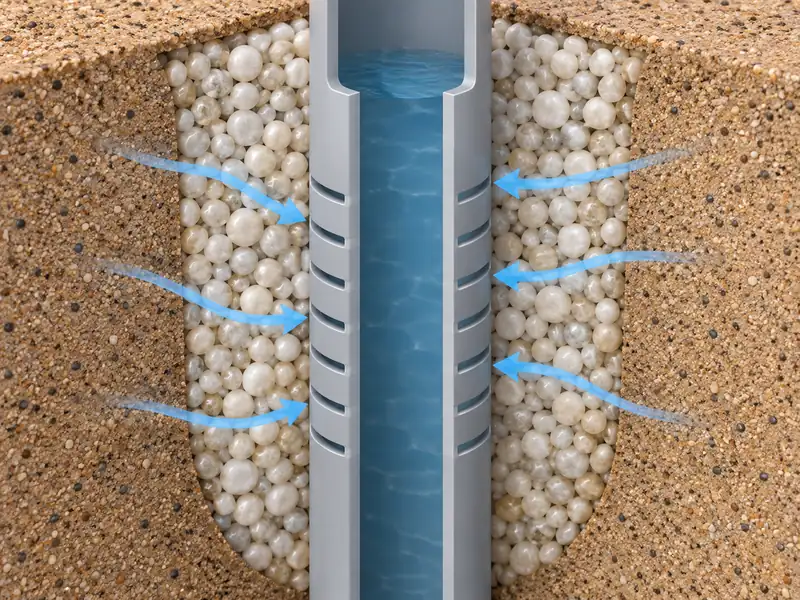
In an artificially packed screen interval, the path runs from the formation through the pack and then through the screen wall. Each region has its own geometry and resistance to movement. Water does not encounter the PVC slot as an isolated opening suspended in otherwise empty space.
Imagine enlarging a small portion of this arrangement. The formation contains a distribution of particle sizes, the surrounding pack contains its specified grains, and the pipe contains manufactured slots. Compatibility concerns the interfaces between those regions, not simply the appearance of the pipe.
The US EPA’s overview of private well components distinguishes the screen from casing and other parts of the well. That context matters because an intake is only one region of a larger assembly. A screen opening is not intended to perform every sealing or structural function in the well.
Which Slot Dimension Controls the Narrow Opening?
Slot width describes the narrow clear dimension across an opening. Slot length describes how far that opening extends in its longer direction. Changing length can increase geometric opening area without changing the nominal narrow passage dimension.
For a simple rectangular illustration, an opening 0.5 mm wide and 20 mm long has 10 square millimetres of area. Doubling its length gives 20 square millimetres while keeping the nominal width at 0.5 mm. Doubling width instead gives the same area increase but changes the passage geometry.
These are arithmetic examples, not recommended slot dimensions. Real openings can differ from perfect rectangles, and particle passage depends on more than one idealised measurement. Nevertheless, the comparison shows why equal opening area does not mean equal retention behaviour.
Our article on slotted PVC pipe open area develops the area calculation separately. Here the important distinction is between how much opening exists and how narrow each opening is. One percentage cannot answer both questions.
Scenario One: What If the Pack Contains Material Finer Than the Slot?
If appreciable pack material can pass through the openings, the screen may not retain the intended granular layer as designed. A visually neat pattern does not compensate for an incompatible combination. The issue begins with the relationship between opening dimensions and the pack grading.
Consider two screens with identical diameter, active length and slot count, but different slot widths. Place the same conceptual pack around each. Even if both products are manufactured consistently, they do not present the same boundary to the surrounding grains.
Counting openings cannot resolve this example, because the material immediately outside the screen must remain compatible with the narrow passages through its wall, regardless of how regularly those passages are arranged along the pipe. It is whether the specified pack and specified opening belong together for the intended formation. That decision must precede translating the slot pattern into a manufacturing recipe.
Why Is an Average Grain Size an Incomplete Description?
An average can conceal the fine and coarse portions of a distribution. Two granular materials can share a central value while differing substantially in the amount of smaller material they contain. Their interaction with one opening width need not be identical.
A grading curve expresses how particle sizes are distributed across the sample. That is more informative than describing the pack as simply fine sand or coarse sand. The relevant design method then determines how the measured distribution is used.
Scenario Two: Does Making Every Slot Narrower Always Help?
Narrower openings change both retention geometry and available area when the remaining pattern is held constant. They do not automatically improve the whole intake. A design must reconcile particle control with the intended hydraulic performance and the available screen geometry.
Using the earlier illustrative rectangle, reducing width from 0.5 mm to 0.25 mm halves its area if length remains 20 mm. Recovering that area would require a different count, length or pattern. Each alternative changes another feature of the component.
Adding openings can also remove more of the pipe wall or move cuts into areas reserved for other functions. Those consequences cannot be resolved by treating slot width as a standalone setting. The finished component must still provide its specified geometry and service capability.
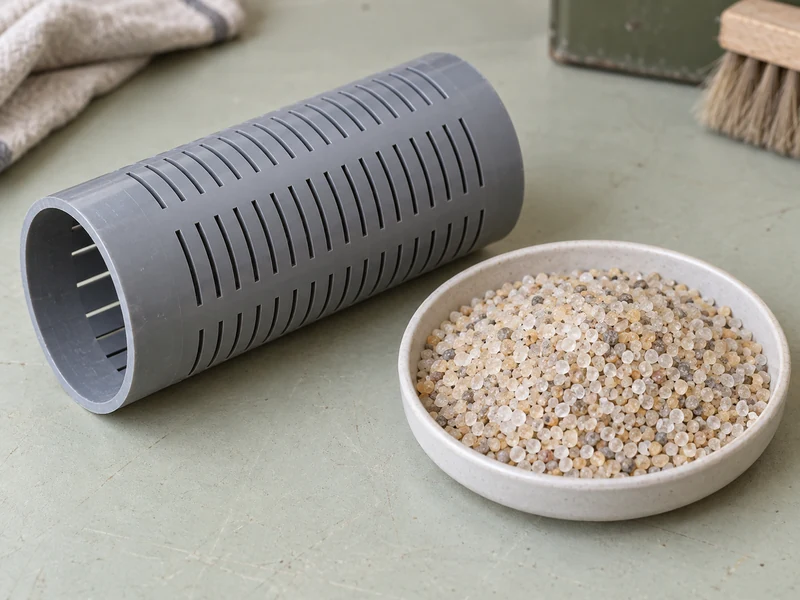
The deliberate unslotted ends and solid sections illustrate one such constraint. Material reserved for a connection is not spare screen area that can always be opened up. The complete product layout sets the available region for the intake pattern.
Scenario Three: What Changes When the Formation Is Different?
A combination developed for one formation cannot automatically be transferred to another. The same pipe can sit beside differently graded material or a different screened interval. Repeating the hardware does not recreate the surrounding conditions.
EPA’s monitoring well design guidance discusses designing the pack and screen together using formation information, including sieve analysis where appropriate. Its coarser-formation procedure includes retaining at least 90 percent of the pack at the screen. That contextual guidance is not a universal slot number or a drinking-water-well specification.
The percentage refers to pack retention within a stated design approach. It should not be mistaken for an instruction to remove 90 percent of the pipe wall, nor for a prediction of how much formation sediment will enter the well. Identifying what a percentage describes is essential before applying it.
Can a Drawing Replace the Formation Information?
A drawing can define pipe dimensions, opening layout and the intended pack region. It cannot establish the actual particle distribution at a site unless that information has been supplied through the design process. A precise manufacturing drawing can still be based on unsuitable environmental assumptions.
This distinction helps assign responsibility clearly. The well designer establishes the intake requirements and compatible materials. The pipe manufacturer then needs a reproducible definition of the screen that implements those requirements.
How Can Similar-Looking Screens Serve Different Designs?
Several independent features can change while the overall appearance remains familiar. A useful comparison separates the feature from the function it primarily describes. None of the following rows alone is a complete well-screen specification.
| Feature | What It Describes | What It Does Not Establish Alone |
| Slot width | Narrow opening dimension | Complete pack compatibility |
| Slot count and length | Extent of the opening pattern | Particle retention or well yield |
| Pack grading | Distribution of surrounding grain sizes | The manufactured slot geometry |
| Active screen length | Length available for the intake zone | Correct placement in the formation |
For example, extending the active length adds opportunities for openings but also changes which interval the intake occupies. Increasing slot count within the same length changes the pattern instead. Those are distinct design responses even if both increase calculated opening area.
How Is the Chosen Relationship Carried Into Production?
The manufacturer needs an unambiguous opening width, pattern, active length and end arrangement. Units and drawing references should be explicit so the same geometry reaches programming, tooling and production. A shorthand screen-size label should not substitute for the dimensions the process actually uses.
The Yuyu pipe slotting machine range provides equipment for producing patterned openings. The DS250-SA pipe slotting machine is one published equipment example. Neither reference establishes that every possible slot width or pack combination is supported by a particular machine configuration.
Our discussion of consistent slot patterns in PVC and PE pipes connects specified geometry to repeatable manufacture. Consistency means producing the intended opening arrangement across the active region. It cannot compensate for selecting an unsuitable intake design before manufacture begins.
Understanding the pack-screen relationship therefore starts outside the pipe and works inward. The formation, granular transition and manufactured openings must be considered as connected parts. That perspective explains why slot width matters while keeping it in proportion to the rest of the well.