
Blow forming creates a socket on a PP pipe by softening a controlled length of the pipe end, containing it within forming tooling and using a pressure difference to expand it into the required cavity. The tooling defines the shape while cooling makes the enlarged end stiff enough to retain it. Heating, pressure and restraint therefore perform different jobs within one connected cycle.
The starting material is an existing pipe, and only its end is reshaped. This article follows that end through a conceptual forming cycle; exact tooling, temperatures, pressures and timings depend on the supplied equipment and the pipe formulation.
What Changes Between a Straight Pipe End and a Finished Socket?
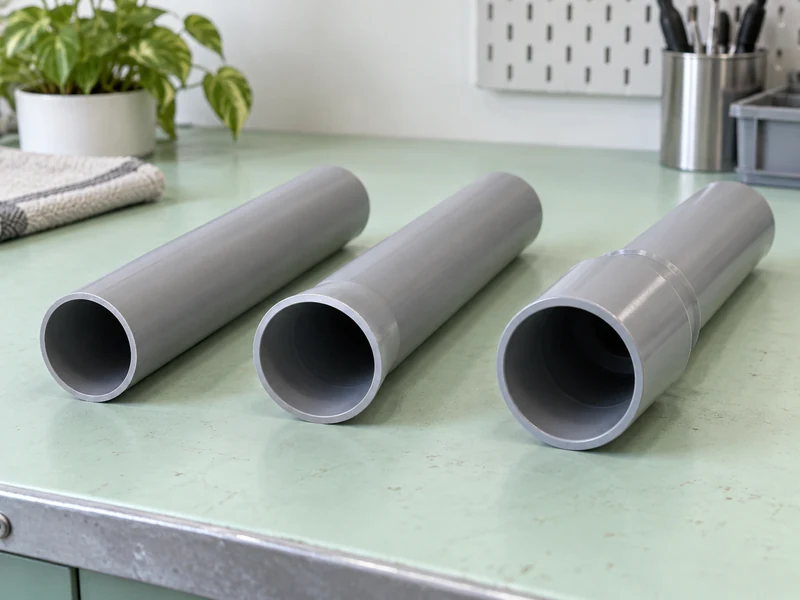
A socket provides an enlarged receiving section at the end of a pipe. Its bore, shoulder and any sealing profile must work together with the intended mating component. Enlarging the mouth alone does not define the complete joint geometry.
Imagine marking a short band around a straight pipe before forming. After that band expands, the same material occupies a larger circumference, so its thickness and distribution can change. The process must therefore manage where deformation occurs, as well as how far the end expands.
The useful distinction is between three responsibilities:
- Heat makes the selected section deformable.
- Pressure drives the softened wall toward the forming surface.
- Tooling and cooling establish and stabilise the geometry.
Different receiving profiles serve different joint designs. Our explanation of socket types used in pipe belling provides that wider context without implying that one forming method produces every socket type.
Stage One: How Is the Pipe End Made Ready to Expand?
The heating stage creates a deformable zone of suitable length and temperature distribution. Material outside that zone remains the relatively rigid pipe body. The boundary between them influences where the future shoulder develops.
In a contact-heating arrangement, heat travels from heated tooling into the pipe wall. The contact surfaces, duration and use of internal heating influence the temperature through the section. A surface that has softened is not proof that the entire wall has reached the same condition.
Yuyu’s DS160PP-NII automatic belling machine lists contact heating with internal heating, blow-type forming and water cooling. This is a concrete example of those operations being combined in a PP/PE pipe-end process. Its published arrangement should not be interpreted as a universal recipe for every PP pipe.
Why Does the Heated Length Matter?
Heating determines the length of material available to become the socket. A narrow soft zone concentrates deformation; a longer soft zone allows movement over a greater distance. The appropriate length follows the intended socket profile and the tool’s method of controlling the pipe.
Consider two otherwise similar ends with the same measured surface temperature but different heated lengths. They can respond differently when pressure is applied because different volumes of material are free to move. Temperature alone consequently cannot describe the starting condition for the next stage.
What Happens During Transfer to the Forming Position?
The softened end continues exchanging heat with its surroundings during transfer. A repeatable transfer sequence helps deliver a similar temperature distribution to the mould on each cycle. Unplanned waiting changes the forming condition even when the heater settings remain constant.
The pipe also needs suitable support during this movement. A softened end should arrive at the forming position without being used as a load-bearing handle or being forced sideways. Support and alignment belong to the forming sequence, rather than being separate housekeeping details.
Stage Two: How Do Air Pressure and the Mould Work Together?
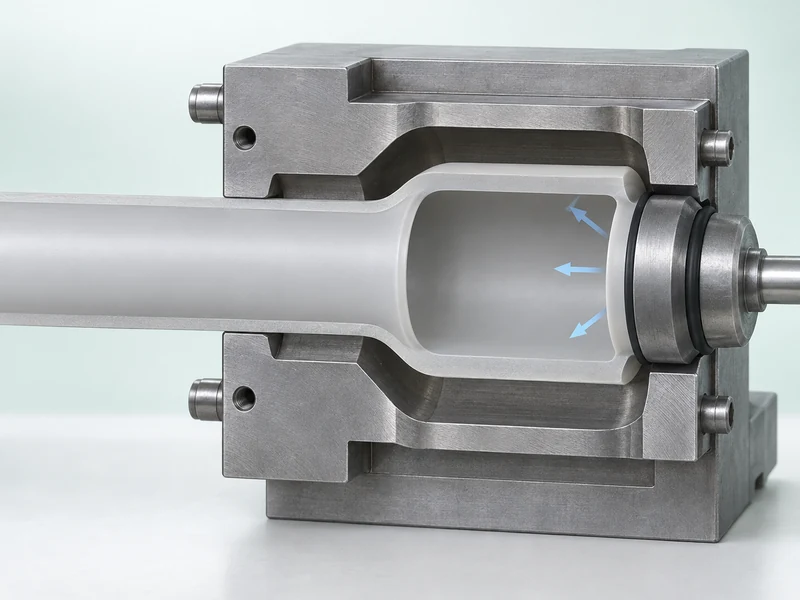
The softened wall expands because pressure inside the forming region exceeds the pressure outside it. A suitable seal arrangement contains that pressure, while the outer cavity limits outward movement. The exact positions of seals, plugs and supports depend on the machine design.
The Open University’s description of blow moulding explains the general principle of inflating thermoplastic material against a mould. Pipe-end belling applies a related pressure-forming principle to a local region of an existing tube. It does not require the complete bottle-making sequence described in that educational reference.
Pressure supplies the forming load; it does not replace the heat needed to let the material move. Similarly, a soft end cannot define its final dimensions without the appropriate tooling. Thinking of these as separate functions helps explain why increasing one setting cannot compensate for every change elsewhere.
Does Higher Pressure Automatically Produce a Better Socket?
No: useful pressure is the pressure needed for the specified material and tooling to complete the intended movement. More pressure can increase loading on the softened wall, seals and equipment without creating a better shape. The approved operating sequence must account for both the deformation and the equipment limits.
Once a region has contacted a rigid cavity surface, it cannot continue expanding outward freely. Other regions may still be moving toward their final positions. The shape therefore develops through changing contact conditions, rather than appearing everywhere at the same instant.
Why Is the Shoulder More Than a Simple Step in Diameter?
The shoulder links the enlarged socket to the original pipe body. Material must pass through that change in geometry while the neighbouring straight section remains controlled. Its contour influences material distribution and the transition between the two regions.
A smooth-looking mouth gives only a partial picture of this movement. The shoulder and the useful receiving length are also part of the intended shape. For readers following the whole line, our step-by-step belling process places forming between heating and subsequent handling.
Stage Three: When Does the New Shape Become Self-Supporting?
The formed end becomes self-supporting as it loses heat and recovers sufficient stiffness for release and transfer. Cooling and tooling restraint work together during this period. The geometry can still move if the restraints are removed while the material remains too compliant.
A water-cooled system removes heat through the arrangement provided by the machine. Cooling at the surface and cooling deeper in the wall do not happen at the same rate. Wall section, initial heat distribution and mould contact all influence the time needed before release.
PP also has different thermal behaviour from rigid PVC, so a successful PVC setting is not a transferable PP specification. Material grade, additives and the forming history matter. A machine’s ability to process more than one material does not make their recipes interchangeable.
There is a practical distinction between holding the socket in shape and merely leaving the pipe somewhere to cool. The first provides defined restraint during a sensitive stage. The second can expose a still-soft end to gravity, concentrated contact or unintended bending.
Stage Four: What Does Controlled Release Contribute?
Controlled release lets the newly formed pipe end leave the tooling without losing the benefit of the preceding stages. Pressure relief, tool movement and pipe transfer must occur in the sequence intended by the equipment designer. A socket remains part of a long component whose weight and motion still need support.
For example, a hypothetical line may form the end consistently but discharge each pipe onto a narrow contact point near the socket. That contact can impose a local load while the material is still warm. A broad, correctly positioned support changes the handling condition without changing the socket cavity.
This example illustrates why output depends on the complete cycle, including transfer. It is not a reported Yuyu production trial. The surrounding timing relationships are discussed in our article on belling machine capacity.
How Do the Stages Fit Into One Repeatable Process?
A repeatable cycle delivers a similar material condition to each successive stage. Heating establishes deformability, transfer preserves the intended condition, pressure and tooling create the shape, and restrained cooling prepares it for release. Changing one stage changes the starting point for the next.
This relationship can be expressed as a short process map:
- Define the material, pipe section and required socket geometry.
- Heat the intended forming length through a controlled contact sequence.
- Position and contain the softened region within the forming tooling.
- Apply the specified pressure sequence while the cavity establishes the shape.
- Cool under the required restraint, then release and support the pipe.
The Yuyu belling machine range includes different equipment arrangements for different pipe products. Blow forming is best understood as one way of combining heat, pressure and geometric restraint. Its value comes from coordinating those functions so a straight pipe end becomes a usable socket throughout its length, not just at its mouth.