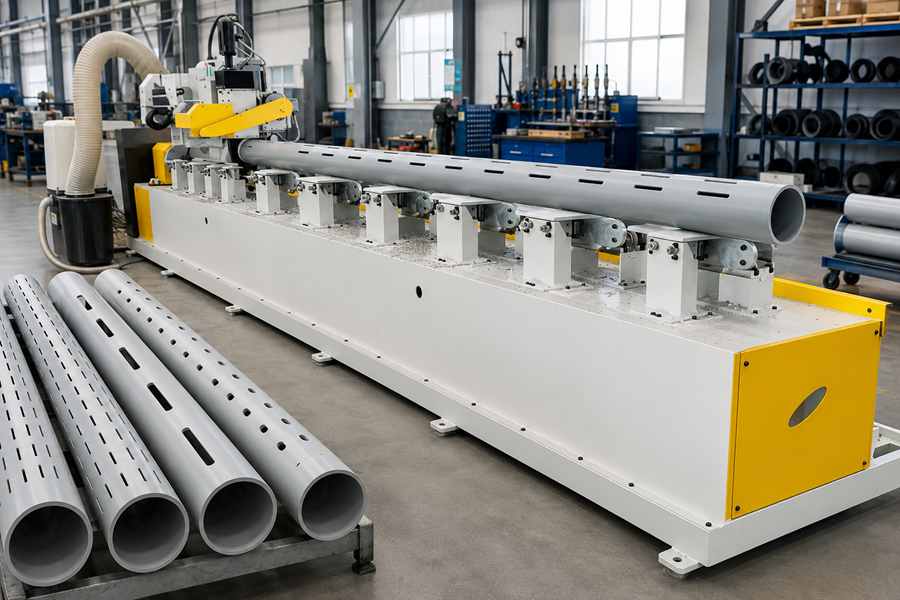
Saw cutting, milling, and punching can all produce slots in plastic pipes, but they do not deliver the same speed, edge quality, flexibility, or tooling cost. The most suitable method depends on the pipe material, wall thickness, slot geometry, production volume, and finished-product requirements.
Comparing the Three Slotting Methods
| Comparison Item | Saw Cutting | Milling | Punching |
| Best feature | Fast repeated straight slots | Flexible and accurate slot shapes | Short forming cycle |
| Slot quality | Clean with suitable blade settings | Smooth and highly controllable | Depends heavily on die support |
| Pattern flexibility | Moderate | High | Low to moderate |
| Tooling requirement | Saw blades and guides | Cutters and controlled tool paths | Dedicated punches and dies |
| Best application | Standard repeated drainage slots | Custom or precision slot patterns | High-volume fixed designs |
When selecting a pipe slotting machine, saw cutting is often practical for standard straight slots. Milling suits products requiring greater dimensional control, while punching becomes attractive when the slot design remains unchanged across large production batches.
Understanding the Saw Cutting Method
Fast Cutting for Repeated Slots
Saw cutting uses one or more rotating blades to enter the plastic pipe wall and create straight openings. The pipe may move along its length, rotate between rows, or remain fixed while the cutting head changes position.
This method works well for:
- Repeated straight slots
- Single-row or multi-row patterns
- Standard drainage applications
- Medium- and large-batch production
- Pipes requiring consistent slot length
Multiple blades can process several slots during one cutting movement. However, closely spaced blades increase spindle load and require accurate pipe support.
Saw Cutting Advantages
Saw systems usually provide a practical balance between output, tooling cost, and operating simplicity. Blades are available in different diameters, thicknesses, and tooth designs, making the process adaptable to several plastic pipe specifications.
Main advantages include:
- High speed for repeated slots
- Relatively simple tool replacement
- Suitable for several pipe diameters
- Easy integration with automatic feeding
- Consistent straight-slot geometry
- Scalable multi-blade configuration
Saw cutting is especially effective when the product uses one standard slot width and a predictable spacing pattern.
Saw Cutting Limitations
Blade speed, feed rate, and tooth design must suit the plastic material. Incorrect settings may create melted edges, burrs, surface scratches, or excessive dust.
Saw cutting also removes material, so chip collection is necessary. Very narrow, curved, or complex slot shapes may require a different process.
Understanding the Milling Method
Controlled Material Removal
A rotating cutter travels along a programmed route to form the required opening in the plastic pipe wall. The tool can control slot length, width, depth, end shape, and position more precisely than a simple straight blade.
Milling is suitable for:
- Rounded-end slots
- Wide or stepped openings
- Different slot sizes on one pipe
- Short custom production batches
- Products requiring close dimensional control
- Patterns that change frequently
A servo-controlled system can adjust the tool path through the machine recipe. This makes milling useful when buyers produce several designs rather than one fixed pattern.
Milling Advantages
Milling offers greater design freedom because the cutter is not limited to one blade width or one straight entry motion. Slot geometry can often be changed through programming rather than complete machine replacement.
Key advantages include:
- Flexible slot dimensions
- Accurate width and length control
- Smooth slot ends
- Better support for customized patterns
- Easy recipe changes
- Suitable for partial-depth processing
Milling is often the stronger choice when slot quality has greater value than maximum cycle speed.
Milling Limitations
The cutter must travel along the complete slot path, so each opening may take longer than a single saw cut or punch stroke. Complex patterns can further increase tool travel and indexing time.
Milling also produces chips and fine plastic particles. Cutter wear, spindle condition, feed speed, and waste extraction must remain stable to prevent rough surfaces or dimensional variation.
Understanding the Punching Method
Slots Formed in One Stroke
Punching presses a shaped tool through the plastic pipe wall while a die or internal support controls the surrounding material. The slot shape is created directly by the punch rather than by gradual cutting.
This process may fit:
- Fixed slot dimensions
- High-volume production
- Repeated identical patterns
- Suitable wall thicknesses
- Pipes that can be supported internally
- Applications requiring a short working stroke
Because each stroke is brief, punching can offer high output when pipe positioning and waste discharge are fully automated.
Punching Advantages
Punching removes the need for a cutter to travel along the slot length. Once the pipe is positioned, the machine can create the opening with one controlled movement.
Its main advantages include:
- Short individual forming time
- Repeatable fixed slot shape
- Limited fine cutting dust
- Suitable for high-volume products
- Predictable tool path
- Simple cycle after setup
Punching is most economical when the same pipe size and slot pattern remain in production for long runs.
Punching Limitations
Each slot size normally requires matching punch and die tooling. Changing the pipe diameter, wall thickness, or slot geometry may require new components and additional setup.
Poor support can deform the plastic pipe around the opening. The process may also create stress marks, raised edges, incomplete separation, or local flattening when tooling clearance is unsuitable.
What Determines the Best Slotting Method?
Slot Shape and Edge Quality
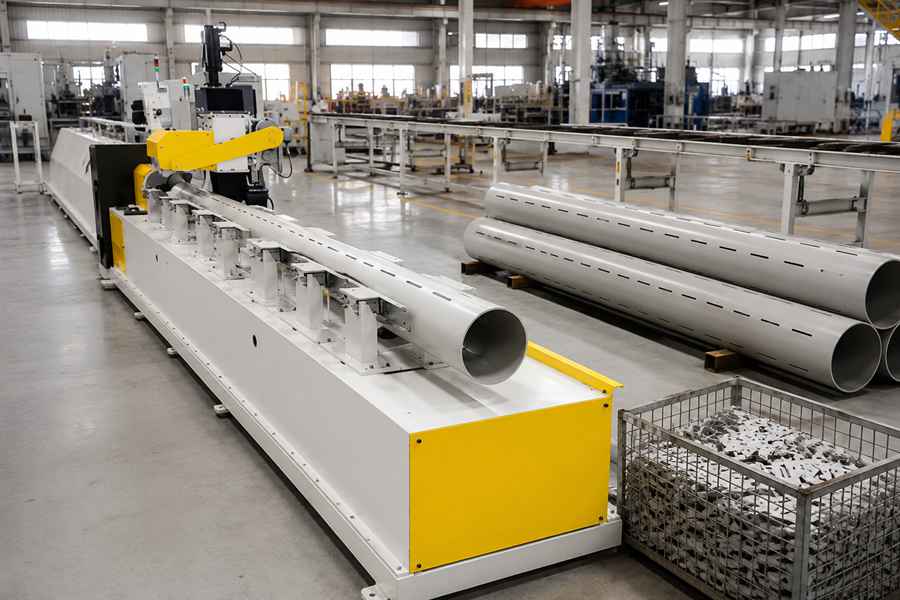
Straight slots with a standard width are usually well suited to saw cutting. Milling provides more control when the opening requires rounded ends, different widths, or customized geometry.
Punching works best when the required shape can be produced cleanly with dedicated tooling. Buyers should inspect both sides of the plastic pipe wall because the entry and exit edges may not look identical.
Pipe Diameter and Wall Thickness
Large-diameter plastic pipes need stable support regardless of the slotting method. Long pipes may also sag between rollers, causing inconsistent slot depth or positioning.
Wall thickness affects each method differently:
- Saw cutting:Thicker walls increase cutting load and blade contact time.
- Milling:Greater depth may require slower feed or several passes.
- Punching:Tool force and die clearance must match the wall thickness.
Thin-wall pipes require careful clamping because excessive pressure can change the pipe shape before slotting begins.
Production Volume and Product Variety
High-volume production favors processes with short cycles and limited adjustment. Punching can be effective for one stable product, while multi-blade saw cutting suits repeated straight-slot patterns.
Milling is often more efficient for mixed orders because pattern changes can be handled through recipes and cutter adjustments. Its individual cycle may be longer, but reduced tooling changeover can improve daily output.
Dust, Chips, and Waste Handling
Saw cutting and milling remove plastic material, producing dust, short chips, or curled particles. These systems need extraction close to the tool and may also require internal pipe cleaning.
Punching may produce separated plastic pieces rather than fine cutting dust. These pieces must still be discharged reliably so they do not remain inside the pipe, die, or clamping area.
| Waste Issue | Saw Cutting | Milling | Punching |
| Fine dust | Moderate to high | Often higher with small cutters | Usually limited |
| Larger chips | Common | Common | Mainly punched pieces |
| Internal residue | Possible | Possible | Possible |
| Collection priority | Blade-area extraction | Cutter extraction and filtration | Scrap-piece discharge |
Waste handling should be tested during continuous operation. A collection system that works for several minutes may become blocked during a full production shift.
Which Method Fits Common Plastic Pipe Requirements?
Choose Saw Cutting When
Saw cutting is usually suitable when the plastic pipe requires many straight, repeated slots. It also fits production lines that process moderate specification changes without needing completely new tooling.
This process is well suited to applications where buyers focus on:
- Stable hourly output
- Standard slot geometry
- Multi-row processing
- Reasonable tooling cost
- Straightforward maintenance
Choose Milling When
Milling is better when slot dimensions or patterns change between orders. It is also suitable when surface quality, dimensional accuracy, or customized opening shapes are important.
It fits buyers who need:
- Flexible product design
- Recipe-based size changes
- Rounded or shaped slots
- Low- to medium-volume custom orders
- Precise slot width control
Choose Punching When
Punching is worth considering when production volume is high and the product design remains stable. The cost of dedicated tooling becomes easier to justify when the same slot pattern is repeated over many pipes.
It fits applications with:
- Fixed pipe specifications
- Long production runs
- Identical slot dimensions
- Suitable wall support
- Short target cycle times
What Buyers Should Test Before Purchasing
A machine trial should use the buyer’s actual plastic pipes rather than a sample selected by the supplier. The most difficult wall thickness, pipe diameter, slot quantity, and pattern should be included.
Record the following results:
- Slot width and length
- Slot spacing accuracy
- Edge condition
- Pipe deformation
- Chips left inside the pipe
- Cycle time per pipe
- Tool replacement time
- Qualified output per hour
Buyers should also request a changeover demonstration. A fast machine may still be inefficient if changing the pipe size or slot pattern requires lengthy manual realignment.
Look Beyond the Fastest Cycle
The lowest cycle time does not automatically produce the lowest processing cost. Tool life, rejected pipes, cleaning stops, changeover time, and replacement tooling all affect the true cost per qualified pipe.
Saw cutting generally offers the most balanced solution for repeated straight slots. Milling provides greater flexibility, while punching is strongest when production is highly standardized.