
Pipe wall thickness affects PVC bending by changing how heat reaches the full section, how the softened tube responds to forming loads and how long the bend needs support during cooling. A thicker wall usually needs more time for heat to reach its interior under otherwise comparable conditions. A thinner wall heats more readily but can be more vulnerable to local indentation and loss of cross-sectional shape.
These are process tendencies, not universal machine settings. The discussion below concerns controlled factory heat bending of suitable rigid PVC pipe; the pipe formulation, tooling, radius and intended application still determine the usable process window.
Why Do Pipes With the Same Diameter Bend Differently?
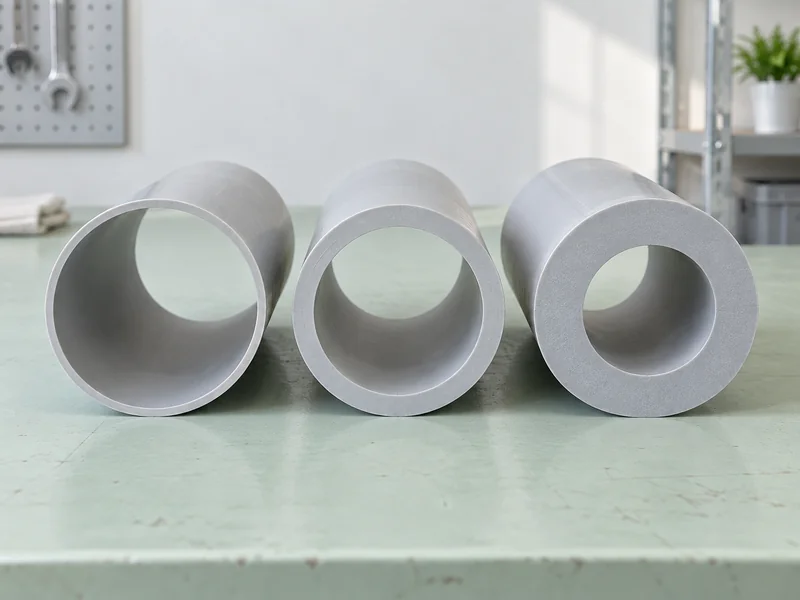
Equal outside diameters do not mean equal amounts of material or equal resistance to deformation. Increasing wall thickness reduces the bore and adds material to the cross-section. It also changes the way the pipe carries the loads imposed by the bending tool.
For a circular pipe with outside diameter D and wall thickness t, the material area is π(Dt − t²). This geometric relationship shows why doubling the wall thickness does not simply double every production parameter. The heating method, contact conditions and deformation history determine how that extra material behaves.
For example, two illustrative pipes with a 50 mm outside diameter and walls of 2 mm and 4 mm contain approximately 302 mm² and 578 mm² of material in their cross-sections. The thicker specimen contains about 1.92 times as much material per unit length when density is unchanged. Those figures describe geometry, not a recommended heating-time multiplier.
How Does Thickness Change Heat Penetration?
With predominantly external heating, heat must travel from the outside surface toward the bore. A greater wall thickness lengthens that path. The surface can therefore become pliable before the inner region reaches a comparable forming condition.
PVC is an amorphous thermoplastic, and its properties are influenced by formulation, as outlined in the ECVM discussion of PVC material behaviour. A controller reading is consequently not a direct measurement of the temperature throughout the pipe wall. It identifies a condition at the sensor location, which must be related to the actual part through process development.
Does a Thicker Wall Always Need a Higher Temperature?
No: additional heating time, better heat distribution or a different exposure arrangement may be more appropriate than a higher setpoint. Raising surface temperature can increase the difference between the surface and the interior. It can also expose the outside to excessive heat before the full section becomes formable.
Our article on heating temperature and PVC bending quality explains the temperature side of the process. Wall thickness adds a second question: whether sufficient heat has reached the regions that must deform.
Can Heating Time Be Calculated From Thickness Alone?
Not reliably for a production recipe. In a simplified conduction model, a characteristic diffusion time varies with the square of the heat-travel distance when material properties and boundary conditions remain comparable. Real bending equipment also involves changing convection, radiation, tool contact and sometimes heating from more than one direction.
The useful inference is that a modest thickness change may require more than a proportional adjustment in dwell. Use this simplified heat-transfer relationship to understand the direction of change; determine the actual timer through controlled trials on the pipe and equipment involved. In particular, it should not be used to turn a successful thin-wall timer directly into a thick-wall timer.
What Happens to the Wall During Bending?
Material on the outside of a bend follows a longer path, while material on the inside follows a shorter one. The resulting tensile and compressive deformation can redistribute wall thickness and change the bore shape. Starting thickness influences the available section, but it does not eliminate these effects.
A thicker tube may resist local collapse better under some conditions, yet a poorly heated thick section can demand excessive forming force. A thin tube may form readily but need more carefully distributed support. The practical goal is a suitable temperature distribution combined with controlled deformation, rather than maximum force.
For more on the resulting geometry, see ovality and wall thinning in bent plastic pipes. That discussion complements the thickness-dependent process choices here.
How Should Support Change With Wall Thickness?
Support should prevent unwanted cross-sectional movement without creating local impressions in the softened pipe. External moulds establish the bend shape; internal support, where provided by the machine, helps control the bore. The suitable arrangement depends on the diameter-to-thickness ratio as well as the bend radius.
| Production Situation | Main Concern | Useful Process Focus |
| Relatively thin wall | Indentation or flattening while soft | Distributed support and controlled clamping |
| Relatively thick wall | Uneven temperature through the section | Heat penetration before increasing forming load |
| Thickness varies around the pipe | Unequal resistance during deformation | Consistent incoming pipe geometry |
| Tighter bend at the same diameter | Greater deformation demand | Suitable radius, support and forming sequence |
| Warm bend released early | Movement after tooling opens | Cooling and discharge support |
Yuyu’s pipe bending machine page describes heating, forming and cooling as connected operations. Its featured DS63-BM arrangement uses an inner mould with air and an outer shaping mould. That is a configuration example, not evidence that every PVC grade or wall section uses the same support settings.
Why Does a Thicker Bend Often Need More Cooling Attention?
A thicker section generally stores more heat per unit length at the same temperature. Cooling the exposed surface does not immediately remove the heat deeper inside. The bend may therefore need support after its outside appears firm enough to handle.
Look at the interval between completing the bend and transferring it out of the tool. If the angle or bore changes after this transition, compare release conditions before assuming the heating stage was wrong. The temperature of incoming coolant and its access to the formed section can alter the result across a run.
Use the same elapsed time when comparing the geometry of different trial pieces. Comparing one part immediately after release with another after a long rest can make a stable process appear inconsistent. A consistent comparison separates time-dependent movement from genuine variation between cycles.
How Can a Process Be Adapted to Another Wall Thickness?
Begin with the established recipe closest to the new pipe, then verify the assumptions behind it. Confirm the actual wall section, material designation and forming geometry before adjusting the cycle. A nominal size label alone is not enough information.
- Record the existing heating, support, forming and cooling sequence.
- Identify what changed: thickness, diameter, material, radius or more than one factor.
- Check heating uniformity before increasing forming force.
- Keep transfer timing consistent while comparing trial pieces.
- Adjust one controlled parameter at a time within the equipment’s permitted range.
- Save the successful combination as a separate product recipe.
Suppose a 4 mm wall is introduced after a successful 2 mm wall run at the same diameter. If the thicker pipe resists bending while its surface is already soft, simply adding clamping pressure may create marks without solving the thermal imbalance. Investigating exposure and heat distribution first is a more informative next step.
The two wall sections in this example were chosen to illustrate a diagnostic approach; they are not measurements from a customer installation or a documented Yuyu production run. The actual response must be assessed on the installed equipment and the specified pipe.
Can Wall Thickness Compensate for an Unsuitable Bend Radius?
Extra thickness is not a general remedy for an overly demanding radius. Bend severity, material behaviour and the support method remain important even when more material is available. A geometrically successful bend also does not automatically retain the original straight pipe’s performance rating.
Keep the formed product within the intended application and its established qualification requirements. For a broader view of defect mechanisms, our guide to preventing cracking and deformation during PVC bending connects heating and tooling choices. It should be read alongside the specific pipe manufacturer’s processing guidance.
What Should Be Recorded for Stable Production?
Record wall thickness as part of the recipe identity, together with diameter, material, bend radius and angle. Include heating exposure, support settings, cooling conditions and the transfer sequence. This makes a useful recipe reproducible instead of leaving operators to reconstruct it from a temperature setting.
Where a product change requires process assistance, Yuyu’s technical service provides a route to discuss the installed configuration. The key production lesson is that wall thickness changes the entire thermal and forming sequence. Treating it as a recipe variable helps explain why pipes that fit the same tooling can still require different processing conditions.