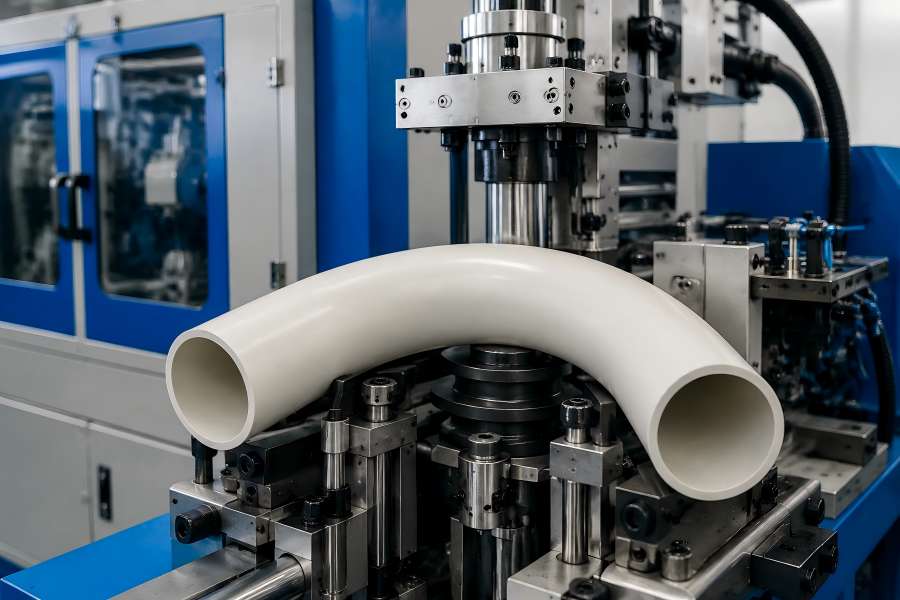
PVC pipe bending requires precise heating, forming, and cooling control to prevent cracking and deformation. A professional PVC pipe bending machine ensures stable temperature, accurate bending, and consistent quality for customized pipe production.
Common Defects During PVC Pipe Bending
During PVC pipe bending, different process conditions can affect the final quality of the formed pipe. Understanding common defects helps manufacturers identify problems and optimize production parameters.
| Defect Type | Main Characteristics | Possible Causes |
| Pipe Cracking | Cracks appear on the outer bending surface | Low heating temperature, excessive stress, small bending radius |
| Pipe Flattening | Circular pipe becomes oval or deformed | Insufficient support, excessive pressure, improper tooling |
| Wall Thickness Variation | Uneven thickness between inner and outer walls | Uneven heating, incorrect bending speed |
| Surface Wrinkles | Folding marks appear on the inner bending area | Excessive compression, unsuitable forming conditions |
| Angle Deviation | Bent pipe does not reach the required angle | Unstable positioning, manual operation errors |
PVC Pipe Cracking
Cracking is a major defect in PVC pipe bending, usually occurring on the outer bending area due to high tensile stress during forming.
Proper heating makes PVC flexible for bending. If the pipe is not sufficiently softened, the outer wall cannot withstand stretching forces and may crack.
Common causes of cracking include:
- Insufficient heating temperature
- Uneven heat distribution
- Excessive bending force
- Too small bending radius
- Poor material flexibility
For example, a thick-wall PVC pipe requires more heating time than a thin-wall pipe. If the same heating conditions are applied to both, the thicker pipe may remain rigid internally and crack during bending.
Using a PVC pipe bending machine with precise heating control can significantly reduce this risk by ensuring the pipe reaches a uniform softening condition before forming.
Pipe Flattening and Ovalization
Maintaining the original circular shape of the PVC pipe is another important challenge during bending.
As the pipe bends, its inner wall compresses while the outer wall stretches. Without proper support, the cross-section may become oval instead of maintaining its original round shape.
Excessive ovalization may cause:
- Difficult installation
- Reduced flow performance
- Lower mechanical strength
- Poor connection accuracy
The degree of deformation depends on:
- Pipe diameter
- Wall thickness
- Bending radius
- Support method
- Forming pressure
For many applications, manufacturers try to control ovality within approximately 5%–10%, depending on product requirements.
Professional PVC Pipe Bending Machines solve this problem through:
- Internal support systems
- Precision molds
- Adjustable clamping mechanisms
- Controlled forming speed
These features help maintain the original pipe geometry after bending.
Wall Thickness Variation
Wall thickness variation is a natural result of pipe bending because different areas of the pipe experience different levels of deformation.
During bending:
- The outer wall becomes thinner due to stretching.
- The inner wall becomes thicker due to compression.
However, excessive thickness variation may reduce the structural performance of the pipe.
Common causes include:
- Uneven heating
- Incorrect bending radius
- Excessive forming force
- Unstable material properties
Manufacturers should optimize bending parameters to ensure deformation is distributed evenly across the pipe wall.
A suitable bending process helps maintain:
- Stable wall thickness
- Better pressure resistance
- Longer service life
Surface Wrinkles and Bending Marks
Wrinkles usually appear on the inner side of the bending area where compression forces are concentrated.
Although small surface marks may not always affect performance, severe wrinkles can indicate poor process control and may influence product appearance and reliability.
Main causes include:
- Excessive compression
- Incorrect heating conditions
- Poor mold design
- Insufficient support
Solutions include:
- Adjusting heating parameters
- Reducing bending speed
- Improving mold structure
- Using suitable supporting systems
A properly designed PVC Pipe Bending Machine minimizes surface defects by controlling the entire forming process.
Main Causes of PVC Pipe Cracking
Improper Heating Temperature
Heating temperature plays a major role in determining PVC pipe bending quality.
PVC must reach a suitable softening temperature before bending. If the temperature is too low, the pipe remains rigid and requires excessive force to deform.
This may cause:
- Surface cracking
- Stress concentration
- Incomplete bending
However, excessive heating can also create problems:
- Material degradation
- Surface damage
- Reduced mechanical strength
Typical heating parameters:
| Parameter | Recommended Range |
| Heating Temperature | 120–160°C |
| Heating Time | 30–150 seconds |
| Temperature Uniformity | Within ±5°C |
| Cooling Time | 30–120 seconds |
The actual settings depend on pipe diameter, wall thickness, PVC formulation, and bending requirements.
Uneven Heat Distribution
Even when the average heating temperature is correct, uneven heat distribution can still cause bending defects.
For example:
- The outer layer becomes soft first.
- The inner layer remains rigid.
- Different areas deform at different speeds. .
To solve this problem, modern PVC Pipe Bending Machines use:
- Multi-zone heating systems
- Infrared heating technology
- Digital temperature monitoring
These technologies ensure more uniform material softening.
Excessive Bending Stress
During bending, excessive stress can damage the PVC structure.
High stress usually occurs when:
- Bending speed is too fast
- Radius is too small
- Heating is insufficient
- Forming pressure is too high
A controlled bending system helps reduce unnecessary stress by adjusting:
- Movement speed
- Bending force
- Position accuracy
Incorrect Bending Radius
Bending radius directly affects the stress level during forming.
A smaller radius creates stronger deformation because the outer wall needs to stretch more.
General recommendations:
| Pipe Application | Recommended Bending Radius |
| Standard PVC conduit | 3D–5D |
| Medium-size pipes | 4D–6D |
| High-strength applications | 5D–8D |
(D represents the outside diameter of the pipe.)
Selecting a suitable bending radius helps maintain pipe strength while achieving the required shape.
Poor Pipe Material Quality
The quality of the original PVC pipe also affects bending performance.
Poor-quality pipes may have:
- Uneven wall thickness
- Low flexibility
- Poor thermal stability
Manufacturers should select pipes with:
- Consistent material properties
- Uniform extrusion quality
- Stable dimensions
High-quality materials combined with optimized bending conditions provide better results.
Main Causes of PVC Pipe Deformation
While cracking results from excessive tensile stress, deformation is mainly caused by poor support, unstable forming, and improper cooling. Controlling deformation ensures accurate installation and long-term pipe performance.
Insufficient Internal Support
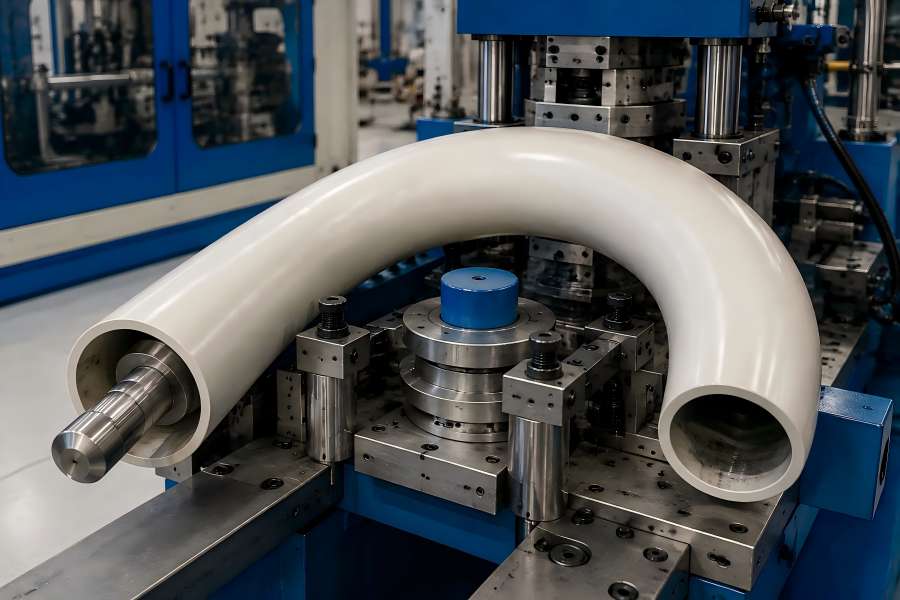
During PVC pipe bending, the pipe wall experiences compression and stretching at the same time. Without sufficient support, the pipe may lose its original circular shape and become flattened or oval.
Internal support systems help maintain pipe geometry by providing resistance against deformation during forming.
Common support methods include:
- Internal mandrels
- Flexible support cores
- Air pressure support
- Customized forming inserts
The suitable support method depends on:
- Pipe diameter
- Wall thickness
- Bending radius
- Product requirements
For small-diameter PVC conduit pipes, simple support structures may be enough. However, large-diameter pipes usually require stronger internal support to prevent collapse.
Incorrect Clamping Pressure
The clamping system keeps the pipe stable during bending. Proper pressure ensures accurate forming without damaging the pipe surface.
If clamping pressure is too low:
- Pipe movement may occur during bending.
- The final angle may become inaccurate.
- Surface defects may appear.
If clamping pressure is too high:
- The pipe surface may be damaged.
- Local deformation may occur.
- Internal stress may increase.
A modern PVC pipe bending machine uses adjustable clamping systems to provide stable holding force according to different pipe specifications.
Improper Cooling Process
Cooling is the final stage that determines whether the bent pipe maintains its shape.
After heating and forming, PVC remains in a softened condition. Without proper cooling control, the pipe may experience:
- Shape recovery
- Dimensional changes
- Internal stress
Common cooling methods include:
Air Cooling
Suitable for small-scale production and smaller pipe sizes.
Advantages:
- Simple operation
- Lower maintenance requirements
Water Cooling
Suitable for continuous production.
Advantages:
- Faster cooling speed
- Higher production efficiency
- Better shape stabilization
Excessive Bending Speed
Bending speed directly affects stress distribution during forming.
If the speed is too high:
- Material does not gradually deform.
- Stress concentration increases.
- Cracking risk becomes higher.
If the speed is too slow:
- Production efficiency decreases.
- Energy consumption increases.
Automatic PVC pipe bending machines allow manufacturers to control bending speed accurately and maintain stable production quality.
How PVC Pipe Bending Machines Improve Bending Quality
Modern PVC pipe bending machines provide accurate and efficient pipe forming, reducing operator dependency and improving production consistency compared with manual methods.
Automatic Temperature Control System
A precise heating system is essential for preventing cracks and uneven deformation.
Advanced machines use:
- Digital temperature controllers
- Infrared heating systems
- Multiple heating zones
These technologies ensure that the bending area reaches a uniform softening condition.
Benefits include:
- Reduced cracking risk
- Better bending accuracy
- More stable production
Servo-controlled Bending System
Servo-controlled bending mechanisms improve movement accuracy during forming.
Compared with manual operation, servo systems provide:
- Precise angle control
- Smooth bending movement
- Repeatable production results
Typical bending accuracy can reach:
±1°–2°
which is suitable for applications requiring consistent pipe geometry.
Internal Supporting Technology
Supporting systems help prevent pipe collapse during bending.
They maintain:
- Pipe roundness
- Dimensional stability
- Smooth surface quality
Internal supports are especially important for:
- Large diameter PVC pipes
- Thin-wall pipes
- High-precision applications
Precision Mold Design
The bending mold directly affects the final quality of the pipe.
A suitable mold should match:
- Pipe diameter
- Wall thickness
- Required bending radius
Proper mold design helps reduce:
- Surface marks
- Wrinkles
- Uneven deformation
Automatic Cooling System
A controlled cooling system stabilizes the final pipe shape after bending.
Advantages include:
- Reduced residual stress
- Better dimensional accuracy
- Faster production cycles
Recommended PVC Pipe Bending Parameters
Optimizing production parameters is essential for achieving high-quality bending results.
| Parameter | Recommended Range | Influence |
| Heating Temperature | 120–160°C | Controls material flexibility |
| Heating Time | 30–150 seconds | Ensures uniform softening |
| Bending Radius | 3D–8D | Reduces stress concentration |
| Cooling Time | 30–120 seconds | Maintains final shape |
| Angle Accuracy | ±1°–2° | Improves installation accuracy |
| Ovality Control | 5–10% | Maintains pipe roundness |
These values should be adjusted according to:
- Pipe diameter
- Wall thickness
- PVC material characteristics
- Application requirements
How to Optimize PVC Pipe Bending Process
Optimizing the PVC pipe bending process requires proper control of materials, heating, forming, and cooling to reduce defects and improve bending accuracy and efficiency.
Choose Suitable PVC Pipe Materials
Material quality directly affects bending performance.
Manufacturers should consider:
- Wall thickness consistency
- Material flexibility
- Thermal stability
- Surface condition
PVC pipes with stable mechanical properties are easier to form and less likely to crack during bending.
Optimize Heating Conditions
Proper heating allows PVC pipes to soften evenly before forming.
Manufacturers should control:
- Heating temperature
- Heating time
- Heat distribution
Insufficient heating may cause cracking, while excessive heating may damage material properties.
Automatic temperature control systems help maintain consistent heating results.
Select Correct Bending Parameters
Bending radius, speed, and forming force directly affect final pipe quality.
Manufacturers should adjust parameters according to:
- Pipe diameter
- Wall thickness
- Required angle
- Application conditions
A suitable bending radius reduces stress concentration and improves shape stability.
Improve Supporting and Cooling Systems
Proper support and cooling help maintain the final pipe shape.
Manufacturers should ensure:
- Stable pipe positioning
- Suitable clamping force
- Effective internal support
- Controlled cooling time
These measures reduce flattening and dimensional changes after bending.
Perform Regular Process Testing
Continuous testing helps maintain stable production quality.
Manufacturers should inspect:
- Bending angle
- Pipe roundness
- Surface appearance
- Wall thickness variation
Recording and optimizing production parameters allows manufacturers to develop suitable bending solutions for different pipe specifications.
Production Tips to Reduce PVC Pipe Bending Defects
Reducing bending defects requires not only advanced equipment but also effective production management.
Choose Suitable PVC Pipe Materials
Before bending, manufacturers should check:
- Pipe wall uniformity
- Material flexibility
- Surface quality
- Dimensional accuracy
High-quality pipes provide better resistance against cracking and deformation.
Maintain Stable Heating Conditions
Manufacturers should regularly check:
- Heating system performance
- Temperature sensor accuracy
- Heating element condition
Stable heating helps achieve consistent bending results.
Adjust Machine Parameters Properly
Different pipe sizes require different settings, including:
- Heating temperature
- Heating time
- Bending speed
- Clamping pressure
- Cooling duration
A programmable PVC pipe bending machine allows manufacturers to save optimized parameters for different products.
Use Proper Tooling and Perform Inspection
Suitable molds and supporting systems help maintain pipe shape.
Regular inspection of:
- Bending angle
- Pipe roundness
- Surface quality
- Wall thickness
Helps identify problems early and improve production stability.