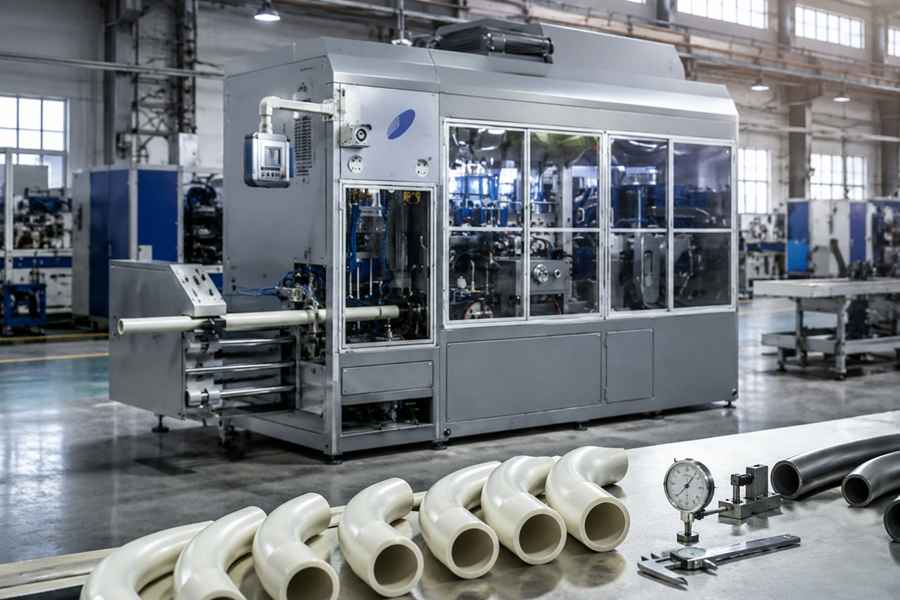
A Pipe Bending Machine reshapes a heated plastic pipe by applying controlled force around a specified bend radius. During this process, the two most common dimensional changes are ovality and wall thinning.
Two Common Changes in Bent Plastic Pipes
What Is Ovality?
Ovality occurs when a Pipe Bending Machine changes the cross-section of a heated plastic pipe from a circular profile into an oval shape. It is commonly evaluated by measuring the largest and smallest outside diameters at the same bend position.
The bend center usually shows the greatest deformation because this area receives the strongest forming load. Both transition sections should also be inspected, as flattening may extend beyond the visible center of the bend.
Ovality can be estimated using:
Ovality rate = (Maximum outside diameter − Minimum outside diameter) ÷ Nominal outside diameter × 100%
- Maximum outside diameter:The widest measurement across the bent pipe section.
- Minimum outside diameter:The narrowest measurement at the same cross-section.
- Nominal outside diameter:The specified diameter of the plastic pipe before bending.
- Ovality rate:The percentage difference between the largest and smallest measured diameters.
What Is Wall Thinning?
Wall thinning refers to the reduction in plastic pipe wall thickness along the outside radius of a bend. During forming, the outer wall travels over a longer path and stretches, while the inner wall is compressed.
The thinnest area often appears near the center of the outer bend. However, uneven heating or poor tool alignment may shift it toward one side of the pipe.
Wall thinning can be evaluated using:
Wall-thinning rate = (Original wall thickness − Minimum wall thickness) ÷ Original wall thickness × 100%
- Original wall thickness:The pipe wall measured before bending.
- Minimum wall thickness:The thinnest point found after the bend is completed.
- Outer bend wall:The stretched section where thickness loss normally occurs.
- Inner bend wall:The compressed section that may become thicker or develop wrinkles.
Comparison Between Ovality and Wall Thinning
Ovality and wall thinning describe different dimensional changes. A plastic pipe can remain relatively round while its outer wall becomes too thin, so the two conditions must be measured separately.
| Comparison Item | Ovality | Wall Thinning |
| Main change | Cross-section becomes oval | Outer bend wall becomes thinner |
| Typical area | Bend center and transitions | Outside radius of the bend |
| Measurement | Maximum and minimum diameter | Original and minimum wall thickness |
| Main concern | Reduced opening and poor fit | Reduced local strength |
What Causes Ovality and Wall Thinning?
Ovality and wall thinning often develop from the same bending conditions. Bend radius, pipe dimensions, material response, heating quality, internal support, forming speed, and clamping stability all influence the final result.
| Influencing Factor | Effect on the Bent Plastic Pipe |
| Tight bend radius | Increases flattening and outer-wall stretching |
| Pipe size and wall thickness | Thin walls resist collapse less effectively |
| Incorrect heating | Causes uneven softness, sagging, or concentrated deformation |
| Weak support or poor alignment | Allows inward collapse and uneven stretching |
| Unstable bending or clamping | Produces sudden or unbalanced forming loads |
A tight bend radius is not always practical simply because the machine has enough forming force. The finished bend must also maintain acceptable roundness, wall thickness, and surface quality.
Incoming pipe variation should also be considered. A plastic pipe that is already oval or uneven in wall thickness may show greater deformation after heating and bending.
How to Control and Inspect Bent Plastic Pipe Quality
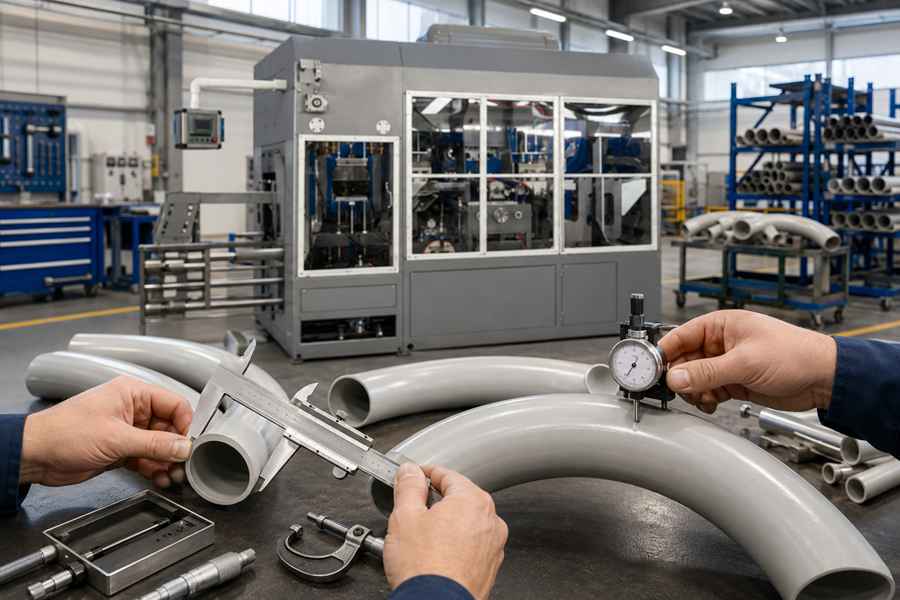
Reducing ovality and wall thinning requires coordinated control of bend geometry, heating, support, forming, cooling, and inspection. Measured results should also be used to refine the settings for each plastic pipe specification.
Optimize Bend Radius and Heating
A suitable bend radius spreads deformation across a longer pipe section, reducing sudden outer-wall stretching and cross-sectional flattening. The radius should match the pipe diameter, wall thickness, material, required angle, and minimum acceptable wall thickness.
The heating zone should cover the bend and nearby transitions without softening unnecessary pipe length. Keep temperature uniform around the circumference and control:
- Heater position and distance
- Heating-zone length
- Pipe rotation
- Heating time
- Independent temperature zones
- Recipes for different pipe specifications
Pipes with the same outside diameter may still require different settings because wall thickness, color, formulation, and batch condition affect heat absorption.
Improve Internal Support and Tool Alignment
A mandrel, flexible core, internal filling, or other support can limit inward collapse during bending. The support should remain close to the main deformation area and have suitable clearance for the pipe.
The bending die, clamps, guides, rollers, and internal support should share the same reference line. Tool surfaces should also remain clean and smooth to prevent uneven stretching, scratches, and unstable forming.
For machines processing several pipe sizes, tooling changes should restore alignment without repeated manual correction. Poor changeover repeatability can create different ovality levels between production runs.
Control Bending and Cooling
Bending movement should be gradual through the main deformation area. Excessive speed may stretch the outer wall too quickly, while excessive clamping pressure can flatten a heated thin-wall pipe.
A stable forming sequence includes:
- Position and clamp the pipe
- Start bending gradually
- Reduce speed through the main bend
- Hold the final angle
- Cool before releasing the pipe
Cooling should remain even around the formed section. Releasing the pipe too early or cooling only one side may increase springback, ovality, and shape variation.
Measure Ovality and Wall Thickness
A correct bend angle does not confirm acceptable pipe quality. Inspect the bend center, entrance and exit transitions, inner radius, outer radius, and any visibly flattened section.
Recommended measurements include:
- Maximum and minimum outside diameter
- Ovality rate
- Original and minimum wall thickness
- Wall-thinning rate
- Inner-wall wrinkles
- Bend angle and radius
- Surface scratches or heat marks
Measure wall thickness at several points around the outer bend. A single diameter or thickness reading may miss narrow areas of local deformation.
What Buyers Should Test Before Purchasing
Plastic pipe bending equipment should be evaluated by finished-product quality rather than maximum pipe diameter alone. A machine may have enough power to complete the bend but still produce unacceptable ovality or wall thinning.
Buyers should send samples representing the most demanding production conditions:
- Largest required outside diameter
- Thinnest wall in the product range
- Tightest specified bend radius
- Largest required bend angle
- Most heat-sensitive plastic material
- Pipes with normal batch variation
The supplier should record the bend angle, ovality, minimum wall thickness, cycle time, and cooling duration. Testing several consecutive pipes provides a clearer picture of production stability than one carefully adjusted sample.
Buyers should also request a tooling-change demonstration. The machine should return to acceptable bending quality without lengthy manual alignment after changing pipe size or bend radius.
Troubleshooting Bent Plastic Pipe Defects
When the finished bend does not meet requirements, the visible defect can help identify the most likely process cause.
| Observed Defect | Likely Cause | Practical Adjustment |
| Excessive ovality or bend-center collapse | Insufficient internal support | Adjust support size and position |
| Severe outer-wall thinning | Tight bend radius or poor heating | Increase the radius and refine heating |
| Inner-wall wrinkles | Excessive compression | Adjust support, heat, and bending speed |
| Uneven thinning or surface marks | Misaligned tooling or unstable forming | Check alignment, temperature, and speed |
| Shape changes after release | Insufficient cooling | Extend holding and cooling time |