
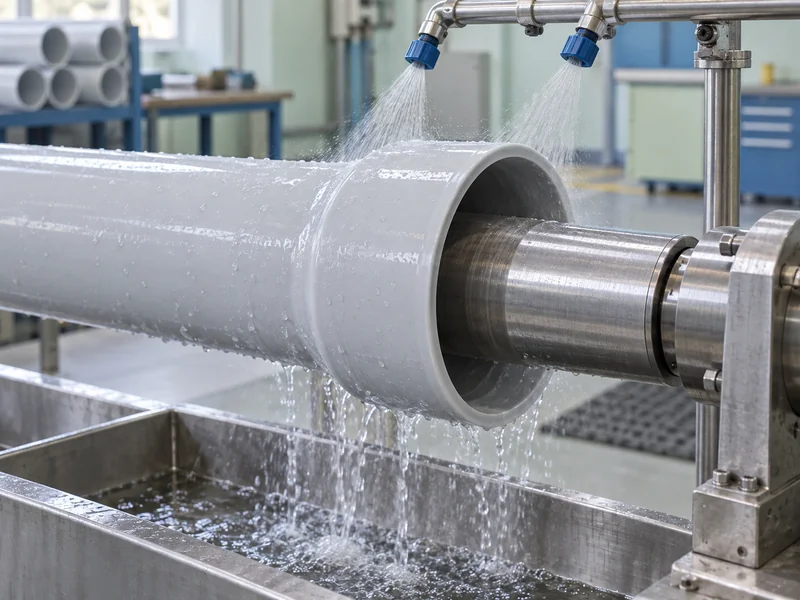
Cooling matters in PVC pipe belling because the expanded end must recover enough stiffness to retain its socket shape when the forming tool withdraws. An end that looks correct while supported can still change shape after release if heat remains unevenly distributed through its wall. A stable cooling stage therefore controls both the condition at demoulding and the way the pipe is supported immediately afterward.
This article concerns factory socket forming in rigid PVC pipe production. The appropriate settings depend on the pipe compound, wall thickness, socket geometry and machine configuration; a single cooling time cannot cover every product.
What Does Cooling Actually Do After the Socket Is Formed?
Cooling reduces the mobility of the heated polymer so the newly formed end can carry ordinary handling loads without continuing to deform. During forming, tooling establishes the socket geometry while the pipe end is sufficiently soft. During cooling, that geometry must remain supported as the material becomes stiffer.
The European Council of Vinyl Manufacturers describes PVC as an amorphous material in its discussion of PVC physical properties. This means socket stabilisation should not be described as a crystallisation process. Thermal contraction, the previous stretching of the end and time-dependent recovery still matter even though rigid PVC is not a semicrystalline polymer.
The practical distinction is between making the shape and preserving it. For the surrounding production sequence, see our explanation of how belling machines work.
Why Can a Socket Change Shape After Demoulding?
A socket can move after release because the surface and the interior of its wall are not necessarily at the same temperature. External cooling may make the outside feel firm while material deeper in the section remains warmer. Removing the tool at that point also removes the support that was resisting recovery and distortion.
How Does Uneven Cooling Affect Roundness?
Unequal cooling around the circumference can leave some regions stiffer than others. A warm section can then respond differently to gravity, ejector contact or the weight of the pipe. Before blaming the forming mould, compare nozzle coverage, water distribution and the position where the end rests after release.
Why Does the Socket Shoulder Need Attention?
The transition between the expanded socket and the original pipe body has a different shape from the straight barrel. Tool contact and coolant access may also differ there. A repeatable cycle needs to stabilise this transition rather than judging completion only from the exposed mouth of the socket.
Socket designs also require different forming details. Our guide to different socket types explains why a smooth socket and a gasket-retaining profile should not automatically share a process recipe.
Which Conditions Change the Cooling Requirement?
The cooling requirement changes with the amount of heat in the formed end and the route by which that heat can leave. Pipe size is relevant, but diameter alone is an incomplete guide. Two products with the same outside diameter can behave differently when their walls, compounds or socket profiles differ.
| Condition | Why It Matters | Production Implication |
| Wall thickness | Changes the heat stored and the distance heat travels | Keep separate recipes for materially different wall sections |
| Heating history | Determines the starting temperature distribution | Keep heating and cooling records together |
| Coolant condition | Changes the driving force and consistency of heat removal | Track supply temperature and circulation |
| Socket profile | Changes tooling contact and local geometry | Review the shoulder and any formed groove |
| Release and support | Changes the loads on the newly formed end | Keep ejection and transfer consistent |
These factors interact. Increasing heating exposure to resolve incomplete forming can create a new cooling requirement even if the cooling timer has not changed. Conversely, a cooling problem that appears only late in a shift may originate in a warming recirculation system rather than a changed pipe batch.
Is Colder Water Always Better?
No: the useful objective is repeatable heat removal and stable geometry, not the lowest possible water temperature. A colder supply can increase the rate of surface cooling, but that does not prove the whole wall reaches a suitable release condition sooner. Large temperature differences may also change the relationship between the surface and the warmer interior.
Start with the machine manufacturer’s recommended operating range and the validated recipe for the pipe. Before changing water temperature, check whether flow is reaching every intended cooling location. A partially obstructed nozzle is a distribution problem that a colder tank may conceal without resolving.
- Keep supply and return paths clear.
- Monitor temperature where coolant reaches the machine, not only at the tank.
- Check spray direction after tooling changes.
- Maintain filtration and water treatment according to equipment instructions.
- Record changes in ambient and incoming pipe conditions.
Yuyu’s DS250 automatic belling machine is one equipment reference for this production stage. The actual cooling arrangement and operating settings should follow the supplied configuration, rather than assumptions based solely on a model name.
How Does Cooling Affect the Production Cycle?
Cooling can limit output when a formed socket occupies tooling until it becomes ready for release. Reducing that dwell can shorten a cycle, but only if it does not increase dimensional drift, handling damage or rework. The useful measure is repeatable usable output across a run.
Consider an illustrative shift in which the first few sockets hold their shape, but later pieces progressively lose roundness after discharge. If the pipe and heating settings are unchanged, compare coolant supply temperature, circulation and transfer conditions across the same period. This observation narrows the investigation; it does not establish the cause without further evidence.
Our article on belling machine capacity places the cooling stage within the wider line cycle. The nominal forming time and the sustainable line output are different quantities.
What Should Happen Between Tool Release and Stacking?
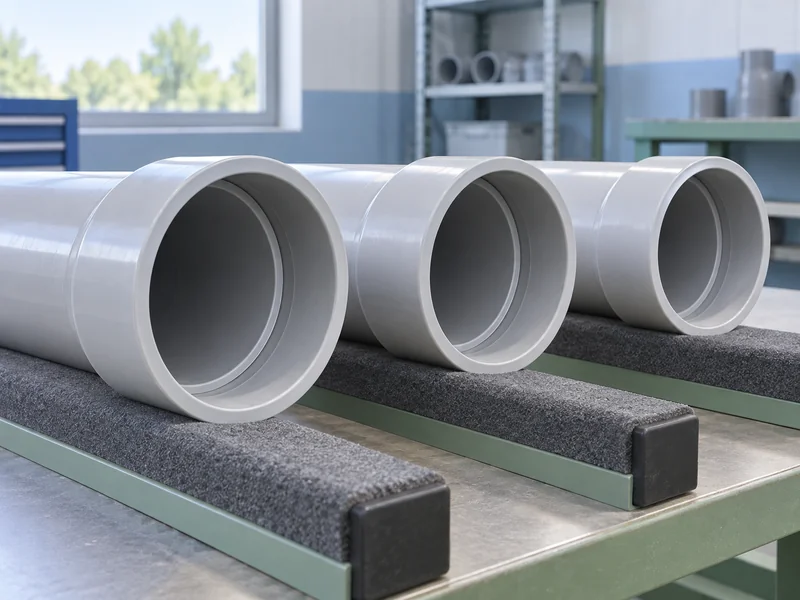
The pipe should leave the tooling without concentrated loads that distort a still-warm socket. Support locations, conveyor alignment and contact surfaces deserve the same consistency as the timer. A socket can be adequately formed yet damaged by the next transfer movement.
Keep the hot end from carrying the weight of a long unsupported pipe. Avoid allowing the mouth to strike a stop or placing fresh sockets under a heavy stack before the process permits it. Those details are especially useful when distortion appears on only one side or at a repeatable contact position.
A supported rest after discharge can help stabilise handling conditions, but it should not become a substitute for adequate cooling on the forming tool. If a process relies on special downstream restraint, that restraint belongs in the documented production method. Otherwise, different shifts may unknowingly produce different results.
How Can Operators Separate Cooling Problems From Heating Problems?
Use the timing and location of the symptom to decide what to investigate first. A shape that is already incomplete before release points toward a different set of causes from a shape that gradually moves afterward. Neither observation should trigger a random change to every setting.
- Confirm the pipe grade, size and wall section match the current recipe.
- Compare the formed end before release with its condition after the normal transfer.
- Check coolant delivery and support before altering setpoints.
- Change one controlled variable and identify the affected production batch.
- Compare results at consistent elapsed times and temperature conditions.
If additional cooling improves stability but leaves a repeated surface mark unchanged, there may be more than one cause. Tool condition, contamination or alignment can create marks independently of cooling. Keeping observations separate prevents a longer timer from becoming a catch-all response.
What Makes a Cooling Recipe Repeatable?
A repeatable recipe describes the conditions around the cooling time, not just its numerical value. Record coolant supply conditions, heating settings, tooling identity, pipe dimensions and the release sequence together. Then a successful setting can be reproduced after a stoppage or product change.
The Yuyu belling machine range includes different forming arrangements, so the details of this record should reflect the installed machine. The shared principle is to keep the socket supported while it regains stiffness and to preserve that geometry through discharge. Cooling becomes more predictable when it is treated as a controlled forming stage rather than an idle pause.