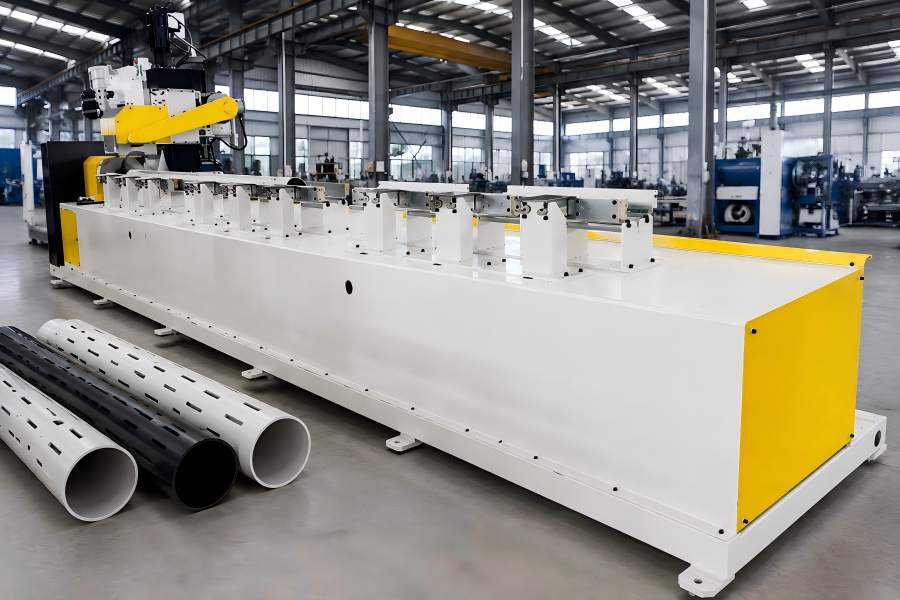
Plastic pipes such as PVC, PP, and PE are widely used in infrastructure, agriculture, water management, and filtration systems. Pipe slotting machines create precise slots that balance flow, filtration, and pipe strength, helping manufacturers improve efficiency, reduce waste, and produce reliable products for modern plastic processing applications.
What Is a Pipe Slotting Machine?
A pipe slotting machine is a specialized piece of equipment designed to create narrow, precise slots on the surface of plastic pipes.
Unlike perforation machines that produce round holes, slotting machines generate elongated openings with controlled dimensions and spacing. These slots allow liquids, gases, or other materials to flow through the pipe while filtering out unwanted particles or maintaining structural stability.
Modern pipe slotting machines are capable of processing:
- PVC pipes
- PE pipes
- HDPE pipes
- PP pipes
- Corrugated pipes
- Solid-wall pipes
- Large-diameter pipes
- Small-diameter pipes
Depending on application requirements, machines can produce:
- Longitudinal slots
- Circumferential slots
- Spiral slot patterns
- Multi-row slot arrangements
- Customized slot designs
Advanced equipment allows manufacturers to program slot dimensions and patterns according to customer specifications. By adjusting software settings, operators can quickly switch between different pipe diameters, slot widths, and slot layouts without requiring extensive mechanical modifications. This flexibility makes pipe slotting machines highly valuable for modern manufacturers serving multiple industries and product categories.
Why Slotting Is Important in Plastic Pipe Manufacturing
Slots are often critical to the functionality of the finished pipe.
Without properly designed slot patterns, many drainage, filtration, and water collection systems would fail to perform effectively. The quality, spacing, and geometry of the slots directly affect how fluids move through the pipe and how efficiently unwanted materials are filtered out.
Slotting serves several important purposes:
Water Collection
Slotted pipes allow groundwater to enter while preventing surrounding soil from clogging the system. This function is essential for drainage and dewatering applications.
Filtration
Controlled slot sizes act as filters, blocking larger particles while permitting fluid flow. Proper slot dimensions improve filtration efficiency and system longevity.
Drainage
Slots facilitate efficient water removal in agricultural, construction, mining, and environmental applications. Uniform slot patterns help ensure predictable drainage performance.
Ventilation
Certain industrial systems use slotted pipes to distribute air or gases evenly. Consistent slot arrangements improve airflow control.
Resource Extraction
Mining and energy industries often rely on slotted pipes for fluid collection, groundwater control, and extraction systems.
The precision of the slotting process directly affects system performance, operational reliability, and long-term maintenance costs.
Materials Commonly Processed by Pipe Slotting Machines
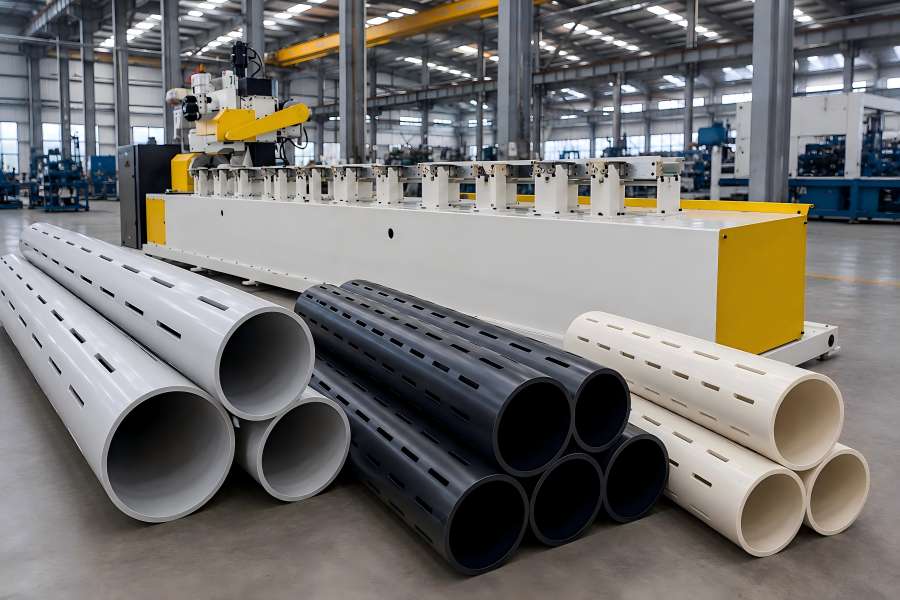
PVC Pipes
PVC remains one of the most commonly processed materials in the pipe industry.
Advantages include:
- Excellent rigidity
- High dimensional stability
- Corrosion resistance
- Easy machinability
- Long service life
- Cost-effective production
PVC slotted pipes are widely used in:
- Agricultural drainage
- Groundwater management
- Construction projects
- Municipal drainage systems
- Cable protection infrastructure
The material’s rigidity allows for highly accurate slot formation and excellent dimensional consistency.
PE Pipes
Polyethylene pipes, especially HDPE, have become increasingly popular in modern infrastructure and environmental projects.
Benefits include:
- High flexibility
- Excellent impact resistance
- Chemical resistance
- Long-term durability
- Resistance to environmental stress cracking
PE slotted pipes are commonly used in:
- Landfill drainage systems
- Mining operations
- Water management projects
- Environmental engineering
- Industrial fluid collection systems
Because PE is softer than PVC, slotting machines must maintain careful process control to prevent deformation and ensure slot consistency.
PP Pipes
Polypropylene pipes offer:
- High temperature resistance
- Excellent chemical resistance
- Good mechanical properties
- Lightweight construction
- Long service life
PP slotted pipes are often found in:
- Industrial filtration systems
- Chemical processing facilities
- Water treatment plants
- Specialized industrial applications
Modern slotting machines can accommodate the unique processing requirements of PP materials while maintaining high production efficiency and slot accuracy.
How a Pipe Slotting Machine Works
Although machine designs vary, most pipe slotting systems follow similar operating principles.
Pipe Feeding
The pipe is automatically fed into the machine through a controlled positioning system.
Servo motors or precision drive systems ensure accurate movement throughout the slotting process while maintaining synchronization with cutting operations.
Pipe Positioning
The machine aligns the pipe according to programmed slotting parameters.
Proper positioning is essential for maintaining slot consistency, especially when producing complex slot arrangements or multiple slot rows.
Slot Cutting
The cutting system creates slots using specialized tools designed for plastic processing.
Depending on machine configuration, slot creation may involve:
- Mechanical cutting
- Milling technology
- Rotary cutting systems
- CNC-controlled cutting heads
The machine continuously monitors movement to ensure every slot meets dimensional requirements.
Pattern Control
The machine controls:
- Slot width
- Slot length
- Slot spacing
- Slot quantity
- Slot arrangement
Advanced control systems allow highly repeatable production and minimize variation between batches.
Finished Pipe Output
After slotting is completed, the pipe exits the machine for inspection, packaging, or further processing. Some production lines integrate automatic inspection systems to verify slot quality before the pipe moves to the next stage.
Key Features of Modern Pipe Slotting Machines
Modern equipment offers significantly greater capabilities than earlier manual systems.
Common features include:
CNC Control Systems
Computerized controls allow precise programming of slot patterns.
Operators can easily adjust:
- Slot dimensions
- Pipe specifications
- Production speed
- Pattern configurations
This flexibility reduces setup time and improves production efficiency.
Servo Motor Technology
Servo systems provide:
- Accurate positioning
- Smooth motion control
- High repeatability
- Reduced mechanical errors
Servo-driven machines maintain superior slot consistency even during long production runs.
Automatic Pipe Handling
Automation reduces manual labor while increasing productivity.
Benefits include:
- Faster processing
- Improved consistency
- Lower labor costs
- Reduced operator fatigue
Multi-Diameter Compatibility
Many machines can process multiple pipe sizes with minimal changeover requirements.
Manufacturers can react swiftly to shifting market demands thanks to this flexibility.
User-Friendly Interface
Production monitoring, parameter adjustment, and machine operation are all made easier by touchscreen control systems.
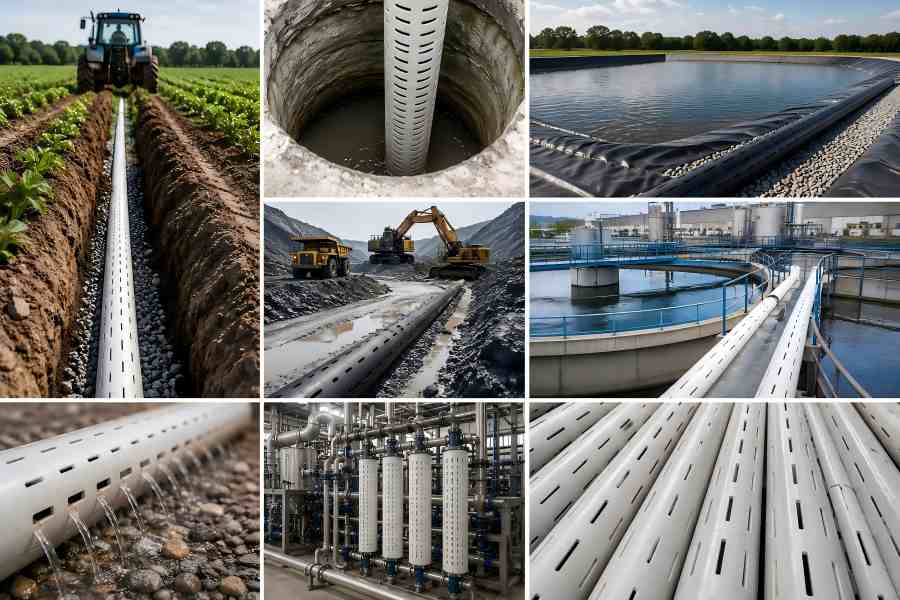
Applications in Agricultural Drainage Systems
Agriculture remains one of the largest users of slotted plastic pipes.
Excess water can negatively affect crop growth by limiting oxygen availability in the root zone and increasing the risk of root diseases.
Slotted drainage pipes help:
- Remove excess groundwater
- Improve soil conditions
- Increase crop yields
- Prevent waterlogging
- Enhance field productivity
PVC and PE drainage pipes are commonly installed beneath agricultural fields to collect and transport water away from growing areas.
Pipe slotting machines enable manufacturers to produce highly consistent drainage products that meet agricultural performance requirements and support efficient farm management.
Applications in Groundwater Collection
Groundwater management systems rely heavily on slotted pipes.
These systems collect underground water while preventing excessive soil intrusion.
Common applications include:
- Water wells
- Groundwater recharge systems
- Dewatering projects
- Municipal water infrastructure
- Environmental monitoring systems
Precise slot patterns help optimize water collection efficiency while maintaining long-term system reliability. Consistent slot dimensions are especially important in well screens where filtration performance directly impacts water quality.
Applications in Landfill Leachate Collection
Modern landfills require sophisticated drainage systems to manage leachate.
Leachate is the liquid generated when water passes through waste materials and may contain contaminants requiring careful collection and treatment.
Slotted PE and HDPE pipes are widely used because they offer:
- Chemical resistance
- Durability
- Long service life
- Reliable fluid collection
- Environmental protection benefits
Pipe slotting machines ensure consistent slot geometry that supports efficient leachate collection and compliance with environmental regulations.
Applications in Mining Operations
Mining environments present demanding operating conditions.
Slotted plastic pipes are frequently used for:
- Dewatering systems
- Tailings management
- Groundwater control
- Resource recovery systems
- Environmental protection projects
These applications require pipes that can withstand harsh environments while maintaining reliable fluid flow.
Modern slotting technology helps manufacturers produce high-quality products capable of meeting mining industry requirements and supporting efficient operations.
Applications in Water Treatment Systems
Water treatment facilities rely on filtration and fluid distribution systems that often incorporate slotted pipes.
Applications include:
- Intake systems
- Filtration units
- Collection systems
- Distribution networks
- Wastewater treatment processes
Consistent slot patterns improve filtration performance and ensure predictable hydraulic behavior.
The need for precision slotted pipes is anticipated to develop sharply as worldwide water quality requirements continue to rise.
Applications in Industrial Filtration
Industrial filtration systems often use slotted pipes as support structures or collection components.
Industries utilizing these systems include:
- Chemical processing
- Food production
- Pharmaceutical manufacturing
- Petrochemical facilities
- Environmental engineering
Precise slot dimensions are critical because filtration performance depends directly on slot geometry.
Pipe slotting machines allow manufacturers to maintain tight dimensional tolerances required for these demanding applications.
Benefits of Automated Pipe Slotting Machines
The transition from manual processing to automated slotting technology has transformed plastic pipe manufacturing.
Key advantages include:
Improved Accuracy
Automated systems maintain consistent slot dimensions throughout production, reducing variation and improving product quality.
Increased Efficiency
Pipes can be processed much more quickly and precisely by modern machines than by hand.
Reduced Waste
Precise control minimizes defective products, material losses, and rework requirements.
Better Product Quality
Consistent slot patterns improve overall pipe performance and customer satisfaction.
Reduced Labor Expenses
Automation increases manufacturing efficiency and lessens reliance on manual processes.
Increased Adaptability
Manufacturers can quickly switch between different pipe sizes and slot configurations, supporting diverse production requirements.
Increased profitability and competitiveness are directly impacted by these advantages.
Challenges in Plastic Pipe Slotting
Despite technological advances, manufacturers still face several challenges.
Common issues include:
Material Deformation
Soft materials such as PE may deform if processing parameters are not properly optimized.
Tool Wear
Worn cutting tools can affect slot quality, dimensional accuracy, and production consistency.
High-Speed Stability
Maintaining consistent slot patterns at high production speeds requires advanced machine design and precise control systems.
Dimensional Variations
Incoming pipe quality can influence final slot consistency and product performance.
Pattern Complexity
Customized slot arrangements may require sophisticated programming and machine capabilities.
Modern slotting machines address these challenges through automation, precision engineering, and intelligent process control.
Future Trends in Pipe Slotting Technology
The future of pipe slotting machines is closely linked to Industry 4.0 and smart manufacturing initiatives.
Emerging trends include:
Intelligent Process Monitoring
Sensors continuously monitor machine performance and product quality to improve process stability.
Artificial Intelligence
AI systems can analyze production data and optimize cutting parameters automatically.
Predictive Maintenance
Machine data reduces downtime and repair costs by identifying maintenance needs prior to failures.
Enhanced Automation
Production lines that are fully automated continue to increase productivity while requiring less labor.
Greater Customization
Manufacturers increasingly demand flexible systems capable of producing complex slot patterns for specialized applications.
These innovations will further improve efficiency, quality, and production flexibility.