
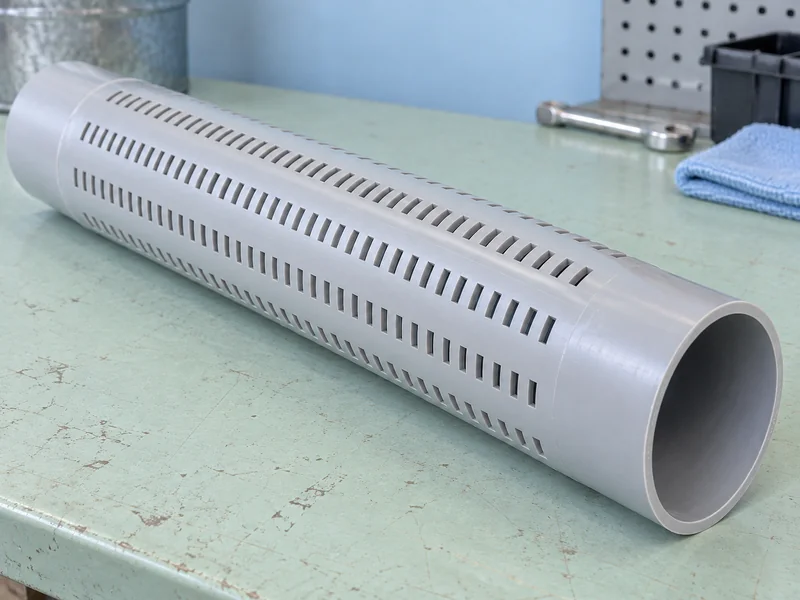
The open area of a slotted PVC pipe is determined by the clear area of each slot, the number of slots and the pipe surface area used as the reference. For approximately rectangular through-slots, total opening area can be estimated by adding slot width multiplied by slot length for every opening. Expressing that total as a percentage also requires a clearly stated pipe diameter and reference length.
Slot width alone cannot describe how open a pipe is. Two pipes can have the same width but very different total opening areas because their slot lengths, row counts, spacing or unslotted sections differ.
Why Can Pipes With Equal Slot Widths Have Different Total Opening Areas?
Slot width describes one opening dimension; open area describes how much passage all the openings provide together. Width helps determine which particles can pass through an individual slot. Total area describes a different geometric characteristic and must not replace the particle-retention requirement.
A pipe with many narrow openings can have more total open area than a pipe with fewer wide openings. However, that does not make the two screens equivalent for an application. The opening size, layout, surrounding material and structural requirements still need separate consideration.
The University of Florida’s publication on screened wells for agricultural irrigation treats slot opening selection and total open area as distinct design issues. Its hydraulic discussion also separates a screen’s transmitting capacity from the water-producing capability of the formation. This is why an opening-area calculation should never be presented as a guaranteed well yield.
Which Dimensions Belong in a Slotted Pipe’s Opening-Area Calculation?
First calculate the combined clear area of the slots, then divide by the cylindrical surface area for the declared reference section. Keep every length in the same unit. The following simple model assumes non-overlapping, approximately rectangular openings.
- Area of one slot: a = w × l.
- Total opening area for identical slots: A = N × w × l.
- Reference cylindrical surface area: S = π × D × L.
- Open-area percentage: P = 100 × A ÷ S.
Here, w is the clear slot width, l is the developed slot length along the surface, N is the number of slots, D is the stated reference diameter and L is the reference length. Using outside diameter produces an outside-surface convention. If a drawing specifies another convention, use that consistently and identify it in the calculation.
What If the Slots Are Not Rectangular?
Use the actual opening geometry rather than forcing every shape into width times length. Rounded ends, tapered cuts or incomplete breakthrough can change the clear area. For slots that vary in size, add their individual areas or group them by matching dimensions.
A saw cut also needs to extend through the wall to form a passage. A visible mark on the outside is not automatically an open slot. The relationship between blade movement and the finished opening is discussed further in our overview of blade systems in PVC pipe slotting machines.
What Does a Worked Example Look Like?
Consider an illustrative pipe section with a 160 mm outside diameter and a 1,000 mm active slotted length. Assume it contains 400 separate rectangular through-slots, each 1 mm wide and 30 mm long. These are example dimensions for explaining the arithmetic, not a recommended screen design.
| Quantity | Calculation | Result |
| Area per slot | 1 × 30 | 30 mm² |
| Total opening area | 400 × 30 | 12,000 mm² |
| Reference surface area | π × 160 × 1,000 | Approximately 502,655 mm² |
| Open-area percentage | 100 × 12,000 ÷ 502,655 | Approximately 2.39% |
If the same 400 slots are counted across a 1,200 mm reference section that includes plain ends, the percentage becomes approximately 1.99%. The openings have not changed. Only the denominator has changed, which explains why two apparently conflicting percentages can both be mathematically correct.
For meaningful comparisons, state whether the figure covers the active slotted region or the complete pipe length. Keep plain joint areas and uncut support bands visible in the drawing rather than hiding them inside a percentage.
How Do Slot Length, Count and Spacing Interact?
Increasing slot length or count increases geometric opening area when all other dimensions remain unchanged. Reducing spacing can fit more openings into a given section. Those changes also reduce the material left between cuts, so area and structural continuity must be considered together.
Does Adding Rows Always Increase the Percentage?
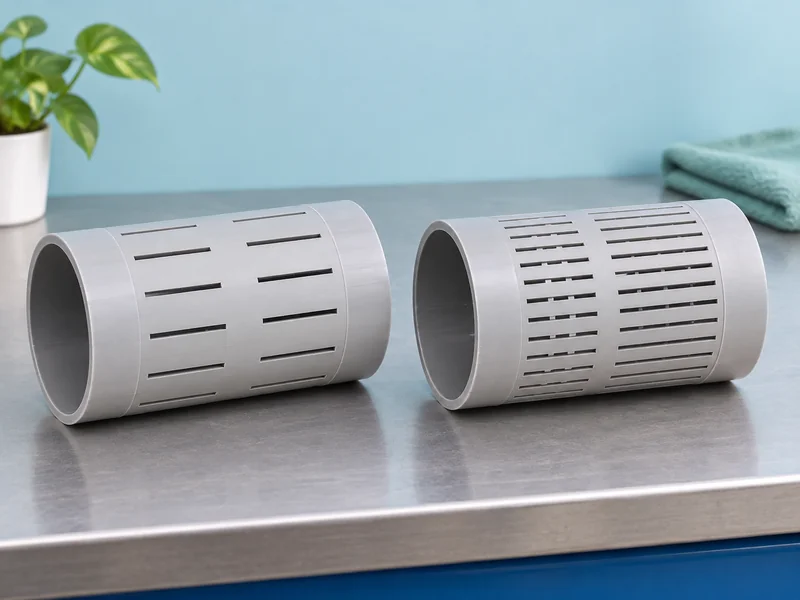
It does when additional rows contain additional openings within the same reference surface. It does not when the existing slots are merely redistributed into more rows without increasing their total area. Counting the actual openings avoids confusing visual density with calculated open area.
Do Staggered Slots Have More Open Area?
Staggering by itself does not change the area of a fixed number of identical slots. It changes the spatial arrangement. Any increase in open area comes from a change in count or dimensions made possible by the revised layout, not from the stagger alone.
The production challenge is then to reproduce that layout along the pipe. Our article on consistent slot patterns in PVC and PE pipes covers positioning and repeatability. Yuyu’s DS250-SA pipe slotting machine is a relevant equipment example for producing these patterned cuts.
Why Is Geometric Open Area Different From Effective Flow Area?
Geometric open area is calculated from the openings in the pipe. Effective flow conditions also depend on obstructions, deposits, the surrounding filter material and the hydraulic resistance of the slot passages. Consequently, a clean drawing-based percentage is not a complete description of performance in service.
A burr can partly obstruct an opening, and a narrow section through the wall may control passage even if the outside looks wider. Later, deposits or material around the pipe may further restrict access. It is useful to keep the manufactured geometry, the clear as-produced opening and the installed hydraulic behaviour as separate concepts.
For a chosen flow Q through an assumed available area A, the average entrance velocity is Q divided by A. This arithmetic helps explain why available area matters, but selecting an allowable velocity belongs to the application design. It does not establish the flow that a particular ground formation will deliver.
Why Not Maximise the Number of Slots?
Every slot removes material from the pipe wall. Increasing the open area can reduce the continuity of the remaining section and change its response to handling and service loads. The best pattern therefore satisfies the hydraulic and structural requirements together.
Pay attention to the uncut material between adjacent slots, along longitudinal bands and near pipe ends. An average calculated over the complete slotted section says little about a narrow band of material left between neighbouring cuts. Avoid assuming that a pattern suitable for one wall thickness remains suitable when the wall becomes thinner.
- Keep joint and end zones consistent with the product drawing.
- Distinguish slot pitch from the remaining solid distance between cuts.
- Consider both circumferential and axial spacing.
- Account for the actual slot-end geometry.
- Evaluate the finished slotted product rather than relying on the rating of the uncut pipe.
How Do Manufacturing Changes Affect the Calculation?
A calculation based on nominal dimensions assumes the machine produces those dimensions consistently. Tool condition, positioning, pipe support and cutting depth can change the result. A small width change repeated across many openings can alter the total area even when the pattern still looks familiar.
This is a reason to maintain a clear connection between the product drawing and the process recipe. Record the required width, developed length, count and reference section together. When one changes, revise the calculation rather than retaining an old percentage on a new pattern.
Round perforations need a different individual-opening formula, so they should not inherit rectangular-slot calculations. Our comparison of pipe slotting and pipe perforating explains that distinction. The broader Yuyu pipe slotting machine range provides equipment context for turning a defined pattern into repeatable production.
What Information Makes an Open-Area Figure Useful?
A useful figure includes its assumptions: pipe diameter, active or total length, slot dimensions, slot count and geometric convention. It also states whether it describes nominal geometry or clear manufactured openings. Without those details, a percentage is difficult to compare or reproduce.
The most practical approach is to define the opening size for the application, distribute enough openings within the available section, and preserve the required solid material. Then calculate the percentage using a transparent denominator. This keeps slot width, total open area and pipe strength connected without treating them as interchangeable quantities.