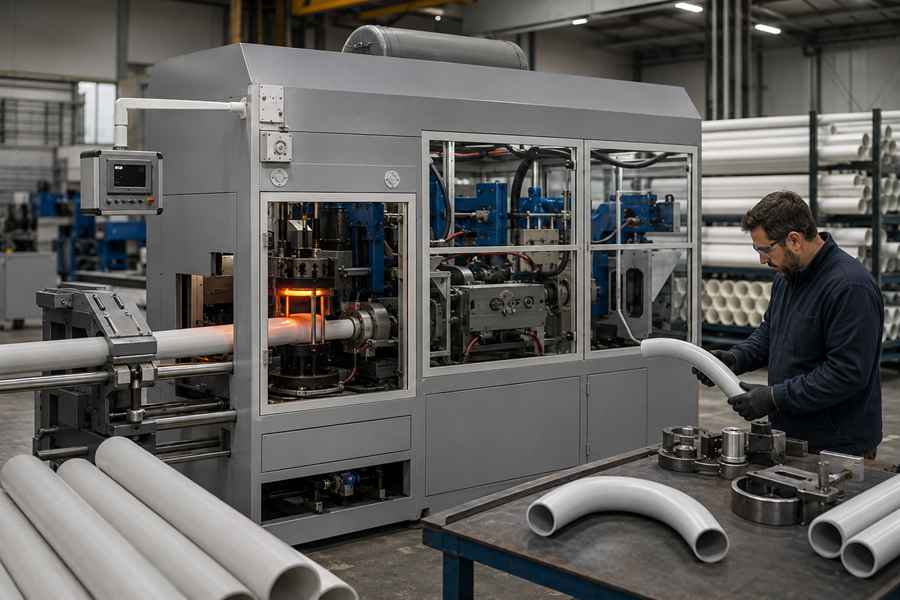
Springback is a common challenge in plastic pipe bending, as the pipe may open slightly after leaving the mold. Understanding its causes helps improve angle accuracy and reduce repeated adjustments.
What Is Plastic Pipe Springback?
Plastic pipe springback is the partial shape recovery that occurs after a formed pipe is released from the bending die, clamp, or support of a Pipe Bending Machine. The bend usually opens slightly, making the final angle smaller than the angle created during forming.
Springback may appear immediately after release or continue as the plastic pipe cools. The final angle should therefore be measured after a consistent cooling period rather than directly after unloading.
Main Causes of Plastic Pipe Springback
Plastic pipe springback is rarely caused by a single setting. Material behavior, heating quality, pipe dimensions, bend geometry, forming movement, cooling, and tooling stability usually work together to determine the final recovery amount.
| Main Cause | How It Influences Springback | Typical Result |
| Plastic material recovery | Elastic stress remains after forming and pushes the bend open | Reduced final angle |
| Heating condition | Insufficient or uneven softening creates unstable deformation | Angle variation and twisting |
| Pipe dimensions | Diameter and wall thickness change bending stiffness | Different recovery between pipe sizes |
| Bend geometry | Small radius and large angles increase internal stress | Larger angle deviation |
| Forming process | Fast movement or short holding leaves residual stress | Unstable bend shape |
| Cooling and tooling | Early release or poor alignment changes final shape | Delayed or uneven springback |
A Pipe Bending Machine may reach the programmed position correctly, but the cooled plastic pipe can still show angle deviation. The final cooled geometry should always be used to evaluate springback performance.
1. Elastic Recovery of Plastic Materials
During plastic pipe bending, the material experiences both permanent deformation and elastic deformation. The permanent part maintains the bend, while the elastic part stores stress and attempts to return the pipe toward its original shape after release.
Material properties strongly influence the recovery amount. Different plastic materials, formulations, fillers, pigments, or recycled content may change stiffness and heat response, resulting in different springback even under the same bending conditions.
Important factors include:
- Material stiffness:Higher stiffness usually increases recovery force after unloading.
- Material formulation:Additives and fillers may change deformation behavior.
- Batch variation:Small differences between production batches can affect final angle accuracy.
2. Insufficient or Uneven Heating
Heating determines whether the plastic pipe becomes flexible enough for controlled forming. When the heating temperature is insufficient, the plastic pipe stays rigid and retains greater elastic stress throughout bending.
Uneven heating creates different deformation levels around the pipe circumference. One side may become softer and stretch more, while the cooler side retains more recovery force.
Common heating-related causes include:
- Unequal temperature distribution around the pipe
- Incorrect heating-zone length
- Unstable pipe rotation during heating
- Incorrect heating settings for different wall thicknesses
The heating process should be matched with the plastic material, pipe diameter, wall thickness, and required bend radius.
3. Pipe Diameter and Wall Thickness
Pipe size directly affects bending resistance. Larger-diameter plastic pipes usually require more controlled heating because the temperature difference between the outer surface and inner wall can become greater.
Wall thickness also changes springback behavior. Thick-wall pipes may retain stronger internal stress, while thin-wall pipes may lose stability if internal support is insufficient.
| Pipe Condition | Possible Springback Effect |
| Large diameter | More difficult to heat uniformly |
| Thick wall | Higher residual stress after bending |
| Thin wall | Easier deformation but weaker shape retention |
| Uneven wall thickness | Different recovery around the bend |
Therefore, springback settings should not be copied between different pipe sizes, even when the material is the same.
4. Bend Radius and Bend Angle
Bend geometry determines how much stress is introduced into the plastic pipe. A tighter bend radius increases tension along the outer curve and creates stronger compression on the inner curve.
A larger bend angle also increases the total deformation area. More stored stress may remain inside the material, causing a greater difference between the formed angle and the final cooled angle.
Key geometry factors include:
- Bend radius
- Bend angle
- Pipe diameter
- Wall thickness
- Heated length
Using one compensation value for all bend conditions often leads to unstable results. Each common production specification should be verified separately.
5. Forming Speed and Holding Time
Bending speed affects how evenly the softened plastic material moves during forming. Excessive speed can create uneven stress distribution because the material has limited time to adjust.
Holding time is equally important. After reaching the required angle, the plastic pipe needs time to stabilize while remaining supported.
Possible causes include:
- Bending speed too high
- Sudden acceleration or stopping
- Insufficient holding period
- Early clamp release
A stable forming cycle usually produces lower springback variation than simply increasing machine speed.
6. Cooling and Tooling Stability
Cooling affects whether the formed shape can remain stable after release. A plastic pipe may appear solid on the outside while the internal material is still soft and able to recover.
Tooling alignment also plays an important role. Misaligned bending dies, clamps, guides, or internal supports can create uneven stress, causing one side of the pipe to spring back more than the other.
| Tool or Process Issue | Possible Effect |
| Misaligned bending die | Uneven angle recovery |
| Loose guide or clamp | Position variation between cycles |
| Insufficient cooling | Delayed springback |
| Uneven cooling | Bend distortion |
Stable tooling and controlled cooling are necessary for repeatable springback performance.
How to Reduce Plastic Pipe Springback
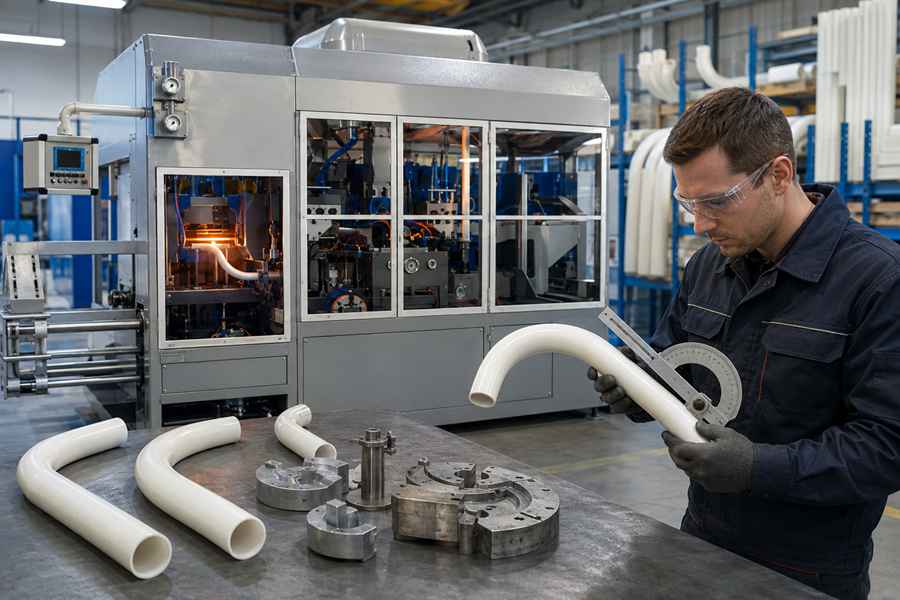
Springback control should address the actual cause rather than relying only on a larger forming angle. Stable heating, smooth movement, sufficient holding, balanced cooling, and specification-based recipes produce more repeatable bends.
Stabilize Heating and Forming
The heating zone should cover the complete bend and nearby transitions without softening unnecessary pipe length. Heater position, temperature, pipe rotation, heating time, and zone length should remain consistent across production cycles.
Bending movement should be smooth, while clamps and supporting tools should hold the pipe without crushing it. The formed bend should remain supported long enough to stabilize before release.
Use Tested Angle Compensation
Overbending forms the plastic pipe slightly beyond the required final position. After springback occurs, the pipe returns closer to the target angle.
The compensation value should be established through actual bending tests. Plastic material, diameter, wall thickness, bend radius, and required angle should each be included when saving the process recipe.
How to Measure Springback Correctly
Springback should be calculated from the difference between the formed angle and the final cooled angle. Measuring only the pipe immediately after release may miss delayed movement.
A consistent inspection process should record:
- Programmed machine angle
- Angle before tool release
- Angle immediately after release
- Final angle after cooling
- Holding and cooling time
- Plastic pipe specification
The pipe should be supported in the same position for every measurement. Different reference points or cooling periods can make stable production appear inconsistent.
Several consecutive bends should be checked. One adjusted sample cannot show whether the process will maintain the same angle during normal production.