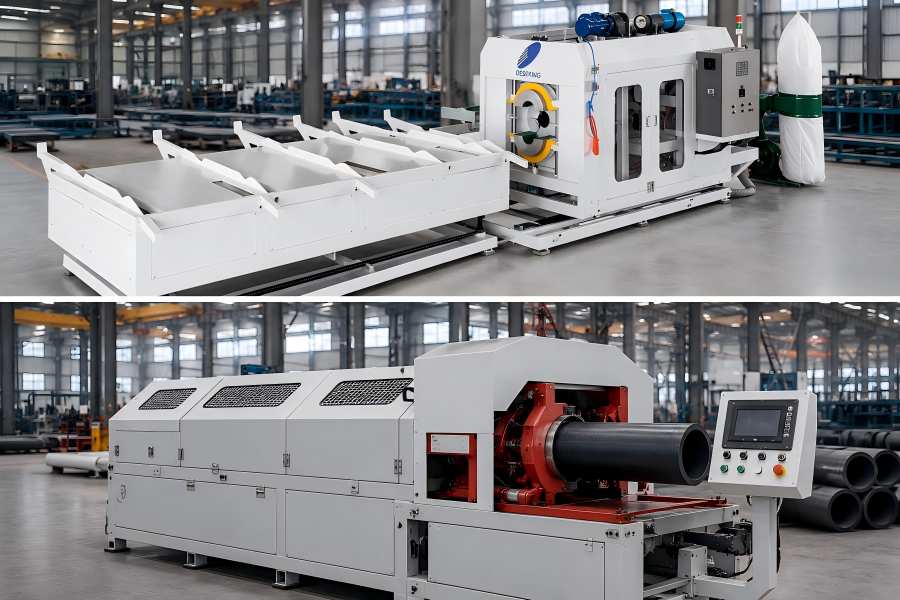
Pipe threading machines and pipe grooving machines both prepare pipes for connection, but they serve different purposes. Threading creates screw threads for fittings, while grooving forms grooves for mechanical couplings. Choosing the right machine depends on pipe material, application, installation needs, and industry standards.
What Is a Pipe Threading Machine?
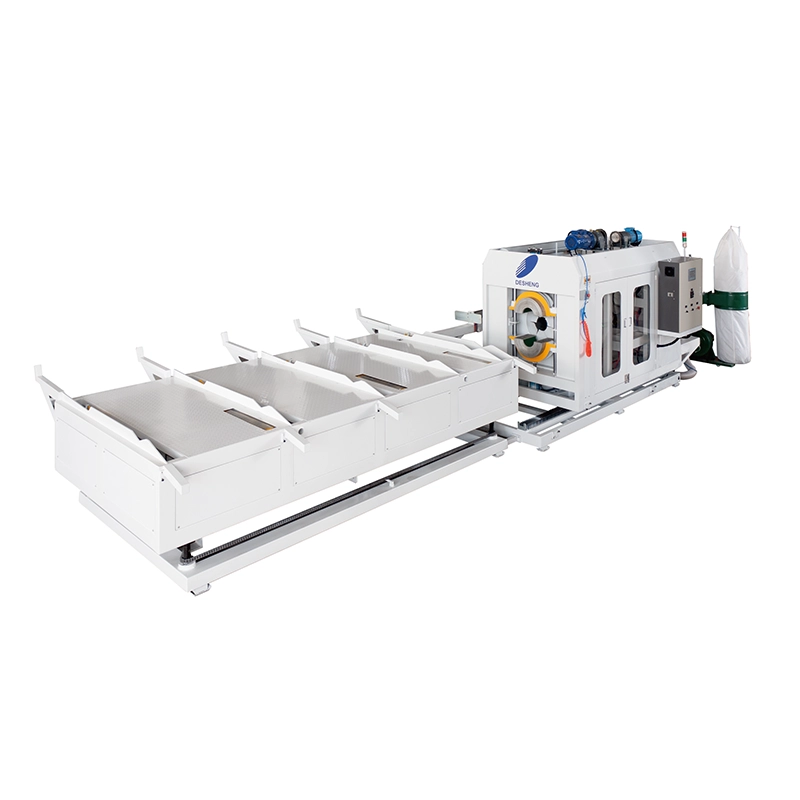
A pipe threading machine is specialized equipment used to create screw threads on the external or internal surface of a pipe. Through threaded connections, pipes and fittings can be mechanically connected thanks to these threads.
The machine removes material from the pipe surface using precision cutting tools, producing thread profiles that comply with recognized standards such as NPT, BSPT, BSPP, and other regional specifications.
Threaded pipe connections have been widely used for decades because they provide a practical and reliable joining method without requiring welding or complex assembly procedures.
Pipe threading machines are commonly used in:
- Water supply systems
- Gas distribution networks
- Plumbing installations
- Irrigation systems
- Industrial fluid transport
- Fire protection systems
- Compressed air pipelines
- Chemical processing facilities
Modern threading machines can process a wide range of materials, including:
- PVC pipes
- CPVC pipes
- HDPE pipes
- PE pipes
- Steel pipes
- Stainless steel pipes
- Aluminum pipes
- Brass pipes
Depending on production requirements, threading equipment can be classified into:
- Manual threading machines
- Portable threading machines
- Semi-automatic threading machines
- Fully automatic threading machines
- CNC pipe threading machines
As manufacturing technology advances, many companies are replacing traditional manual equipment with automated systems capable of delivering higher precision, faster production speeds, and improved consistency.
How Does a Pipe Threading Machine Work?
The threading process generally follows several steps to ensure precise and reliable thread formation.
Pipe Positioning
First, the pipe is put into the machine and clamped firmly. Proper positioning is critical because even slight movement during processing can negatively affect thread accuracy.
Advanced machines utilize hydraulic or pneumatic clamping systems to ensure stable pipe holding throughout the operation.
Tool Alignment
Thread-cutting tools are selected and adjusted according to the pipe diameter, wall thickness, and required thread standard.
Accurate alignment ensures that the thread profile is produced consistently along the entire threaded section.
Thread Cutting
The cutting head rotates around the pipe while gradually removing material from the pipe surface. Depending on the machine design, either the cutting tool or the pipe itself may rotate.
To produce the required thread shape, this stage necessitates exact control over cutting depth, feed rate, and speed.
Thread Formation
As the cutting process continues, the machine forms the complete thread profile including pitch, angle, and depth.
To maintain constant thread quality across lengthy production runs, these parameters are automatically controlled by contemporary CNC systems.
Inspection
The produced threads are examined for dimensional accuracy, surface smoothness, and adherence to necessary standards once threading is accomplished.
Some advanced systems integrate automatic measurement and quality-control functions that verify thread dimensions in real time.
The result is a threaded pipe end capable of connecting securely with compatible fittings and accessories.
What Is a Pipe Grooving Machine?
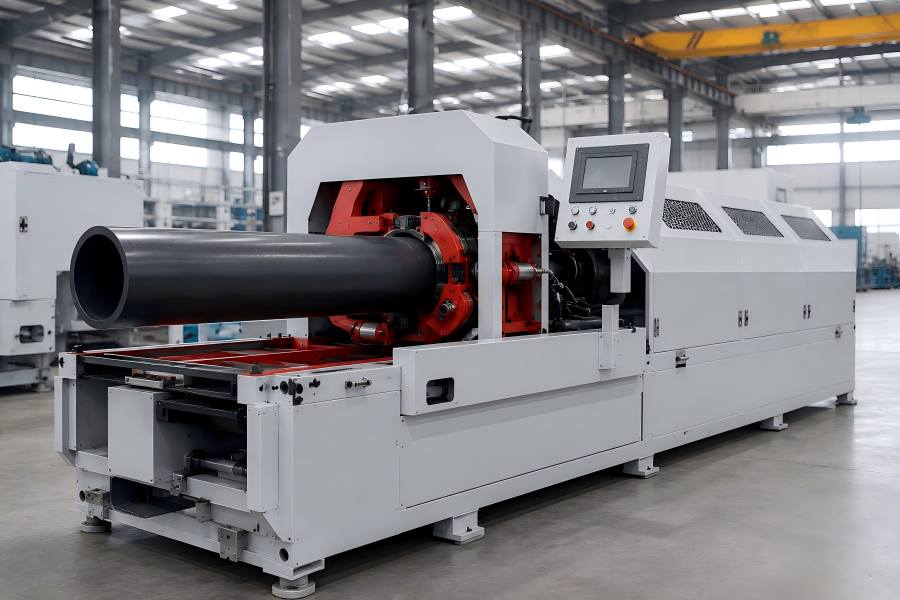
A pipe grooving machine is designed to create grooves near the end of a pipe. These grooves enable the pipe to be joined using mechanical couplings rather than threaded fittings.
Unlike threading, grooving does not create helical threads. Instead, the machine forms a circular channel around the pipe circumference that serves as an engagement point for a grooved coupling.
Grooved piping systems have become increasingly popular because they allow faster installation and simplified maintenance compared to traditional joining methods.
Pipe grooving machines are widely used in:
- Fire sprinkler systems
- HVAC systems
- Cooling water networks
- Industrial process piping
- Mining operations
- Municipal infrastructure
- Commercial buildings
- Power generation facilities
There are two primary grooving methods:
Roll Grooving
The most common method, where rollers gradually form a groove by cold-forming the pipe wall.
Cut Grooving
A machining process that removes material to create the groove, typically used for specific applications or heavy-wall pipes.
Roll grooving is generally preferred because it is faster, cleaner, and more economical for most installations.
How Does a Pipe Grooving Machine Work?
Pipe grooving machines typically use a cold-forming process that reshapes the pipe wall without significant material removal.
Pipe Clamping
The pipe is securely positioned between drive rollers and grooving rollers.
Proper alignment is essential to ensure groove uniformity around the entire circumference.
Pipe Rotation
The machine rotates the pipe at a controlled speed while maintaining consistent pressure from the grooving rollers.
Stable rotation ensures groove dimensions remain uniform.
Groove Formation
A specially designed grooving roller gradually presses into the pipe wall.
As pressure increases, the pipe material deforms and forms the required groove shape.
Groove Shaping
The machine continues applying pressure until the groove reaches the specified depth and width.
Automated systems precisely control groove dimensions to meet coupling requirements.
Quality Verification
After processing, groove dimensions are inspected to ensure compatibility with mechanical couplings.
Proper groove formation is essential for maintaining sealing performance and connection reliability.
Because roll grooving reshapes material instead of cutting it away, it generally produces less waste and requires less maintenance than threading operations.
Key Differences Between Pipe Threading and Pipe Grooving Machines
Despite the fact that both devices get pipes ready for assembly, their functions and uses are very different.
| Feature | Pipe Threading Machine | Pipe Grooving Machine |
| Primary Function | Create screw threads | Create circumferential grooves |
| Connection Type | Threaded fittings | Mechanical couplings |
| Material Removal | Yes | Minimal or none |
| Processing Method | Cutting | Roll forming |
| Typical Applications | Plumbing, gas, irrigation | Fire protection, HVAC |
| Installation Speed | Moderate | Fast |
| Tool Wear | Higher | Lower |
| Pipe Flexibility | Limited | Better flexibility |
| Production Waste | Higher | Lower |
| Maintenance Requirements | Higher | Lower |
These differences influence production efficiency, installation costs, system performance, and long-term maintenance requirements.
Advantages of Pipe Threading Machines
Pipe threading machines remain one of the most important pipe processing solutions across numerous industries.
Strong Mechanical Connections
Threaded joints create durable mechanical connections capable of withstanding pressure and vibration when properly installed.
This makes threading particularly suitable for water, gas, and utility applications.
Established Industry Standard
Threaded connections have been used for generations and remain accepted in many national and international standards.
Their widespread use makes fittings and accessories readily available.
Wide Compatibility
Threaded pipes can connect to valves, elbows, tees, reducers, couplings, and countless other components.
This flexibility simplifies system design and installation.
Suitable for Smaller Pipe Sizes
For plumbing systems with small and medium diameters, threaded connectors are particularly useful.
Many residential and commercial installations rely heavily on threaded joints.
Cost-Effective Equipment
Basic threading machines often require relatively modest capital investment, making them attractive for small manufacturers and contractors.
High Precision with Modern Technology
Today’s CNC threading systems can achieve exceptional accuracy, reducing rejection rates and improving overall product quality.
Limitations of Pipe Threading Machines
Despite their advantages, threading systems also present several challenges.
Material Removal
The cutting process removes material from the pipe wall, potentially reducing wall thickness in the threaded area.
Slower Processing Speed
Thread cutting generally requires more processing time than roll grooving.
For large-volume projects, this may affect productivity.
Tool Wear
Thread-cutting dies and inserts gradually wear during operation.
Regular replacement and maintenance are necessary to maintain thread quality.
Potential Leakage Risks
Improper thread formation or installation can create leakage points.
Sealants or thread tapes are often required.
Increased Maintenance Requirements
Threading machines contain more cutting components that require lubrication, adjustment, and periodic replacement.
Operator Skill Requirements
Manual and semi-automatic threading operations often depend heavily on operator experience.
Incorrect settings can affect thread quality and production consistency.
Advantages of Pipe Grooving Machines
Pipe grooving technology has become increasingly popular due to its installation efficiency and operational flexibility.
Faster Installation
Grooved couplings can be assembled significantly faster than threaded joints.
This reduces project completion times.
Lower Labor Costs
Shorter installation times translate directly into reduced labor expenses.
Large construction projects particularly benefit from this advantage.
Minimal Material Loss
Since roll grooving deforms rather than removes material, waste generation is extremely low.
Flexible Connections
Grooved couplings can accommodate vibration, thermal expansion, and minor movement.
This flexibility improves system durability.
Simplified Maintenance
Individual sections can be removed and replaced without extensive disassembly.
Maintenance personnel can complete repairs more efficiently.
Excellent Sealing Performance
Modern grooved couplings utilize advanced gasket technology that provides reliable leak resistance.
Scalability for Large Systems
Grooved systems are particularly effective for large-diameter piping networks where threaded connections become impractical.
Limitations of Pipe Grooving Machines
Grooving technology has several advantages, but it isn’t appropriate for every situation.
Coupling Dependency
Grooved systems require specialized couplings and gaskets.
This may increase component costs compared to standard threaded fittings.
Higher Equipment Investment
Industrial grooving machines often involve greater upfront investment than entry-level threading equipment.
Regulatory Restrictions
Certain applications or regional standards may require threaded, welded, or flanged connections instead of grooved joints.
Groove Precision Requirements
Improper groove dimensions can compromise coupling performance and sealing reliability.
Material Compatibility Considerations
Not all pipe materials respond equally well to grooving processes, requiring careful evaluation during equipment selection.
Typical Applications of Pipe Threading Machines
Pipe threading machines remain essential in numerous sectors.
Plumbing Systems
Residential, commercial, and institutional plumbing installations frequently use threaded pipe connections for reliable assembly, easy replacement, and compatibility with standard valves and fittings.
Gas Distribution Networks
Threaded fittings provide reliable connections in low- and medium-pressure gas systems, where sealing performance, dimensional accuracy, and safe installation are especially important.
Agricultural Irrigation
Many irrigation systems utilize threaded plastic pipes because they are easy to assemble, remove, maintain, and adapt to different field layouts.
Water Treatment Facilities
Treatment plants often incorporate threaded valves, gauges, pumps, and instrumentation, requiring accurate pipe threads for stable connection and long-term system operation.
Industrial Utility Systems
Compressed air, cooling water, drainage, and auxiliary service lines commonly use threaded connections for flexible installation, equipment connection, and routine maintenance.
Plastic Pipe Manufacturing
Specialized plastic pipe threading machines produce threaded PVC, CPVC, and HDPE products for construction, agriculture, infrastructure, and industrial fluid transport applications.
Typical Applications of Pipe Grooving Machines
Grooving technology dominates many large-scale piping projects.
Fire Protection Systems
Fire sprinkler systems represent one of the largest markets for grooved piping technology, offering fast installation, reliable sealing performance, and simplified maintenance.
HVAC Systems
Heating and cooling networks benefit from rapid assembly, flexible connections, vibration absorption, and easier maintenance throughout the system’s operational lifespan.
Industrial Processing Plants
Manufacturing facilities often utilize grooved piping for utility and process distribution systems, where efficiency, durability, and reduced downtime are critical.
Mining Operations
Grooved systems perform well in environments subject to vibration, heavy equipment movement, and demanding operating conditions requiring dependable pipe connections.
Commercial Construction
Large office buildings, hospitals, airports, and shopping centers frequently employ grooved piping systems to accelerate installation and reduce labor costs.
Municipal Infrastructure
Water distribution networks and public utility projects increasingly adopt grooved connections for efficient installation, long-term reliability, and maintenance convenience.
Which Machine Is Better for Plastic Pipes?
The answer depends largely on the desired connection method.
For many plastic pipe manufacturers, pipe threading machines are the preferred solution because PVC, CPVC, and other thermoplastic systems often utilize threaded fittings.
Plastic pipe threading machines are specifically engineered to process softer materials without causing cracking, excessive deformation, or dimensional instability.
Specialized cutting parameters ensure smooth thread formation while maintaining pipe integrity.
Grooving is more commonly associated with metal pipe systems, particularly steel pipes used in fire protection and HVAC applications. However, some specialized plastic piping systems may also utilize grooved connections under specific conditions.
For manufacturers producing threaded plastic pipe products, investing in a dedicated plastic pipe threading machine typically provides the best balance of productivity, quality, and market compatibility.
Considerations for Selecting Between the Two Machines
Pipe Material
Different materials respond differently to cutting and forming processes, so material hardness, wall thickness, brittleness, and deformation resistance should be carefully evaluated.
Pipe Diameter
Large-diameter pipes often favor grooved systems because installation is faster, while smaller pipes may be more suitable for threaded connections.
Production Volume
High-volume operations benefit from automated equipment that maximizes throughput, reduces manual labor, improves consistency, and supports continuous production schedules.
Industry Standards
Project specifications frequently determine whether threaded or grooved connections are permitted, making compliance with local and international standards essential.
Installation Speed Requirements
Projects with tight schedules often favor grooved systems because mechanical couplings can significantly reduce assembly time and labor requirements.
Maintenance Expectations
Systems requiring frequent modifications may benefit from grooved connections, which allow easier disassembly, replacement, inspection, and future pipeline expansion.
Available Budget
Initial investment, tooling costs, maintenance expenses, coupling costs, labor savings, and long-term operating costs should all be evaluated.
Future Expansion Needs
Grooved systems often simplify future system modifications and expansions, while threaded systems may be more suitable for smaller fixed installations.