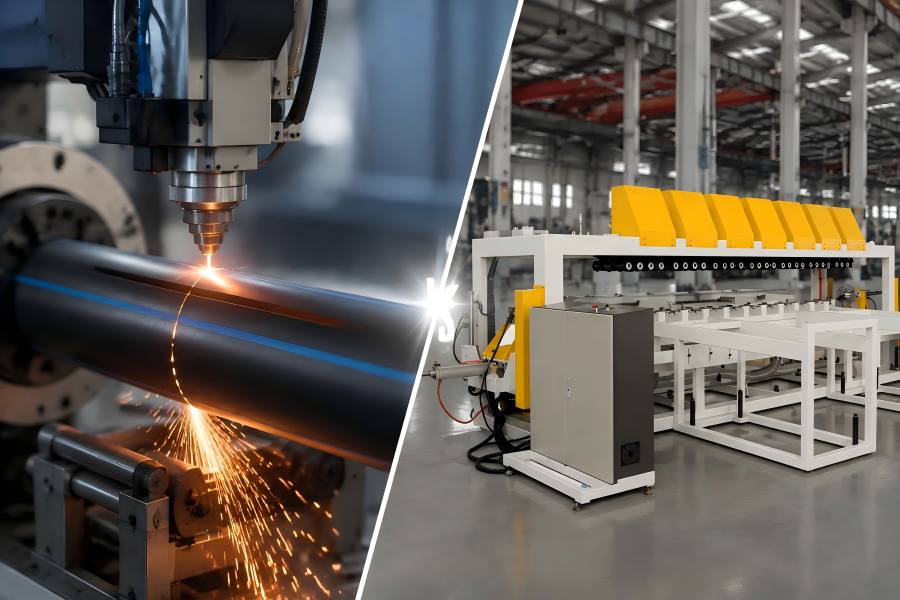
The growing use of PVC, HDPE, PE, and PP pipes increases demand for efficient slotting solutions. Laser and mechanical slotting machines offer different advantages in precision, cost, and efficiency, helping manufacturers choose suitable technology for drainage, filtration, and irrigation applications.
What Is a Plastic Pipe Slotting Machine?
A plastic pipe slotting machine creates precise narrow slots on plastic pipes, allowing water or air flow while maintaining pipe strength. Unlike perforating machines, it produces elongated openings instead of round holes.
Slotted plastic pipes are commonly used in:
- Groundwater well screens
- Agricultural drainage systems
- Underground water collection
- Filtration pipelines
- Industrial liquid separation systems
The quality of slots directly affects:
- Filtration efficiency
- Water flow performance
- Pipe durability
- Installation reliability
For this reason, selecting the appropriate slotting technology has become an important decision for plastic pipe manufacturers.
How Does a Mechanical Pipe Slotting Machine Work?
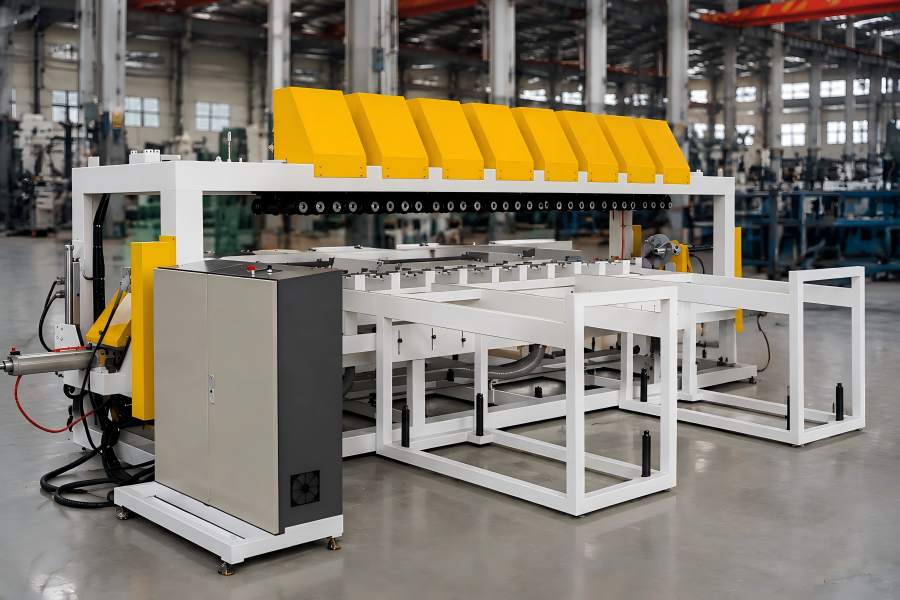
A mechanical pipe slotting machine uses physical cutting tools to create slots on plastic pipes. It is one of the most commonly used solutions for PVC, PE, and HDPE pipe processing due to its stable performance and relatively low investment cost.
The typical processing process includes three steps:
Pipe Positioning
The plastic pipe is fixed by a clamping system to ensure stable movement during processing.
Accurate positioning helps maintain consistent slot spacing and prevents uneven cutting.
Mechanical Cutting
Rotating blades, milling cutters, or saw-type tools remove material from the pipe surface to create slots.
The slot dimensions are controlled by:
- Cutting tool design
- Processing speed
- Pipe movement distance
- Machine settings
Pipe Movement and Indexing
The machine controls pipe rotation and movement to achieve specific slot arrangements.
Automatic mechanical slotting machines can process different pipe diameters by adjusting cutting tools, positioning systems, and slotting parameters.
Mechanical slotting technology remains widely used because it provides:
- Reliable production performance
- Simple operation
- Lower equipment investment
- Easy maintenance
How Does a Laser Pipe Slotting Machine Work?
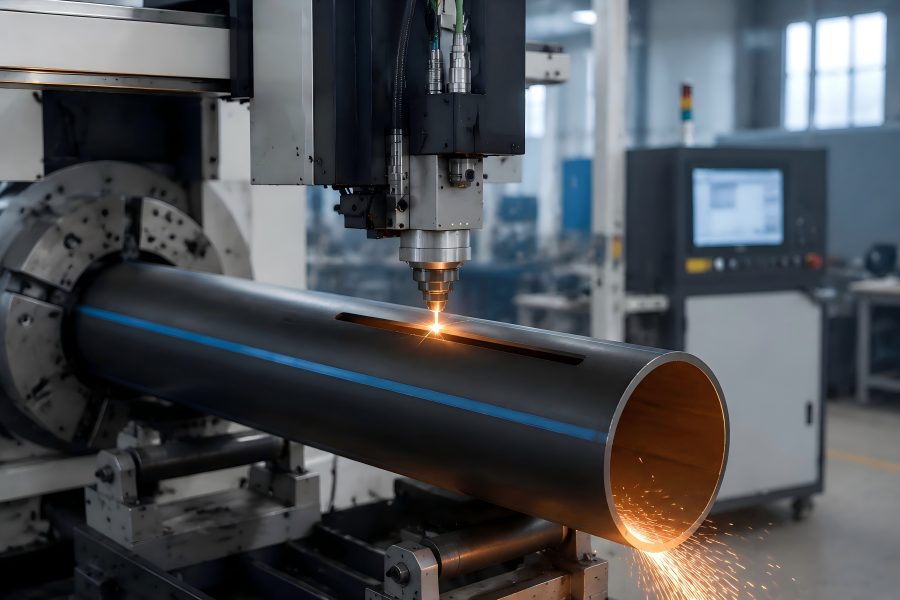
A laser pipe slotting machine uses a focused laser beam to create precise slots on plastic pipes through non-contact processing.
Instead of using physical cutting tools, laser energy melts or vaporizes the pipe material at the processing point.
The process includes:
Pipe Positioning
The pipe is accurately fixed inside the machine to ensure stable processing.
Laser Cutting
A high-energy laser beam creates slots according to programmed parameters.
The system can control:
- Slot width
- Slot length
- Slot spacing
- Slot patterns
Digital Control
Laser slotting machines use CNC control systems to adjust processing parameters quickly.
Because no mechanical cutting tools are required, manufacturers can switch between different slot designs without replacing blades or changing tooling.
Laser technology is ideal for applications where the following are required:
- High slot precision
- Complex slot patterns
- Customized pipe designs
Laser Slotting vs Mechanical Slotting: Processing Accuracy Comparison
Accuracy is one of the most important differences between laser and mechanical slotting technologies.
Laser Slotting Accuracy
Laser slotting provides excellent precision because there is no direct contact between the cutting system and the pipe surface.
Its advantages include:
- Narrow slot width
- Consistent slot spacing
- Complex slot patterns
- Reduced mechanical stress
This makes laser systems suitable for applications requiring strict filtration performance, such as high-performance well screen pipes.
Another advantage is flexibility. Manufacturers can adjust slot designs through software settings without replacing physical cutting tools, making laser systems suitable for customized production.
Mechanical Slotting Accuracy
Mechanical slotting machines also provide reliable accuracy, especially for standard plastic pipe applications.
Their advantages include:
- Stable cutting performance
- Simple operation
- Proven processing technology
- Easy maintenance
However, mechanical cutting accuracy may be influenced by:
- Tool wear
- Cutting speed
- Material hardness
- Operator adjustment
For standard PVC drainage pipes and general filtration pipes, mechanical slotting accuracy is usually sufficient and provides better cost efficiency.
Production Efficiency Comparison
Production efficiency is another important factor when selecting a plastic pipe slotting solution. The suitable technology depends on production volume, slot design requirements, and manufacturing flexibility.
Mechanical Slotting Production Efficiency
Mechanical slotting machines are widely used in mass production because they provide stable processing speed and reliable operation.
Their advantages include:
- Fast processing speed
- Continuous production capability
- Lower equipment investment
For manufacturers producing large quantities of standard slotted pipes, mechanical systems provide a practical and economical solution.
Production speed varies based on several key factors, including:
- Pipe diameter
- Number of slots
- Cutting method
- Machine automation level
Automatic mechanical slotting machines can reduce manual operation requirements and improve production consistency.
For example, manufacturers producing standard PVC drainage pipes or HDPE well screen pipes often prefer mechanical slotting equipment because it can maintain stable output while controlling production costs.
Laser Slotting Production Efficiency
Laser slotting technology provides higher flexibility, especially when manufacturers frequently change pipe specifications or slot patterns.
Because laser systems do not require physical cutting tool replacement, operators can quickly adjust:
- Slot dimensions
- Slot spacing
- Slot patterns
- Processing programs
This makes laser slotting suitable for customized pipe production and small-batch manufacturing.
However, for simple and high-volume production, mechanical slotting machines may still provide better cost efficiency because of their lower operating investment.
Cost Comparison Between Laser and Mechanical Slotting Machines
Machine investment is an important factor when selecting a pipe slotting solution. Mechanical slotting machines usually provide lower costs for standard plastic pipe production, while laser systems offer higher precision and flexibility with a larger initial investment.
Mechanical Slotting Machine Cost
Mechanical slotting machines use cutting tools and relatively simple mechanical structures, making them more affordable.
Typical investment range:
- Standard mechanical slotting machines: USD 5,000–20,000
- Automatic mechanical slotting systems: USD 20,000–50,000
Their main advantages include:
- Lower purchase cost
- Simple operation
- Affordable spare parts
- Easy maintenance
They are suitable for large-volume production of standard PVC, PE, and HDPE slotted pipes.
Laser Slotting Machine Cost
Laser slotting machines require advanced components, including laser sources, CNC control systems, optical systems, and cooling units.
Typical investment range:
- Standard laser slotting machines: USD 40,000–80,000
- Customized laser systems: USD 80,000–150,000+
Although the initial investment is higher, laser systems reduce dependence on cutting tools and provide greater flexibility for customized slot designs.
For manufacturers producing standard pipes in large quantities, mechanical slotting machines often provide better cost efficiency. For high-precision applications, laser slotting technology can provide greater long-term value.
Maintenance Requirements Comparison
Maintenance requirements have a direct impact on the long-term operating costs and stability of pipe slotting machines. Different technologies require different maintenance approaches to maintain processing accuracy.
Mechanical Slotting Machine Maintenance
Mechanical slotting machines require regular inspection and replacement of:
- Cutting blades
- Saw tools
- Bearings
- Drive components
Since cutting tools directly contact the pipe, wear occurs during operation. However, maintenance is relatively simple, spare parts are affordable, and troubleshooting can usually be completed quickly.
Laser Slotting Machine Maintenance
Laser slotting machines use non-contact processing, reducing the need for traditional cutting tool replacement.
However, they require regular maintenance of:
- Laser source
- Optical components
- Cooling system
- Control system
Laser systems usually require more specialized technical support but provide stable processing accuracy and lower tool wear during long-term operation.
Overall, mechanical machines offer easier and lower-cost maintenance, while laser systems provide higher precision and flexibility with more advanced maintenance requirements.
Material Compatibility for Plastic Pipes
Different plastic pipe materials have different flexibility, hardness, and processing characteristics, which affect slotting accuracy and equipment selection.
Choosing the right slotting technology helps maintain consistent slot quality and prevent pipe damage.
PVC Pipe
PVC pipes are mainly used in:
- Drainage
- Electrical protection
- Water supply systems
Because PVC has relatively stable rigidity and is easy to process, mechanical slotting machines are widely used for standard PVC slotted pipe production.
For customized slot designs or higher precision requirements, laser slotting provides additional flexibility.
HDPE Pipe
HDPE pipes are mainly used in:
- Water wells
- Irrigation systems
- Industrial pipelines
Due to their high toughness and flexibility, HDPE pipes require stable positioning and accurate processing control.
Both technologies can process HDPE pipes, but laser systems are better suited for applications requiring:
- Narrow slot designs
- Higher accuracy
- Customized patterns
PE Pipe
PE pipes are commonly used in irrigation, water distribution, and filtration applications.
Mechanical slotting is suitable for standard PE pipe production, while laser technology provides advantages for customized slot structures and complex designs.
PP-R Pipe
PP-R pipes are mainly used for hot and cold water systems.
Because of their different material properties, proper processing parameters are required to maintain slot quality and prevent deformation.
Application Comparison: Which Technology Fits Different Industries?
The best pipe slotting technology depends on application requirements, production volume, and slot specifications. Mechanical slotting machines are widely used for standard production, while laser slotting machines are suitable for applications requiring higher precision and flexibility.
Groundwater Well Screen Pipes
Well screen pipes require accurate slot dimensions to achieve effective filtration performance.
Mechanical slotting machines are suitable for standard well screen pipe production because they provide:
- Stable performance
- High production efficiency
- Lower manufacturing costs
Laser slotting machines are preferred for applications requiring:
- Fine slot designs
- Complex patterns
- Higher filtration accuracy
Agricultural Drainage Pipes
Agricultural drainage systems usually require large-volume production with standard slot designs.
Mechanical slotting machines are commonly selected because they provide:
- High production efficiency
- Lower investment costs
- Easy maintenance
For customized drainage solutions with special slot requirements, laser systems provide greater flexibility.
Industrial Filtration Pipes
Industrial filtration applications require precise slot sizes to control liquid flow and filtration performance.
Laser slotting machines provide advantages in:
- Higher slot accuracy
- Flexible slot patterns
- Consistent processing quality
They are suitable for demanding applications such as:
- Water treatment
- Mining filtration
- Chemical separation systems
Custom Plastic Pipe Manufacturing
Manufacturers producing different pipe sizes and customized slot designs often require flexible processing solutions.
Laser slotting machines provide advantages through:
- Quick parameter adjustment
- Reduced tooling requirements
- Complex slot capability
Mechanical slotting machines remain a cost-effective option for manufacturers focused on high-volume standard production.
Laser Slotting vs Mechanical Slotting Machine: Advantages Comparison
| Factor | Laser Slotting Machine | Mechanical Slotting Machine |
| Processing Method | Laser cutting | Mechanical cutting tools |
| Precision | Very high | High for standard applications |
| Initial Cost | Higher | Lower |
| Maintenance | Specialized maintenance | Simple maintenance |
| Tool Replacement | No cutting tools | Requires tool replacement |
| Complex Slot Patterns | Excellent | Limited |
| Mass Standard Production | Suitable | Excellent |
| Small Batch Customization | Excellent | Moderate |
Which Technology Is Better for Plastic Pipes?
Different plastic pipe manufacturers may require different solutions. The better choice depends on production requirements, pipe materials, slot specifications, and investment goals.
Choose Mechanical Slotting Machines If:
- Producing standard PVC or HDPE slotted pipes
- Large production volume is required
- Lower investment is preferred
- Simple slot patterns are sufficient
Mechanical systems provide reliable performance, easy maintenance, and excellent cost efficiency for conventional applications.
Choose Laser Slotting Machines If:
- High slot precision is required
- Complex slot designs are needed
- Customized production is common
- Premium pipe products are manufactured
Laser systems provide greater flexibility and advanced processing capability for specialized applications.