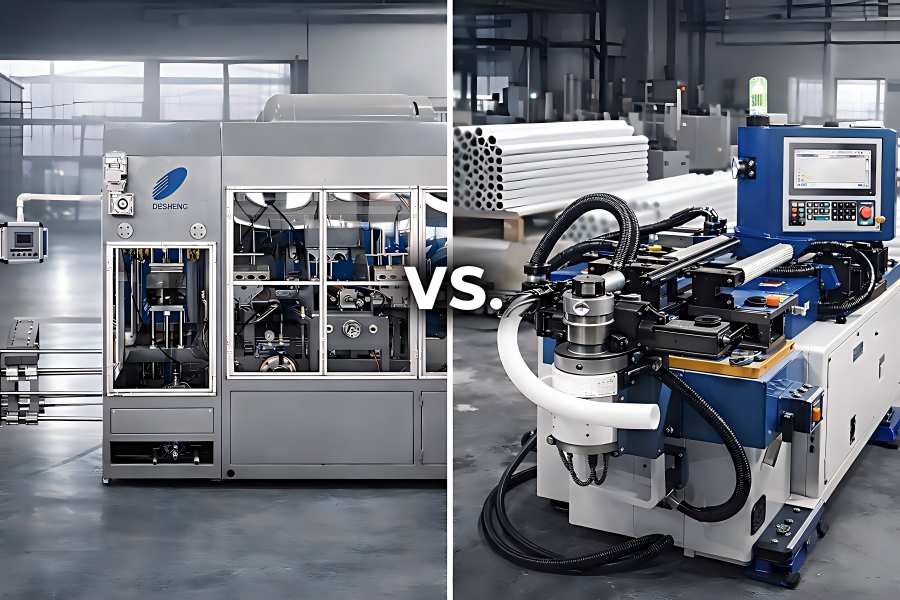
Selecting the appropriate pipe bending machine depends on your production objectives. Fully automatic machines focus on reducing manual work and improving efficiency, while CNC pipe bending machines focus on precise digital control. Some machines combine both features, so buyers should choose based on product complexity, labor needs, and consistency requirements.
A Quick Comparison
| Factor | Fully Automatic Pipe Bending Machine | CNC Pipe Bending Machine |
| Main Focus | Automation level | Digital control method |
| Labor Requirement | Lower | Varies by machine configuration |
| Precision | Good to high | High |
| Repeatability | High | High |
| Complex Bend Capability | Good to high | High |
| Production Efficiency | High | Medium to high |
| Operator Skill Dependency | Lower during operation | Higher for programming and setup |
| Best for | High-volume automated production | Precision and complex bending |
| Is Combination Possible? | Yes | Yes |
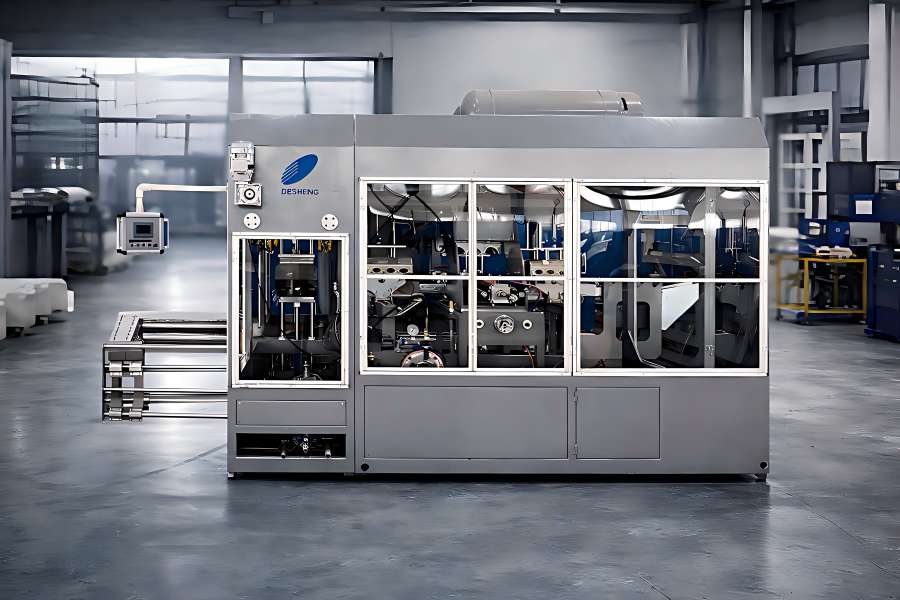
What Is a Fully Automatic Pipe Bending Machine?
A fully automatic pipe bending machine is a machine designed to complete most or all bending operations automatically, with minimal manual intervention. Depending on the configuration, it may automatically handle:
- Pipe feeding
- Positioning
- Rotation
- Bending sequence
- Angle control
- Repeated cycle execution
The main feature of a fully automatic machine is its ability to reduce operator involvement. Once the program or setup is confirmed, the machine can run the bending cycle with high consistency.
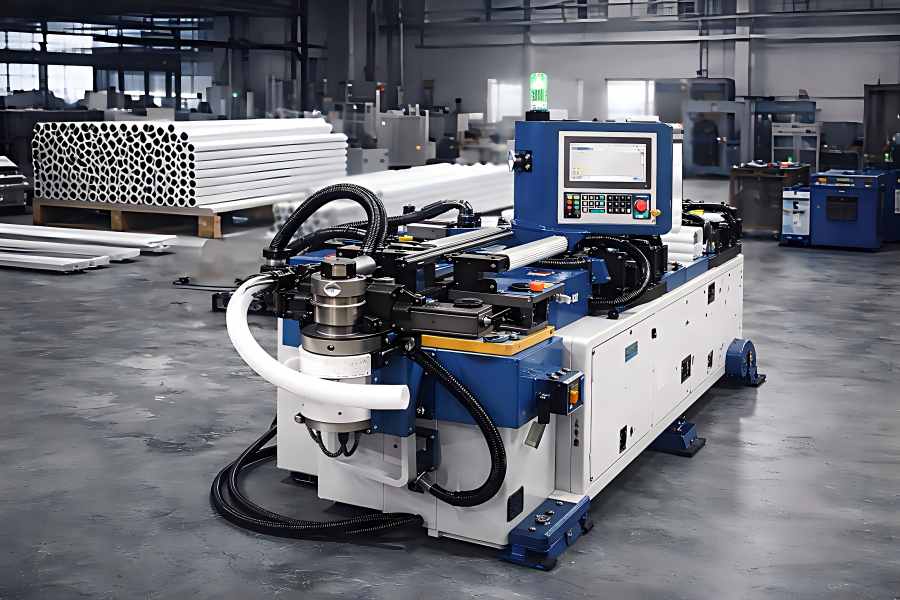
What Is a CNC Pipe Bending Machine?
A CNC pipe bending machine is equipment that uses computer numerical control to control bending parameters. CNC control allows the machine to process programmed instructions for:
- Bend angle
- Feeding length
- Rotation angle
- Sequence order
- Repeated multi-bend operations
The main feature of a CNC machine is precision control through digital programming. It improves repeatability and makes it easier to handle more complex bending requirements.
Fully Automatic vs CNC: Are They the Same?
This is where many buyers become confused. The answer is that they are not exactly the same, although there can be some overlap.
- Fully automatic describes how much of the process is automated
- CNC describes how the machine is controlled
That means:
- A machine can be CNC but not fully automatic
- A machine can be fully automatic and CNC at the same time
- A machine may also be automatic without advanced CNC features, depending on design
For example, a machine may use CNC to control bend angle and feed length, but still require the operator to load the pipe manually or start certain steps by hand. In that case, it is CNC, but not necessarily fully automatic in the full production sense.
Another machine may automatically feed, rotate, and bend pipes according to a digital program. That machine is both fully automatic and CNC.
What Are the Key Advantages of a Fully Automatic Pipe Bending Machine?
A fully automatic pipe bending machine is usually chosen by manufacturers that want to reduce manual work and improve cycle consistency.
Lower Labor Dependence
One of the biggest advantages is that the machine handles more of the process automatically. This reduces the need for constant operator adjustment and makes production less dependent on individual skill levels.
Higher Production Efficiency
Because the machine can execute repeated cycles more smoothly, fully automatic equipment often improves production speed, especially in batch manufacturing.
Better Process Consistency
When feeding, rotation, and bending are automated, there is less variation from one part to another. This is valuable for businesses producing large quantities of similar products.
Better Suitability for Continuous Production
Factories that run long production schedules or high-volume orders often benefit from fully automatic systems because they support more stable workflow and lower manual interruption.
Reduced Human Error
The more steps the machine controls automatically, the less chance there is for setup mistakes, inconsistent positioning, or repeated manual error.
What Are the Key Limitations of a Fully Automatic Pipe Bending Machine?
Although fully automatic machines offer many benefits, they are not always the ideal solution for every buyer.
Higher Initial Cost
A fully automatic machine often includes more complex hardware and automation systems, which raises the purchase price.
May Be More Than Some Buyers Need
If production volume is low or product variation is very high, a full automation setup may not always provide the best return.
More Complex Setup for Some Applications
In certain cases, the machine’s automation features must be configured carefully to match product design. This may require stronger technical support during installation and operation.
Space and Integration Requirements
Fully automatic machines may require more floor space or better coordination with upstream and downstream processes.
What Are the Key Advantages of a CNC Pipe Bending Machine?
A CNC pipe bending machine is often chosen by businesses that need better control, repeatability, and flexibility in bending operations.
High Precision
CNC control allows accurate programming of bend angles, feeding positions, and rotation sequences. This supports more precise and repeatable output.
Strong Capability for Complex Bends
If your products require multiple bends, different angles, or more advanced sequences, CNC control can make those operations easier and more stable.
Better Program Management
CNC systems often allow users to store programs for different products. This improves setup speed and supports easier product switching.
Improved Repeatability
For repeat production, CNC machines help maintain consistency across batches, which is especially important for custom or technical components.
Better Fit for Precision-Focused Production
Manufacturers that value dimensional accuracy and standardized output often prefer CNC-controlled equipment.
What Are the Key Limitations of a CNC Pipe Bending Machine?
CNC machines also present certain limitations depending on the production context.
CNC Does Not Always Mean Fully Automated
Some buyers assume CNC automatically means complete production automation. In reality, some CNC machines still require manual handling steps.
Technical Skill Requirements
Operators and technicians may need more training to manage programming, parameter adjustment, and troubleshooting.
Higher Cost Than Basic Machines
Compared with simpler manual or semi-automatic machines, CNC systems usually cost more because of their digital control capability.
Electronic System Dependence
Because CNC relies on control systems, sensors, and electronic components, maintenance may require stronger technical knowledge.
Which Machine Is Better for High-Volume Production?
If your business produces large volumes of similar bent pipe products, a fully automatic pipe bending machine is often the better choice.
This is especially true when:
- Production runs are repetitive
- Labor reduction is a priority
- Cycle time matters
- You want stable output over long shifts
- Product variations are limited or standardized
In this environment, automation can create major value by reducing handling time and improving consistency.
However, if the fully automatic machine also includes CNC control, the value becomes even greater. That combination supports both automation and precision.
Which Machine Is Better for Complex Bending Requirements?
If your products involve multi-angle bending, varied dimensions, or customized designs, a CNC pipe bending machine may be more suitable.
This is especially true when:
- Products require multiple bend sequences
- Dimensional repeatability is critical
- You produce customized components
- You switch between different products frequently
- Program storage and editing are important
CNC systems are particularly helpful when precision and flexibility matter more than simple repetitive automation alone.
Which Machine Is Better for Reducing Labor?
A fully automatic pipe bending machine usually has the advantage when the main goal is labor reduction.
This is because full automation can reduce:
- Manual feeding
- Repeated positioning work
- Operator involvement in each cycle
- Dependence on skilled manual adjustment
If your factory faces rising labor costs or wants to reduce operator dependency, full automation may be the stronger solution.
Still, it is important for buyers to note that certain CNC machines can also achieve a high degree of automation. The best answer may be a CNC fully automatic machine rather than choosing one concept in isolation.
Which Machine Is Better for Precision?
When precision is the main priority, CNC pipe bending machines usually have the advantage because they are built around digital control of movement and parameters.
CNC control helps with:
- Exact bend angles
- Controlled feed length
- Accurate rotation positioning
- Repeated multi-step bending sequences
For products where dimensional accuracy directly affects assembly, installation, or final product quality, CNC capability is very important.
Which Machine Is Better for Small and Medium Factories?
For small and medium factories, the answer depends on production model more than company size.
A fully automatic pipe bending machine may be a better fit if:
- You produce standard products in batches
- You want to reduce labor reliance
- You need higher efficiency with less manual work
A CNC pipe bending machine may be a better fit if:
- You produce custom or varied products
- You need higher bending precision
- You want flexibility in program settings
- You handle different order types frequently
In many cases, small and medium factories should avoid choosing based on the machine label alone and instead focus on actual workflow.
Which Machine Has Better Long-Term Value?
Long-term value depends on what your business needs most.
A fully automatic pipe bending machine may offer better long-term value when:
- Production volume is high
- Labor reduction has clear financial value
- You need consistent, repetitive output
- Workflow automation is a long-term goal
A CNC pipe bending machine may offer better long-term value when:
- Precision reduces scrap and rework
- Complex products are part of your business
- Flexibility helps you serve more customers
- Stored programs reduce setup time over repeated orders
For many manufacturers, the best long-term value actually comes from a machine that combines both features: a fully automatic CNC pipe bending machine.
Common Business Scenarios
Scenario 1: Standardized Batch Production
A factory produces large numbers of similar bent parts every day. Labor efficiency and cycle consistency are key priorities. In this situation, a fully automatic pipe bending machine is usually the more suitable choice.
Scenario 2: Custom Multi-Bend Products
A manufacturer produces customized pipe components with different angles and multiple bending steps. Precision and programming flexibility matter most. In this case, a CNC pipe bending machine may be more suitable.
Scenario 3: Factory Upgrade for Higher Efficiency
A business wants to modernize production, reduce operator dependence, and improve consistency. Here, a fully automatic CNC solution may provide the best overall value.
Scenario 4: Medium-Volume Technical Production
A company produces repeatable technical parts that require good accuracy, but not always full automation. A CNC machine with partial automation may be the most practical balance.