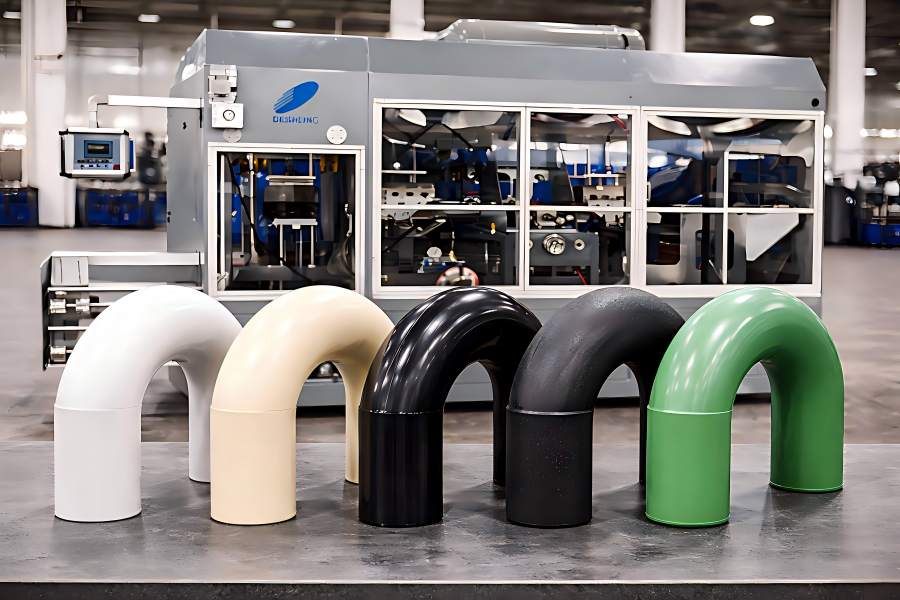
In plastic pipe manufacturing, many products require accurate bends, curves, or custom shapes. Modern pipe bending machines can process various plastic pipes, but bending performance depends on material type, wall thickness, diameter, heating control, and tooling. The right machine improves consistency, efficiency, and overall product quality.
A Quick Comparison
| Pipe Type | Bending Difficulty | Heat Control Requirement | Typical Applications |
| PVC | Low | Moderate | Conduit, drainage, plumbing |
| CPVC | Medium | Moderate to High | Hot water, industrial piping |
| PE | Medium | High | Irrigation, water supply |
| HDPE | High | High | Gas, drainage, infrastructure |
| PPR | Medium | High | Hot and cold water systems |
By Pipe Materials
PVC Pipes
Among plastic pipes, PVC pipes are the most commonly processed types that can be bent using a pipe bending machine. In many cases, they are also one of the easiest and most economical options for bending.
PVC is widely used because it offers:
- Good rigidity
- Relatively stable forming behavior
- Broad application range
- Cost-effectiveness
- Good dimensional consistency
When heated correctly, PVC pipes can be bent into different shapes for applications such as:
- Electrical conduit
- Drainage systems
- Plumbing installations
- Ventilation systems
- Customized fittings and connectors
PVC pipe bending usually requires controlled heating to soften the material without overheating it. If the temperature is insufficient, cracking may occur during bending; if it is too high, the pipe surface may burn, deform, or suffer a loss of structural quality.
A well-designed pipe bending machine can bend PVC pipes with good angle repeatability and clean appearance, making PVC one of the most popular materials for pipe bending equipment.
CPVC Pipes
CPVC pipes can also be bent by a pipe bending machine, although they generally require more careful process control than standard PVC pipes.
CPVC is often selected for applications requiring better heat resistance than PVC, such as:
- Hot water systems
- Industrial fluid transport
- Chemical processing lines
- Specialized building systems
Compared with PVC, CPVC may need more accurate temperature management during bending. This is because the material can be less forgiving if the heat input is not balanced properly. Improper processing may lead to:
- Surface damage
- Stress marks
- Reduced bend uniformity
- Material weakening
Pipe bending machines used for CPVC products typically benefit from:
- Stable heating control
- Accurate mold support
- Controlled bending speed
- Consistent cooling after forming
For manufacturers serving industrial or high-temperature piping markets, CPVC compatibility can be an important machine selection factor.
PE Pipes
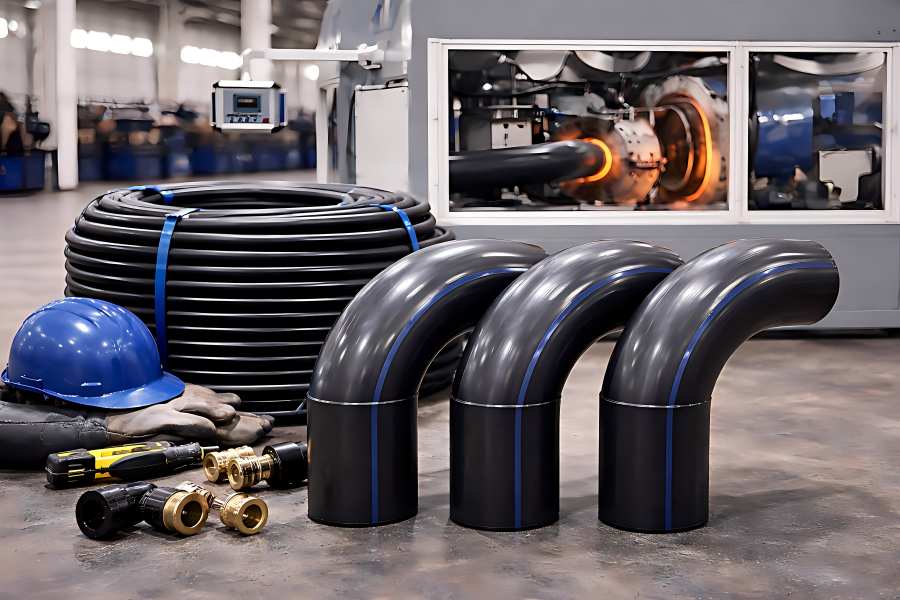
PE pipes are another common category that can be bent by a pipe bending machine. Polyethylene offers good flexibility and is widely used in many piping applications.
PE pipes are often found in:
- Water supply systems
- Irrigation projects
- Agricultural pipelines
- Low-pressure industrial systems
- Protective piping applications
Because PE is generally more flexible than rigid plastics like PVC, it may seem easier to bend. However, that flexibility also means process control is still important. Without proper support during heating and forming, PE pipes may experience:
- Oval deformation
- Surface marks
- Shape instability after bending
- Inconsistent bend angles
The machine must therefore provide stable forming support and proper temperature control. PE pipes can often be bent successfully, but the quality of the result depends on how well the machine manages softening and shape retention.
HDPE Pipes
HDPE pipes are widely used in modern infrastructure and are also suitable for bending in many cases. However, HDPE bending usually requires more attention to material behavior and machine design.
HDPE is commonly used for:
- Water supply pipelines
- Gas distribution systems
- Industrial piping
- Drainage projects
- Cable protection applications
HDPE offers strong durability and good impact resistance, but it can also be more demanding during the bending process, especially for thicker walls or larger diameters. Manufacturers must control:
- Heating uniformity
- Bending pressure
- Internal support if needed
- Cooling stability
- Shape recovery behavior
If not processed correctly, HDPE pipes may spring back, flatten, or lose dimensional consistency after bending. For this reason, a pipe bending machine for HDPE products should have:
- Reliable heating control
- Good mold matching
- Stable clamping and support
- Repeatable motion control
For manufacturers producing HDPE pipe products, machine quality is especially important because the material’s performance benefits must be matched by consistent forming accuracy.
PPR Pipes
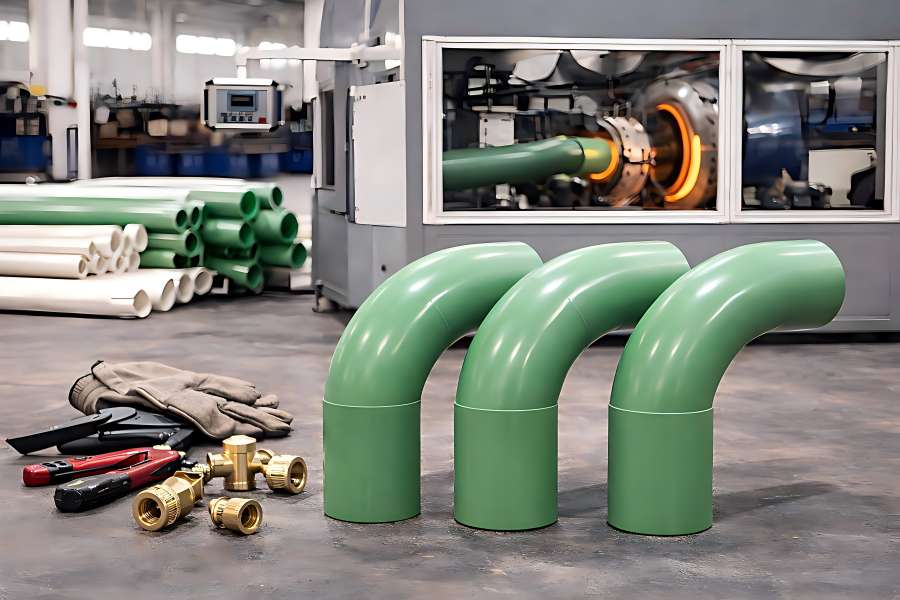
PPR pipes can also be bent by a pipe bending machine, depending on the specific product design and production requirement.
PPR is widely used in:
- Hot and cold water supply systems
- Building piping installations
- Residential and commercial plumbing systems
PPR has good thermal performance, but when bending it, the process must be carefully controlled to protect both shape and material integrity. Poor heating or uneven forming pressure may affect the final bend quality and possibly the pipe’s long-term service reliability.
Pipe bending machines used for PPR products should provide:
- Stable heating distribution
- Accurate mold fit
- Controlled cycle timing
- Reliable cooling after bending
PPR pipe bending is often used in specialized or custom production rather than general commodity pipe manufacturing. For this reason, buyers who work with this material often value customization and process control more than simple speed alone.
By Pipe Applications
Electrical Conduit Pipes
Electrical conduit pipes are one of the most common product categories processed by pipe bending machines, especially in PVC-based production.
These pipes are often bent for:
- Wall and ceiling routing
- Corner transitions
- Installation efficiency
- Preformed conduit assemblies
- Customized electrical system layouts
Because electrical conduit products often require repeatable angles such as 45 degrees, 90 degrees, or custom installation bends, pipe bending machines are highly valuable in this area. The machine can improve:
- Angle consistency
- Surface quality
- Production speed
- Labor efficiency
- Standardization of finished products
While the conduit itself may be made from PVC, CPVC, or other plastic materials, this application category deserves attention because it is one of the strongest commercial uses for pipe bending equipment.
Plumbing and Water Supply Pipes
Many plastic plumbing and water supply pipes can also be bent, depending on the material, wall thickness, and system requirements.
These may include:
- PVC water pipes
- CPVC plumbing pipes
- PPR water supply pipes
- Certain PE and HDPE products
In some cases, bending allows manufacturers or installers to reduce the number of fittings in a system. This can improve installation efficiency and reduce connection points. However, bending quality is especially important in fluid transport applications, because poor bending may affect:
- Internal flow stability
- Dimensional integrity
- Pressure performance
- Long-term reliability
For this reason, pipe bending machines intended for plumbing-related products should provide accurate and repeatable forming control.
Drainage Pipes
Drainage pipes are another important product type that may be bent by a pipe bending machine. These products are widely used in:
- Building drainage
- Underground drainage systems
- Landscaping projects
- Agricultural water management
- Municipal infrastructure
Depending on the pipe material and wall structure, bending may be used to create installation-friendly shapes or customized routing sections. Smooth-wall drainage pipes are generally easier to bend than heavily profiled pipes, but the exact result depends on the machine and the product design.
In this application, manufacturers usually care about:
- Maintaining cross-sectional shape
- Avoiding flattening
- Preserving drainage function
- Achieving smooth bend appearance
A suitable pipe bending machine can help manufacturers produce drainage pipe products more efficiently and with better consistency than manual methods.
By Pipe Size and Design
Corrugated Plastic Pipes
Some corrugated plastic pipes can also be bent, but they are usually more challenging than smooth-wall pipes.
Corrugated pipes are widely used in:
- Drainage systems
- Cable protection
- Agricultural projects
- Underground conduit applications
Their profiled surface means they behave differently during forming. The bending process must account for:
- Uneven wall geometry
- Local stress concentration
- Shape retention across corrugations
- Risk of deformation at crest or valley sections
Not all pipe bending machines are suitable for corrugated products. If the manufacturer needs to bend corrugated pipes, the machine may require:
- Customized tooling
- Stronger support design
- More precise heating zone control
- Process adjustment for pipe profile structure
This is a good example of why buyers should not assume all plastic pipes can be bent with the same machine configuration.
Large-Diameter Plastic Pipes
Large-diameter plastic pipes can also be bent in some cases, but the process becomes more complex as diameter increases.
Larger pipes may require:
- Stronger machine structure
- More stable support
- More accurate heating distribution
- Better mold design
- Controlled bending force
- Extended cooling time
Large-diameter bent pipe products may be used in:
- Infrastructure systems
- Drainage engineering
- Industrial projects
- Utility routing applications
Because these products are more demanding, equipment cost and engineering requirements are typically higher. Buyers in this segment often need customized pipe bending machines rather than standard models.
Small-Diameter Plastic Pipes
Small-diameter plastic pipes are also commonly processed by pipe bending machines, especially in high-volume production.
These may include:
- Small conduit pipes
- Precision routing pipes
- Appliance-related plastic tubes
- Lightweight plumbing components
Although smaller pipes require less force, they also demand good positional accuracy. Even slight instability in heating or clamping can affect the quality of the finished bend. This is especially true in high-speed production where consistency matters.
For small-diameter products, machine advantages often include:
- Fast cycle time
- Stable angle control
- Lower material waste
- Better repeatability in batch production
Customized Plastic Pipe Products
In addition to standard straight pipes, many pipe bending machines are used for customized plastic pipe products.
These may include:
- Preformed installation components
- Special-shaped industrial pipes
- Multi-angle routing products
- Customized connectors
- Application-specific pipe assemblies
In these cases, the material may be PVC, CPVC, PE, HDPE, PPR, or another plastic, but the real challenge is not only the material. It is the combination of shape complexity, dimensional requirement, and production repeatability.
A flexible pipe bending machine helps manufacturers serve these markets by supporting:
- Different pipe sizes
- Multiple bending angles
- Customized molds
- Programmed bending sequences
- Better product consistency
For many machinery buyers, this flexibility is one of the biggest reasons to invest in automatic or semi-automatic pipe bending equipment.
What Key Factors Affect Whether Plastic Pipes Are Bendable?
Although many plastic pipes can be bent, actual process suitability depends on more than just material name. Buyers should evaluate several practical factors.
Material Softening Behavior
Different plastics soften differently under heat. The machine must match the material’s temperature response.
Pipe Wall Thickness
Thicker walls often require more heating time and stronger support. Thin walls may deform more easily if not controlled properly.
Pipe Diameter
Larger diameters are harder to bend consistently and may need more advanced equipment.
Bending Radius
A tighter radius places more stress on the pipe and usually requires more precise process control.
End-Use Requirements
If the bent pipe will be used in pressure systems, visible installations, or demanding technical applications, quality control becomes even more important.
Tooling and Mold Design
Proper mold matching is essential to support the pipe and maintain shape during bending.
Heating System Performance
Stable and even heating is critical for avoiding cracks, burns, and dimensional problems.