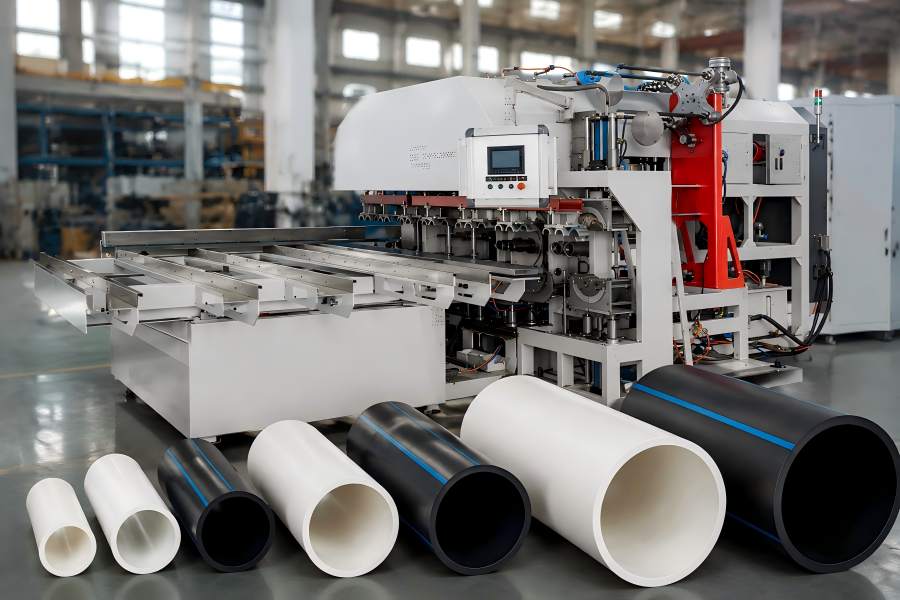
Plastic pipe belling machines expand pipe ends to form socket connections for efficient joining. Their pipe diameter range depends on machine structure, heating method, material, and production requirements, typically covering sizes from around 16 mm to over 1200 mm.
Understanding Pipe Size Range of a Belling Machine
A pipe belling machine expands pipe ends to create socket connections for easier installation. Its processing range depends on machine design, heating capacity, pipe material, and production requirements.
Different models are developed for various pipe sizes, from small electrical conduits and irrigation pipes to large municipal drainage and industrial pipelines. Choosing the right diameter range ensures stable production and better equipment efficiency.
Typical Pipe Diameter Range for Belling Machines
Different plastic pipe belling machines are designed for various production scales, from small electrical conduits and water pipes to large-diameter municipal and industrial pipelines.
The following table shows common pipe diameter ranges for different belling machine categories.
| Belling Machine Type | Typical Pipe Diameter Range | Main Applications |
| Small-Diameter Pipe Belling Machine | 16–160 mm | Electrical conduits, small water pipes, agricultural irrigation pipes |
| Medium-Diameter Pipe Belling Machine | 110–500 mm | Drainage pipes, water supply pipes, construction pipelines |
| Large-Diameter Pipe Belling Machine | 400–1200 mm | Municipal drainage, sewage systems, industrial pipelines |
| Heavy-Duty Custom Belling Machine | 800–1600+ mm | Large infrastructure projects, special engineering applications |
Most standard plastic pipe belling machines used in PVC pipe production are designed around common market sizes from 50 mm to 630 mm.
Larger systems above 800 mm usually require customized mechanical structures because of increased pipe weight, heating requirements, and forming force.
Pipe Diameter Capability Based on Pipe Material
The material of the pipe also affects the belling process. Different plastics have different melting temperatures, flexibility, and forming characteristics, which influence the required machine configuration.
PVC Pipe Belling Machine Size Range
PVC pipes are the most common products processed by belling machines because PVC has stable dimensional accuracy and good forming performance.
Typical PVC pipe belling machines can handle:
- Small PVC pipes: 16–110 mm
- Medium PVC pipes: 110–500 mm
- Large PVC pipes: 500–1200 mm
PVC pressure pipes, drainage pipes, and sewer pipes often require socket connections, making belling equipment a standard part of PVC pipe production lines.
For example, a manufacturer producing residential drainage pipes may only require a machine handling 50–250 mm pipes, while a municipal pipe producer may need equipment capable of processing 400–1000 mm diameters.
HDPE and PE Pipe Belling Capability
Compared with PVC, HDPE and PE pipes have higher flexibility and different thermal properties. Although PE pipes are often connected by butt fusion or electrofusion, certain applications still require socket forming.
HDPE belling machines usually focus on medium and large diameter ranges.
| Pipe Material | Common Belling Diameter Range | Typical Uses |
| PVC | 16–1200 mm | Water supply, drainage, sewage |
| HDPE | 50–1000 mm | Industrial pipelines, municipal systems |
| PE | 32–800 mm | Gas pipes, water pipes, irrigation |
| PP | 20–500 mm | Chemical pipelines, drainage systems |
For HDPE and PE pipes, the machine must provide accurate heating control because excessive heating may affect pipe strength, while insufficient heating can lead to incomplete socket formation.
Factors That Determine the Maximum Pipe Diameter
Although a machine may be advertised with a specific diameter range, actual production capability depends on several technical factors.
Machine Structure and Frame Strength
Large diameter pipes require stronger mechanical structures because their weight increases significantly.
For example:
- A 110 mm PVC pipe can usually be handled by compact equipment.
- A 630 mm pipe requires stronger clamping and supporting systems.
- A 1200 mm pipe requires heavy-duty frames and customized tooling.
The machine frame must maintain stability during heating, expansion, and cooling processes to ensure accurate socket dimensions.
Heating System Capacity
Heating is one of the most important factors affecting pipe size capability.
Small pipes require lower heating power and shorter heating times. Large diameter pipes need:
- Higher heating capacity
- Larger heating zones
- More accurate temperature control
- Longer heating cycles
For large pipes, infrared heating systems are commonly used because they provide uniform heat distribution around the pipe circumference.
Pipe Wall Thickness
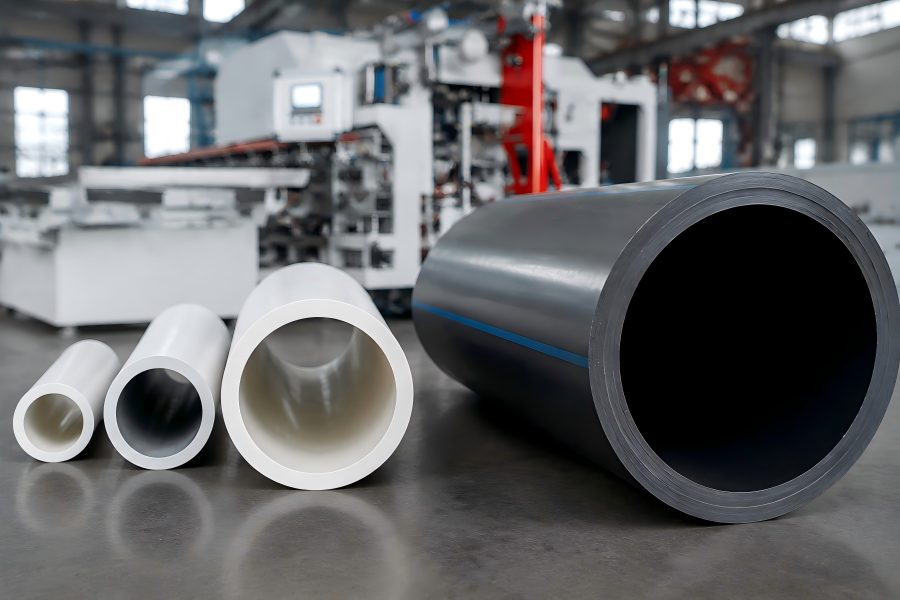
Pipe diameter alone does not determine machine requirements. Wall thickness is also important.
A 400 mm pipe with a thick wall may require more heating power than a thinner 500 mm pipe.
Typical relationships include:
| Pipe Diameter | Common Wall Thickness Range | Equipment Requirement |
| 20–110 mm | 1.5–10 mm | Compact heating and forming system |
| 110–500 mm | 5–40 mm | Medium-duty industrial equipment |
| 500–1000 mm | 20–80 mm | Heavy-duty heating and clamping system |
| 1000 mm+ | 50 mm+ | Customized large pipe equipment |
Manufacturers should evaluate both diameter and wall thickness when selecting a belling machine.
Small Diameter Pipe Belling Machines (16–160 mm)
Small diameter belling machines are mainly used for lightweight plastic pipes.
Common products include:
- Electrical conduit pipes
- Small drainage pipes
- Agricultural irrigation pipes
- Residential water pipes
These machines usually feature:
- Compact structure
- Faster heating cycles
- Lower energy consumption
- Easy operation
For example, a PVC pipe manufacturer producing 20 mm, 32 mm, and 50 mm pipes for electrical applications may select a small automatic belling machine rather than a large industrial system.
Although small diameter equipment has lower production capacity compared with large machines, it provides high flexibility for manufacturers producing multiple small-size products.
Medium Diameter Pipe Belling Machines (110–500 mm)
Medium diameter machines represent the most widely used category in plastic pipe manufacturing.
They are commonly applied for:
- Building drainage systems
- Underground water pipelines
- Agricultural irrigation
- Industrial fluid transportation
Popular pipe sizes include:
- 160 mm
- 200 mm
- 250 mm
- 315 mm
- 400 mm
- 500 mm
These machines usually balance production efficiency and investment cost.
Many PVC pipe manufacturers choose equipment within this range because it covers a large portion of commercial and infrastructure applications.
Large Diameter Pipe Belling Machines (500–1200 mm)
Large diameter belling machines are designed for heavy-duty applications where pipes are used in large-scale infrastructure projects.
Typical applications include:
- Municipal sewage systems
- Stormwater drainage networks
- Industrial wastewater pipelines
- Underground engineering projects
Large-diameter pipes require special attention to:
- Pipe transportation
- Automatic loading systems
- Heating uniformity
- Socket accuracy
- Cooling time
A large diameter belling machine often includes additional supporting equipment such as automatic pipe feeding systems, cooling devices, and inspection systems.
How to Select the Right Belling Machine Based on Pipe Size
Choosing a suitable belling machine requires more than simply checking the maximum pipe diameter. Manufacturers need to consider present production requirements as well as future product expansion plans.
Key selection factors include:
Production Diameter Range
The first consideration is the pipe size range.
A manufacturer producing only 110–315 mm pipes does not necessarily need a machine designed for 1000 mm pipes. Oversized equipment may increase investment costs and reduce production efficiency.
Future Product Expansion
Many manufacturers choose machines with wider diameter compatibility to support future market development.
For example:
A company currently producing 160 mm PVC pipes may select equipment capable of handling 160–500 mm pipes if it plans to expand into larger drainage pipe markets.
Production Speed Requirements
Pipe diameter affects cycle time.
Large pipes usually require:
- Longer heating time
- Longer forming time
- More cooling time
Therefore, manufacturers should evaluate output requirements together with pipe size.
Pipe Material Compatibility
Different materials require different temperature control strategies.
A machine designed mainly for PVC may require modification when processing PE or PP pipes.
Automatic vs Semi-Automatic Belling Machines for Different Pipe Sizes
The automation level also influences pipe size handling.
| Machine Type | Suitable Pipe Size | Advantages |
| Semi-Automatic Belling Machine | 16–500 mm | Lower investment, flexible operation |
| Fully Automatic Belling Machine | 50–1200 mm | Higher efficiency, stable quality |
| Customized Heavy-Duty Belling Machine | 800 mm+ | Designed for special large pipes |
Semi-automatic machines are well suited to small and medium-sized manufacturers handling multiple product specifications.
Fully automatic systems are preferred by large pipe factories requiring continuous production and consistent socket quality.
Custom Belling Machine Solutions for Special Pipe Sizes
Standard belling machines cover most common pipe sizes, but some projects require customized solutions.
Customization may include:
- Special diameter range
- Larger pipe support systems
- Customized heating methods
- Automatic loading and unloading
- Different socket designs
- Higher production speed requirements
For example, manufacturers producing extra-large drainage pipes above 1200 mm may require a specially designed belling machine with reinforced structures and customized tooling.
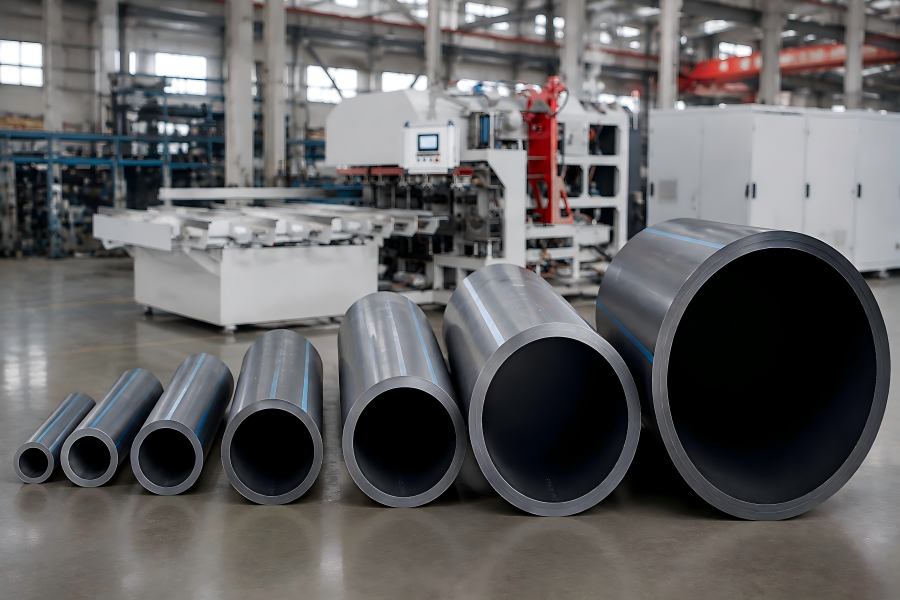
Common Pipe Sizes and Recommended Belling Machine Range
The following table provides guidance on equipment selection based on different pipe sizes.
| Pipe Diameter | Recommended Belling Machine Category | Typical Applications |
| 20–63 mm | Small Pipe Belling Machine | Electrical and irrigation pipes |
| 75–160 mm | Small/Medium Machine | Residential drainage and water pipes |
| 200–400 mm | Medium Machine | Construction and municipal pipelines |
| 500–800 mm | Large Machine | Sewer and industrial drainage |
| 900–1200 mm | Heavy-Duty Machine | Large infrastructure pipelines |
| Above 1200 mm | Customized System | Special engineering projects |