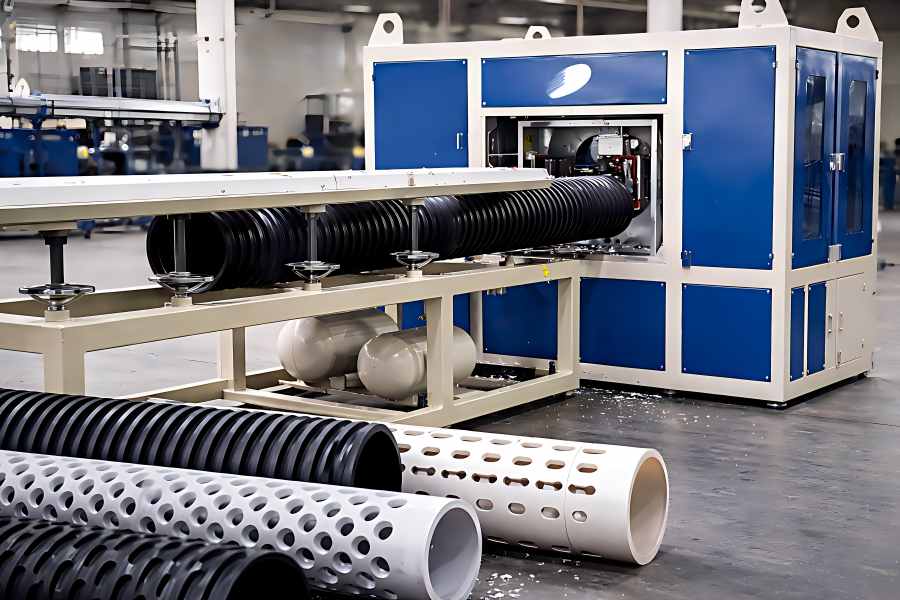
In plastic pipe manufacturing, perforation is no longer merely a secondary process. It directly affects drainage, filtration, ventilation, and product performance. Modern pipe perforating machines must produce precise, consistent hole patterns, from simple single-row holes to staggered, multi-row, and customized slot configurations for different applications.
Why Hole Pattern Matters
Before looking at the specific patterns, it is important to understand why perforation layout matters so much.
The function of a perforated pipe depends not only on whether holes exist, but on how those holes are arranged. Hole diameter, spacing, angle, number of rows, and pattern symmetry can all influence:
- Water intake or discharge performance
- Filtration efficiency
- Structural strength of the pipe
- Soil entry resistance
- Pressure distribution
- Pipe flexibility and durability
- Product compliance with project or industry requirements
For example, a drainage pipe used in road construction may require evenly distributed holes to ensure reliable water collection from multiple directions.
By contrast, an agricultural irrigation pipe may need more controlled hole spacing to regulate water distribution. A leachate collection pipe may require slot-shaped openings instead of round holes to balance liquid flow with debris control.
Because of these different needs, modern pipe perforating machines are designed to support flexible pattern production rather than only one fixed hole arrangement.
Common Types of Hole Patterns a Pipe Perforating Machine Can Produce
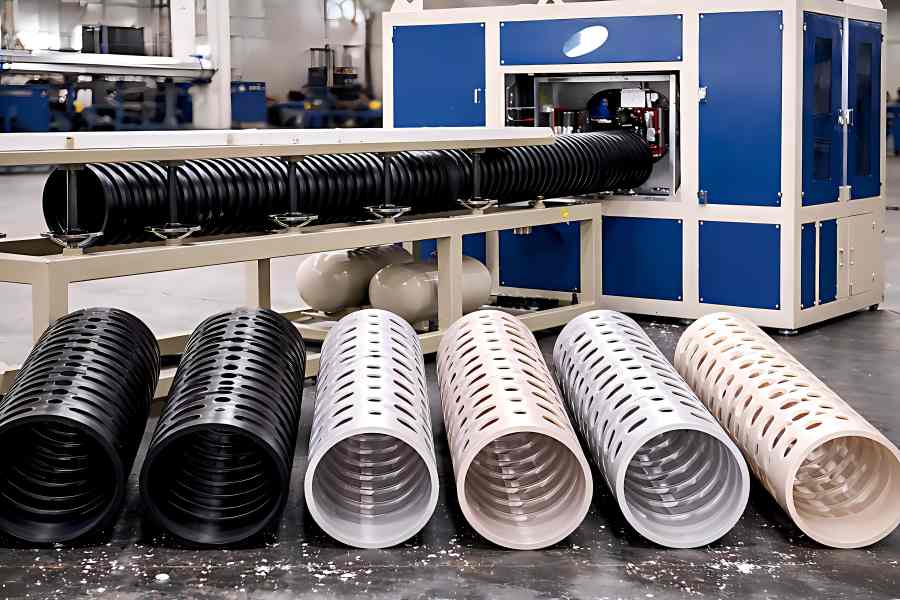
Single-Row Hole Pattern
A single-row hole pattern is among the simplest and most commonly applied configurations, where holes are arranged in a straight line along one side of the pipe.
This pattern is commonly used when the application requires directional drainage or controlled discharge from one area of the pipe. It can also be useful in products where hole positioning must be very specific.
Features of single-row perforation:
- Simple and clean layout
- Easy to control and inspect
- Suitable for directional flow requirements
- Lower tooling complexity
- Often used for specialized pipe functions
Typical applications:
- Basic irrigation pipes
- Controlled venting pipes
- Light-duty drainage products
- Customized industrial pipe designs
A pipe perforating machine that supports single-row perforation is usually a good starting point for manufacturers entering the perforated pipe market, but many customers eventually require more complex patterns.
Double-Row Hole Pattern
A double-row hole pattern places two parallel rows of holes along the pipe surface. These rows may be aligned directly opposite one another or positioned at specific angles.
This pattern offers greater open area than a single-row layout while still maintaining relatively simple production control. Double-row perforation is often chosen when better fluid collection is needed but excessive weakening of the pipe must be avoided.
Advantages:
- Increases drainage or ventilation area
- Provides better performance than a single-row design
- Maintains a balanced pipe structure
- Suitable for medium-duty applications
Common uses:
- Agricultural drainage pipes
- Groundwater collection pipes
- Light construction drainage systems
- Utility and landscaping projects
For plastic pipe machinery manufacturers, offering accurate double-row perforation capability is important because it is one of the most requested formats in practical production.
Multi-Row Hole Pattern
A multi-row hole pattern includes three or more rows of holes distributed around the pipe circumference. The exact number of rows depends on the pipe diameter, intended application, and required open area.
This is one of the most common patterns for drainage pipes because it allows water to enter from multiple directions. It is especially useful in underground systems where the pipe may be surrounded by soil, gravel, or filtered backfill.
Characteristics:
- Higher open area
- Better all-around water intake
- More uniform performance
- Suitable for larger-diameter pipes
- Often used in demanding drainage environments
Applications:
- Road and highway drainage
- Municipal drainage systems
- Foundation drainage
- Tunnel drainage
- Landfill and environmental engineering pipes
A well-designed pipe perforating machine can produce multi-row layouts with high synchronization, ensuring that row spacing and hole alignment remain consistent even at higher line speeds.
Straight-Line Aligned Hole Pattern
In a straight-line aligned pattern, holes in multiple rows are positioned directly in line with one another along the length of the pipe. Each hole appears at the same interval and the rows remain neatly matched.
This pattern is often selected for products requiring a clean and highly uniform appearance. It can also simplify downstream inspection and quality control.
Benefits:
- Easy to measure and inspect
- Visually consistent
- Suitable for standard product specifications
- Simple programming in automated systems
Considerations:
- May create concentrated stress lines if not designed properly
- Not always ideal for applications requiring maximum structural balance
This pattern is often used when the customer prioritizes standardized production and neat, repeatable geometry.
Staggered Hole Pattern
A staggered hole pattern is one of the most popular options in perforated pipe production. In this layout, holes in adjacent rows are offset rather than aligned directly opposite one another.
This arrangement helps distribute open area more evenly while reducing the risk of creating weak straight lines in the pipe wall. As a result, staggered patterns can improve both performance and structural integrity.
Why staggered patterns are popular:
- Better load distribution
- Improved pipe strength compared to fully aligned rows
- More uniform water entry
- Efficient use of pipe surface area
- Common in drainage and filtration applications
Typical applications:
- Subsurface drainage pipes
- Agricultural field drainage
- Corrugated drainage pipes
- Municipal engineering projects
For many buyers, staggered hole capability is a key feature when evaluating a pipe perforating machine, because it reflects the machine’s ability to handle more practical and performance-focused production needs.
Spiral Hole Pattern
In a spiral hole pattern, the perforations follow a helical path around the pipe rather than remaining in straight rows. This creates a continuous spiral arrangement along the pipe length.
Spiral perforation is often used when more even circumferential distribution is required. It can also be useful for products where appearance, flow balance, or specialized technical requirements matter.
Features:
- Distinctive layout
- Even distribution around the pipe body
- Can support continuous intake or discharge behavior
- Often requires more advanced machine synchronization
Applications:
- Specialized drainage systems
- Ventilation pipes
- Customized industrial pipes
- High-value engineered pipe products
Producing spiral hole patterns usually requires a pipe perforating machine with accurate pipe rotation control and synchronized punching or drilling action. This is a more advanced capability and can be a strong competitive advantage for a manufacturer.
Round Hole Pattern
Round holes are the most common hole shape produced by a pipe perforating machine. They are widely used because they are simple, efficient, and suitable for many different applications.
Hole diameters can vary depending on the project requirements. Small round holes may be used for filtration-sensitive systems, while larger holes may be selected for high drainage capacity.
Advantages of round holes:
- Simple tooling design
- Fast production speed
- Broad application suitability
- Easy maintenance and replacement of tooling
- Cost-effective perforation method
Common products:
- Drainage pipes
- Irrigation pipes
- Ventilation pipes
- Utility pipes
- General-purpose perforated plastic pipes
Most buyers expect a pipe perforating machine to support multiple round hole sizes so the machine can adapt to different orders and market segments.
Slot Hole Pattern
In addition to round holes, many pipe perforating machines can produce slot-shaped openings. These may be short slots, long slots, narrow slots, or specially designed filtration slots.
Slot patterns are often used when the pipe must allow water entry while limiting the passage of soil particles or debris. In some applications, slots offer a better balance between open area and filtering control than round holes.
Benefits of slot perforation:
- Good water intake performance
- Better particle control in some environments
- Useful for filtration and leachate systems
- Can increase effective open area
Typical applications:
- Leachate collection pipes
- Well screen-related products
- Soil drainage systems
- Environmental protection projects
- Advanced filtration pipe systems
Machines designed for slot perforation usually require specialized tooling and precise motion control. This is especially important when slot length and edge quality must meet tight standards.
Customized Hole Pattern
Many customers do not want only standard single-row or multi-row patterns. They need customized layouts based on their own projects, market demands, or installation conditions. This is why modern pipe perforating machines are increasingly designed to support custom hole patterns.
Customized patterns may include:
- Different hole diameters in one pipe
- Mixed round and slot holes
- Variable spacing along the pipe length
- Specific angular row positions
- Partial perforation zones
- Dense and sparse sections in the same product
- Customer-defined technical drawings
Why customization matters:
- Different industries have different standards
- Local markets may have unique product preferences
- Some engineering projects require non-standard designs
- Custom capability helps manufacturers win specialized orders
For a plastic pipe machinery manufacturer, promoting custom perforation capability can be a major selling point. Buyers often prefer suppliers that can adapt machine design to real production needs instead of offering only rigid standard models.
Hole Patterns by Pipe Type
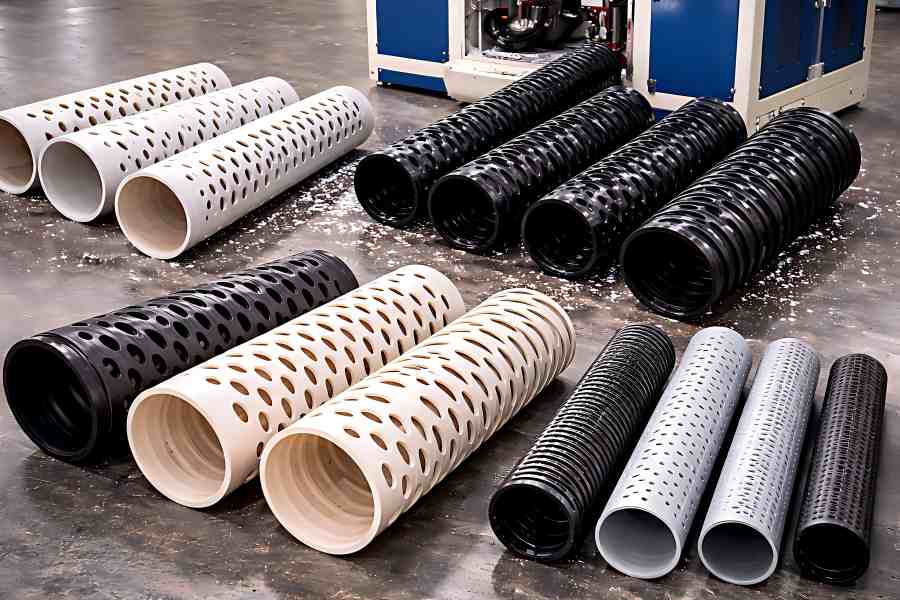
The ideal hole pattern also depends on the type of plastic pipe being produced.
Smooth-Wall Pipes
Smooth-wall pipes can usually support very precise and clean perforation. Machines can create straight rows, staggered rows, spiral layouts, and custom patterns with good visual consistency.
Corrugated Pipes
Corrugated pipes present additional challenges because the surface is not flat. The machine must account for the pipe profile when positioning the holes. Depending on the application, holes may be placed in the valley, crest, or specific parts of the corrugation.
Common patterns for corrugated pipes include:
- Multi-row staggered round holes
- Valley-positioned perforations
- Symmetrical circumferential layouts
- Customized drainage patterns
Large-Diameter Pipes
Large-diameter pipes often require more rows or larger open areas. Multi-row, spiral, and slot-based patterns are more common in these products.
Small-Diameter Pipes
Smaller pipes may require simple row layouts, finer hole diameters, and tighter spacing control. Machine stability is especially important when producing these products at higher speed.
Key Factors That Affect Hole Pattern Capability
Not every pipe perforating machine can produce every pattern. The available pattern range depends on several technical factors.
Tooling Design
The sizes and forms of holes that can be made depend on the punching or drilling equipment. Interchangeable tooling improves machine flexibility.
Pipe Rotation Control
For multi-row, spiral, and circumferential layouts, precise pipe rotation is essential. Poor synchronization will lead to inconsistent hole positioning.
Servo Control and Automation
Advanced servo systems allow better control of spacing, speed, indexing, and pattern programming. This is crucial for bespoke designs in particular.
Pipe Material
PVC, PE, HDPE, and other materials behave differently during perforation. The machine must be matched to the pipe material to ensure clean edges and stable quality.
Pipe Diameter Range
Larger or smaller pipe diameters may require different clamping, guiding, and perforating arrangements. A versatile machine should handle a broad diameter range.
Production Speed
Some patterns are easier to produce at high speed than others. Simple round-hole rows can often run faster, while slot or customized spiral patterns may require slower but more precise operation.
Application Requirements
Different end uses call for different open areas, hole densities, and structural considerations. The pattern that best suits the pipe’s intended use is always the best one.
How to Choose the Right Hole Pattern
When selecting a pattern for production, manufacturers and buyers should ask several questions:
- What is the pipe used for?
- Does the application require directional or all-around flow?
- What open area is needed?
- How important is pipe strength after perforation?
- Is the product intended for drainage, filtration, irrigation, or ventilation?
- Are there customer drawings or project standards to follow?
- Is a standard or custom hole pattern more suitable?
In many cases, the best solution is not the pattern with the most holes, but the one with the best balance of function, strength, and production efficiency.