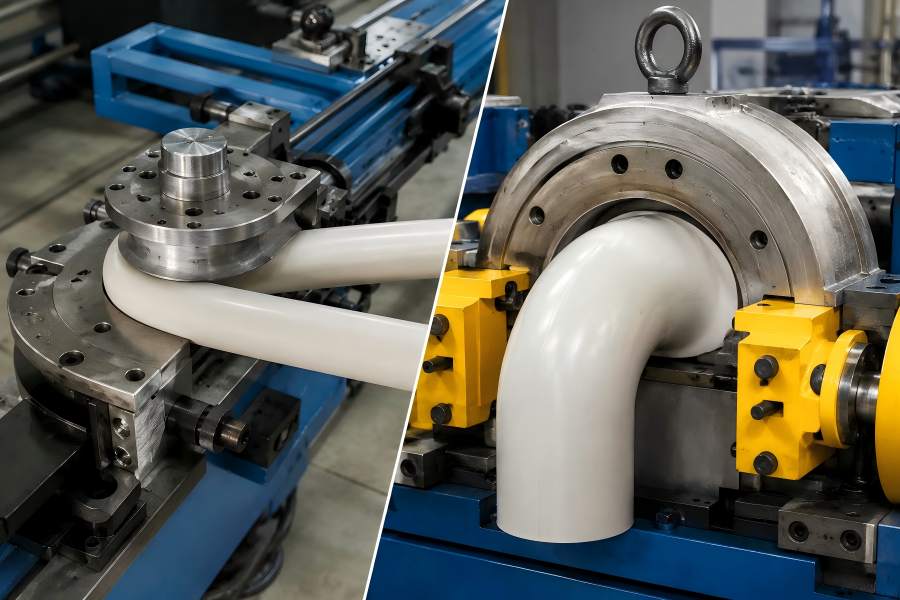
PVC pipes often require precise bends for conduit, drainage, and industrial applications. Rotary bending and mold bending are two common forming methods, each offering different advantages in flexibility, tooling, accuracy, and production volume. Selecting the appropriate method depends on product specifications and production requirements.
Understanding Rotary Bending for PVC Pipes
How Rotary Bending Works
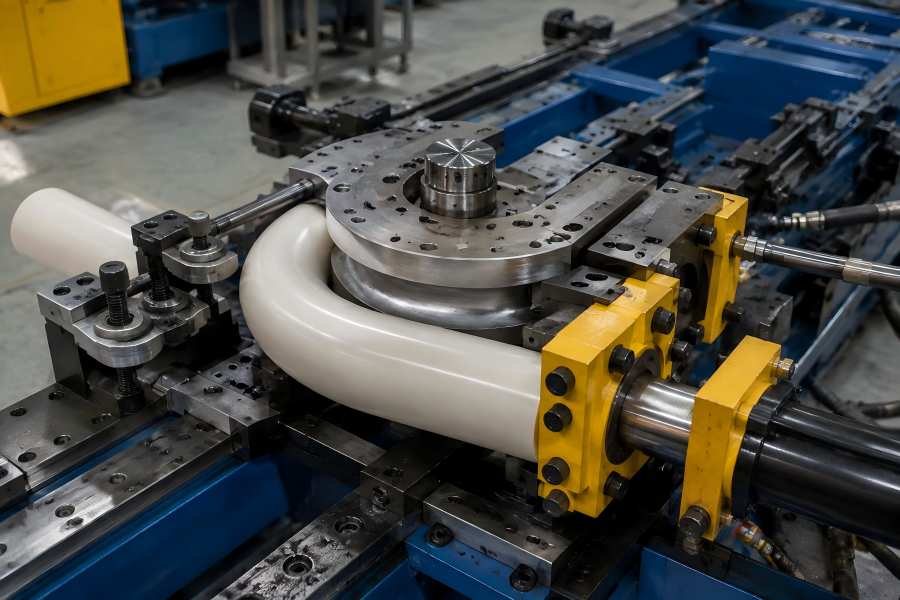
Rotary bending forms a heated PVC pipe through controlled rotational movement around a defined bending point or die. After the bending section reaches a suitable softening condition, the machine clamps and gradually forms the pipe to the required angle and radius.
A typical rotary bending system includes:
- Controlled heating unit
- Rotary forming mechanism
- Pipe clamping system
- Supporting components
- Cooling system
Because the forming movement can be adjusted, manufacturers can produce different angles and radii without relying on a dedicated full-profile mold for every product.
Advantages of Rotary Bending
High Production Flexibility
Rotary bending allows manufacturers to adjust parameters such as:
- Bending angle
- Bending radius
- Forming speed
- Pipe positioning
This flexibility makes the process suitable for manufacturers handling several PVC pipe specifications or frequently changing customer orders.
Lower Tooling Requirements
Compared with mold bending, rotary bending generally requires fewer dedicated forming molds. Adjustable dies, clamps, and supporting components can often cover multiple specifications.
Lower tooling requirements can reduce:
- Initial tooling investment
- Tool storage requirements
- Changeover complexity
- Preparation time for new products
Suitable for Customized Production
Rotary bending is particularly useful for OEM and project-based PVC pipe production where customers may require different angles, radii, or pipe sizes.
Common products include:
- Customized pipe bends
- Offset sections
- Conduit bends
- Special pipe routing components
Faster Product Changeover
When changing from one product specification to another, manufacturers can often adjust machine parameters and replace limited tooling rather than installing an entirely different mold set.
This makes rotary bending suitable for small and medium production batches.
Limitations of Rotary Bending
Rotary bending also requires careful process control. Heating temperature, forming speed, pipe support, and clamping pressure must remain stable to prevent cracking, flattening, or excessive ovality.
For extremely high-volume production of one fixed pipe geometry, dedicated mold bending may provide better repeatability and production efficiency.
Understanding Mold Bending for PVC Pipes
How Mold Bending Works
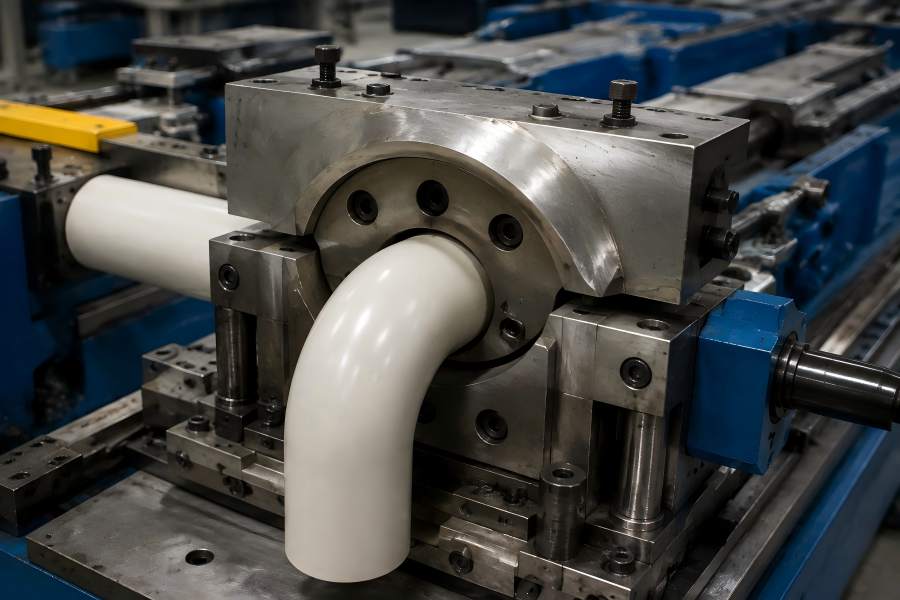
Mold bending uses a dedicated forming mold to define the final shape of a heated PVC pipe. Once the bending area reaches the required softening condition, the pipe is positioned against or inside the mold and formed according to the preset geometry.
The process generally includes:
- Pipe heating
- Positioning
- Mold forming
- Shape holding
- Cooling
- Product removal
Because the mold determines the final radius and angle, mold bending provides highly repeatable forming conditions.
Advantages of Mold Bending
High Dimensional Consistency
When the same mold is used repeatedly, the bending radius and geometry remain relatively stable between production cycles.
This is especially useful for standardized products that require consistent installation dimensions.
Suitable for High-volume Production
Once tooling has been prepared, mold bending can be efficient for producing large quantities of identical PVC pipe bends.
It is particularly suitable when:
- Product specifications remain unchanged
- The same angle is produced continuously
- Large orders require repeatable geometry
Better Shape Control
A dedicated mold provides direct support around the forming area. Proper mold design can help reduce:
- Pipe flattening
- Oval deformation
- Surface irregularities
- Angle variation
This can be useful for PVC pipe products with relatively strict dimensional requirements.
Limitations of Mold Bending
The main limitation is lower production flexibility.
Different pipe diameters, bending radii, or product geometries may require different molds. This increases:
- Tooling investment
- Mold storage requirements
- Product changeover time
- Preparation requirements for customized orders
Therefore, mold bending is generally more economical when product specifications remain stable over long production runs.
Rotary Bending vs Mold Bending: Key Differences
Although both methods can produce high-quality PVC pipe bends, their manufacturing characteristics are different.
| Factor | Rotary Bending | Mold Bending |
| Forming Method | Controlled rotary movement | Dedicated mold forming |
| Production Flexibility | High | Medium to Low |
| Tooling Requirement | Lower | Higher |
| Product Changeover | Faster | Slower |
| Customization | High | Moderate |
| Repeatability | High | Very High |
| Suitable Production | Small to medium batches | Medium to large batches |
| Fixed Geometry Production | Suitable | Highly suitable |
| Tooling Investment | Lower | Higher |
| Parameter Adjustment | Flexible | More tooling dependent |
Rotary bending focuses more on flexibility, while mold bending focuses more on repeatability and standardized production.
Key Factors for Selecting a PVC Pipe Bending Method
Choosing between rotary bending and mold bending depends on pipe specifications, production volume, bend requirements, customization needs, and overall production cost.
Pipe Diameter and Wall Thickness
Pipe dimensions directly affect heating, support, and forming requirements.
Larger or thicker PVC pipes generally require:
- Longer heating time
- Stronger pipe support
- More stable clamping
- Greater forming capacity
Rotary bending is often more flexible when manufacturers need to process several pipe sizes. Mold bending can provide better consistency when one standardized diameter and geometry are produced continuously.
Production Volume
Production quantity strongly influences the economic suitability of each method.
Rotary bending is generally more practical for small and medium batches because tooling changes are limited and different specifications can be processed more easily.
Mold bending becomes more attractive for high-volume production because dedicated tooling can be reused for thousands of identical products.
Depending on pipe diameter, heating setup, and automation level, automatic PVC pipe bending machines typically achieve 20–60-second bending cycles, depending on pipe specifications and cooling requirements.
Bending Radius and Angle Requirements
PVC pipe products may require:
- 45° bends
- 60° bends
- 90° bends
- 120° bends
- 135° bends
- Customized angles
Rotary bending provides greater flexibility when angles or radii change frequently.
Mold bending is more suitable when the same radius and angle must be repeated over a long production run.
Product Customization
For OEM or engineering orders, customers may frequently change:
- Pipe diameter
- Bend radius
- Bend angle
- Product length
- Final geometry
Rotary bending can accommodate these variations with fewer dedicated molds.
Mold bending is better suited to standardized products where dimensional requirements remain consistent.
Cost Considerations
Manufacturers should consider the total production cost instead of comparing equipment prices alone. Tooling, product changeover, labor, batch size, maintenance, and scrap all influence the final cost per part.
The following figures are illustrative production-planning ranges, rather than fixed market prices:
| Cost Factor | Rotary Bending | Mold Bending |
| Typical Tooling Cost | $200–$1,200 | $600–$2,500+ |
| Changeover Time | 15–45 min | 30–90 min |
| Suitable Batch Size | 100–5,000 pcs | 3,000–50,000+ pcs |
| Tooling Cost per Part at 500 pcs* | $0.40–$2.40 | $1.20–$5.00 |
| Tooling Cost per Part at 10,000 pcs* | $0.02–$0.12 | $0.06–$0.25 |
*Tooling cost per part is calculated by spreading the example tooling investment across the batch quantity. Actual costs depend on pipe diameter, bending geometry, mold complexity, material, and machine configuration.
For smaller or frequently changing orders, rotary bending can reduce tooling and changeover expenses.
For large-scale standardized production runs, spreading the initial mold investment across more products helps reduce the tooling cost per unit.
How PVC Pipe Bending Machines Support Both Methods
Modern PVC pipe bending machines can support rotary bending and mold bending through controlled heating, precision forming, stable pipe support, interchangeable tooling, and cooling systems.
Heating Control System
Both methods require uniform pipe softening before forming.
Digital temperature control and multi-zone heating help maintain stable processing conditions. Typical PVC heating conditions may fall around 120–160°C, although the actual setting depends on material formulation, diameter, wall thickness, and production method.
Stable heating helps reduce:
- Cracking
- Uneven bending
- Surface deformation
Bending Accuracy Control
Servo motors, PLC systems, and programmable controls can improve:
- Bending angle
- Forming speed
- Positioning
- Cycle repeatability
Depending on pipe specifications and equipment configuration, automatic systems may control bending angles to approximately ±1°–2°.
Supporting and Clamping System
Proper pipe support is essential for preventing flattening and oval deformation.
Machines may use:
- Internal mandrels
- Adjustable clamps
- Forming rollers
- Customized molds
- Supporting inserts
Rotary bending generally requires flexible support during movement, while mold bending relies more strongly on fixed mold geometry.
Flexible Tooling
Interchangeable tooling allows manufacturers to adjust:
- Pipe diameter
- Bending radius
- Bend angle
- Support position
- Mold dimensions
This increases machine utilization when several PVC pipe products are manufactured on the same production line.
Cooling System
Air or water cooling stabilizes the pipe after forming. Proper cooling helps reduce shape recovery, residual stress, and dimensional variation.
By integrating these functions, a PVC pipe bending machine can provide consistent production for both flexible rotary bending and standardized mold bending processes.
Rotary Bending Applications in PVC Pipe Production
Rotary bending is suitable for PVC pipe production requiring flexible angles, multiple specifications, and frequent product changes. It is especially effective for customized and small-to-medium batch manufacturing.
Electrical Conduit Systems
PVC conduits often require 45°, 90°, or customized bends to match cable-routing layouts. Rotary bending enables relatively fast adjustment of bending angles and radii.
Customized Pipe Components
The method can be used for:
- Customized elbows
- Offset bends
- Multi-angle pipe sections
- Special routing components
This makes rotary bending suitable for OEM and engineering-based orders.
Small and Medium Batch Production
Rotary bending reduces dependence on dedicated molds, allowing manufacturers to switch between different pipe diameters and bending designs with less tooling preparation.
Industrial Pipeline Fabrication
Industrial PVC pipelines sometimes require bends adapted to equipment positions, walls, or other installation restrictions. Rotary bending provides greater flexibility for these non-standard configurations.
Overall, rotary bending is preferable when customization, production flexibility, and fast product changeover are more important than extremely high-volume standardized output.
Mold Bending Applications in PVC Pipe Production
Mold bending is suitable for standardized PVC pipe products requiring consistent shape, dimensional accuracy, and high-volume production.
Standard PVC Bends
It is commonly used for producing fixed geometries such as:
- 45° bends
- 90° bends
- 135° bends
- Fixed-radius products
Dedicated molds help maintain consistent dimensions across repeated production cycles.
Electrical Conduit Components
For large-volume conduit production, mold bending helps manufacturers maintain consistent angles and bending radii across multiple batches.
Drainage and Plumbing Components
Standardized drainage or plumbing products benefit from fixed mold geometry, which helps reduce dimensional variation between finished components.
Large-volume OEM Production
For OEM orders with stable specifications and long production runs, mold bending provides strong repeatability. As production quantity increases, the initial tooling investment is distributed across more products, reducing tooling cost per part.
Overall, mold bending is best suited to high-volume standardized production with fixed bending geometry.
Which Bending Method Is More Suitable for PVC Pipe Production?
Neither bending method is universally better. The correct choice depends on how the PVC pipe manufacturer operates.
Choose Rotary Bending When:
Rotary bending is generally preferable when:
- Multiple pipe specifications are produced
- Bending angles frequently change
- Customized products are required
- Batch quantities are relatively small
- Fast product changeover is important
- Lower dedicated tooling investment is preferred
For manufacturers serving several customers with different specifications, rotary bending provides valuable production flexibility.
Choose Mold Bending When:
Mold bending is generally preferable when:
- Large quantities of identical bends are produced
- Product geometry remains stable
- High repeatability is required
- Dedicated tooling can be used continuously
- Production efficiency is more important than frequent customization
For example, a factory continuously producing the same 90° PVC conduit bend can benefit from a dedicated mold because little adjustment is required between cycles.
Combining Both Methods
Some PVC pipe manufacturers do not need to choose only one method.
A flexible production strategy may use:
- Rotary bending for prototypes and customized orders
- Mold bending for confirmed high-volume products
This approach allows manufacturers to respond to different order quantities while controlling tooling investment.
A customized product can first be developed through flexible rotary bending. Once demand increases and the geometry becomes standardized, dedicated mold tooling can be introduced for higher-volume production.