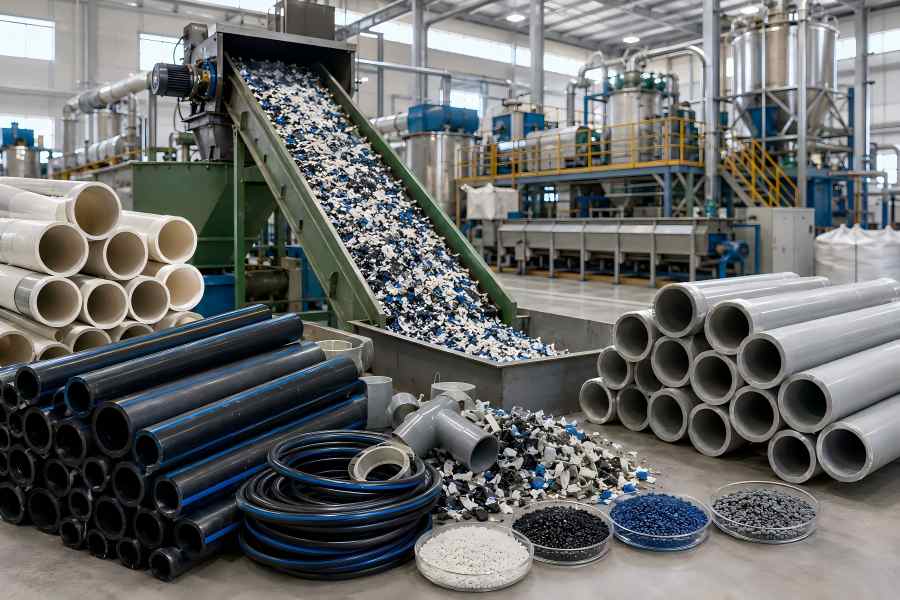
Plastic pipe recycling turns PVC, HDPE, and PP pipe waste from manufacturing, installation, demolition, and replacement projects into reusable materials. Through collection, sorting, shredding, washing, drying, melting, filtration, and pelletizing, recycled pipes can reduce landfill waste, lower material costs, and support circular production.
Main Sources of Recyclable Plastic Pipe Waste
Plastic pipe waste can come from several stages of the product lifecycle.
Post-industrial pipe waste
This is waste generated during manufacturing. It may include start-up scrap, rejected pipes, trimming waste, short pipe pieces, test samples, and defective products. This type of waste is usually cleaner and easier to recycle because the material type is known and contamination is limited.
Construction and installation waste
During pipe installation, contractors often cut pipes to the required length. This creates offcuts and leftover sections. If these are collected separately by material type, they can be valuable recycling feedstock.
Demolition and replacement waste
Old pipes removed from buildings, roads, farms, drainage systems, or industrial facilities can also be recycled. However, this material may contain soil, labels, metal fittings, rubber seals, adhesives, or mixed plastic contamination, so sorting and cleaning are more important.
Municipal and industrial collection streams
Some recycling companies collect HDPE, PP, and PVC materials from multiple sources, including packaging, containers, construction waste, and pipe waste. For pipe-grade reuse, careful material identification and quality control are required.
Step-by-Step Plastic Pipe Recycling Process
Although recycling lines vary by material and output requirement, most plastic pipe recycling processes include the following steps.
Step 1: Collection and transportation
The recycling process begins with collecting pipe waste from factories, construction sites, farms, utility projects, demolition areas, or recycling centers. Pipes are usually bundled, cut into manageable lengths, or crushed before transportation.
Clean, separated pipe waste is more valuable than mixed waste. For example, PVC pipe should not be mixed with HDPE or PP pipe, because each material has different melting and processing conditions.
Step 2: Sorting by material type
Sorting is one of the most critical steps. Recyclers need to identify whether the pipe is PVC, HDPE, PP, PE, PEX, ABS, or another plastic. They may use manual sorting, labels, density separation, infrared sorting, or other identification technologies.
PVC recycling can be especially sensitive because PVC has a different chemical composition and processing window compared with polyolefins such as HDPE and PP. Advanced sorting technologies, including NIR, SWIR, HSI, XRF, LIBS, and AI-based systems, are being developed to improve PVC separation from complex waste streams.
Step 3: Removing metal, rubber, soil, and foreign matter
Used pipes may contain screws, clamps, metal couplings, rubber rings, sand, soil, glue, labels, or other residues. These contaminants can damage recycling equipment or reduce the quality of recycled pellets.
Common cleaning and separation methods include:
| Contaminant | Removal Method |
| Metal fittings | Manual removal, magnetic separation, metal detection |
| Soil and sand | Pre-washing, friction washing, rinsing |
| Rubber seals | Manual sorting, density separation |
| Labels and films | Washing, friction cleaning, air separation |
| Mixed plastics | Manual sorting, optical sorting, density separation |
Step 4: Cutting, shredding, or crushing
Large plastic pipes are difficult to feed directly into extrusion equipment, so they must first be reduced in size. Depending on the pipe diameter, wall thickness, and material, recyclers may use pipe shredders, crushers, granulators, or cutting machines.
For large-diameter pipes, a single-shaft shredder or heavy-duty pipe crusher may be used for primary size reduction. Smaller pipe pieces can then be granulated into flakes. Uniform flake size improves washing, drying, melting, and pelletizing efficiency.
Step 5: Washing and drying
After crushing, plastic flakes are washed to remove dust, mud, oil, paper, labels, and other impurities. Washing systems may include pre-wash tanks, friction washers, hot washing units, rinsing tanks, and centrifugal dryers.
Drying is important because moisture can cause bubbles, poor surface finish, and unstable extrusion during pelletizing or pipe production. HDPE and PP are less moisture-sensitive than some engineering plastics, but good drying still improves material consistency.
Step 6: Melting, filtering, and pelletizing
Clean flakes are fed into an extruder, melted, filtered, and cut into pellets. Melt filtration removes fine contaminants such as small metal particles, unmelted materials, sand, and degraded plastic.
The recycled pellets can then be used as raw material for new products. ADS describes a similar process for HDPE and PP plastic scrap: collected material is baled and delivered, sorted, ground into flake, washed, blended, extruded into pellets, and reused in pipe-related products and chambers.
Step 7: Quality testing
Before recycled material is reused, it should be tested. Common quality checks include melt flow index, density, moisture content, ash content, tensile strength, impact resistance, color, contamination level, and thermal stability.
For pipe applications, quality requirements are stricter than for many general plastic products. Pressure pipes, gas pipes, and drinking water pipes must meet specific standards, so recycled material is often used in non-pressure applications, outer layers, middle layers, drainage products, or other suitable products unless it meets required specifications.
PVC Pipe Recycling Process
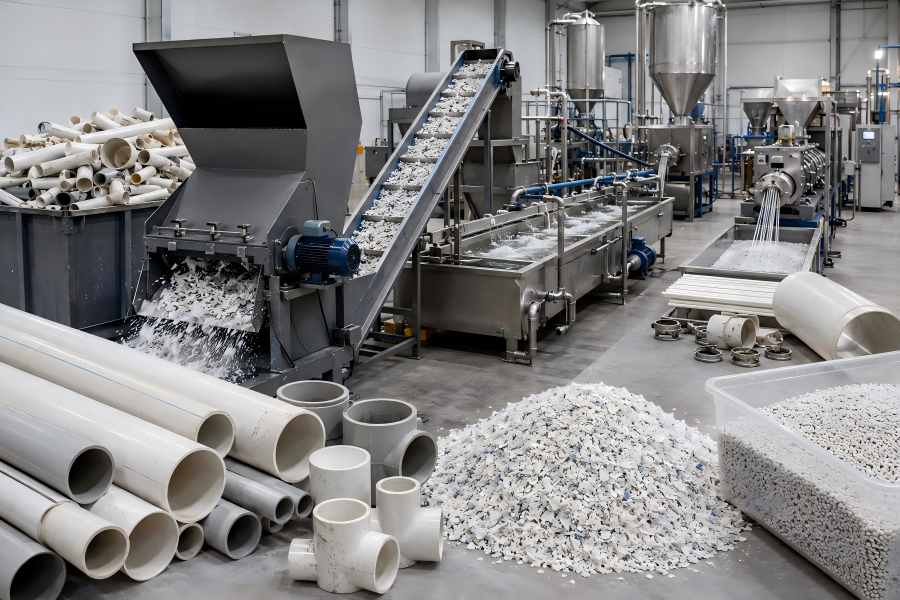
PVC, or polyvinyl chloride, is widely used for drainage pipes, electrical conduit, water pipes, sewer pipes, profiles, and construction materials. Rigid PVC pipe is recyclable, but it requires careful processing.
PVC can be mechanically recycled multiple times under proper processing conditions. ECVM states that both rigid PVC products such as pipes, profiles, and window frames and flexible PVC products can be recovered, reprocessed, and used again in long-life products. VinylPlus Pipes also notes that PVC pipes are part of established collection and recycling schemes in Europe and that mechanical recycling is suitable for clean, well-identified PVC streams.
The typical PVC pipe recycling process includes:
- Collecting rigid PVC pipe waste
- Sorting PVC separately from PE, PP, rubber, and metal
- Removing seals, soil, fittings, and labels
- Crushing or granulating the pipe into flakes
- Washing and drying
- Reprocessing through extrusion
- Producing PVC regrind or pellets
- Reusing the material in suitable PVC products
PVC recycling requires temperature control. If PVC is overheated, degradation may occur, which can affect color, odor, and material performance. For this reason, PVC recycling lines need suitable screw design, stabilizer adjustment, good ventilation, and controlled processing temperatures.
Recycled PVC pipe material can be used in:
| Recycled PVC Application | Typical Use |
| Multilayer pipes | Recycled material in middle layers |
| Drainage pipes | Non-pressure drainage applications |
| Electrical conduits | Cable protection and conduit systems |
| Profiles | Construction profiles and boards |
| Flooring or mats | Depending on formulation and quality |
| Industrial products | Rigid sheets, panels, or molded parts |
For high-quality pipe reuse, PVC must be properly sorted and tested. Legacy additives, mixed materials, and contamination can limit its application. Advanced recycling methods such as dissolution, pyrolysis, and gasification may help process more complex PVC waste streams, especially materials containing additives or composite structures.
HDPE Pipe Recycling Process
HDPE, or high-density polyethylene, is among the most widely recycled pipe materials. It is widely used in drainage, irrigation, water supply, gas distribution, cable protection, and industrial fluid transport.
HDPE has strong toughness, good chemical resistance, and excellent processability, which makes it suitable for mechanical recycling.The recycling process normally includes collection, sorting, shredding, washing, drying, extrusion, filtration, pelletizing, and reuse.
Compared with PVC, HDPE has a wider processing window and does not contain chlorine. It can be melted and reprocessed into pellets for a wide range of applications. However, recycled HDPE quality depends heavily on contamination control, material grade, melt flow consistency, and previous service conditions.
Typical recycled HDPE pipe applications include:
| Recycled HDPE Application | Description |
| Corrugated drainage pipe | One of the most common reuse routes |
| Cable conduit | Suitable for non-pressure protection applications |
| Irrigation pipe | Depends on performance requirements |
| Plastic lumber | Used for outdoor boards and profiles |
| Pallets and crates | Durable molded products |
| Geomembranes or sheets | Depending on grade and purity |
| Blended compounds | Mixed with virgin HDPE for controlled properties |
HDPE pipe recycling is especially practical when the waste stream is clean and separated. Post-industrial HDPE pipe scrap can often be returned to production more easily than mixed post-consumer material. Post-consumer HDPE requires more washing, sorting, and testing.
For pressure-rated pipe applications, recycled material must be carefully evaluated. Not all recycled HDPE is suitable for pressure pipe because pressure systems require long-term strength, slow crack growth resistance, and consistent resin properties.
PP Pipe Recycling Process
PP, or polypropylene, is used in hot and cold water systems, industrial pipes, chemical piping, drainage products, fittings, and pipe-related components. PP is also recyclable through mechanical processing.
The PP pipe recycling process is similar to HDPE recycling:
- Collect PP pipe waste and production scrap
- Sort PP separately from PVC, PE, rubber, and metal
- Remove contamination
- Shred or granulate into flakes
- Wash and dry
- Melt and filter through an extruder
- Pelletize into recycled PP granules
- Reuse in suitable products
PP has a higher melting point than HDPE, so processing conditions must be adjusted accordingly. Recycled PP can become brittle if it has aged, been exposed to UV light, or gone through repeated heat histories. Stabilizers and blending with virgin PP may be used to improve performance.
Recycled PP from pipes can be used in:
| Recycled PP Application | Typical Product |
| Pipe fittings | Depending on quality and application |
| Drainage components | Chambers, covers, and accessories |
| Injection molded parts | Crates, containers, industrial parts |
| Automotive components | Non-critical molded parts |
| Plastic sheets | Industrial boards and panels |
| Blended compounds | Modified PP materials |
PP recycling is valuable because PP is widely used and relatively easy to reprocess when clean. However, mixed PP and PE streams can create performance variation, so proper sorting is important for stable production.
PVC vs. HDPE vs. PP Pipe Recycling Comparison
| Factor | PVC Pipe | HDPE Pipe | PP Pipe |
| Main recycling method | Mechanical recycling, with advanced options for complex waste | Mechanical recycling | Mechanical recycling |
| Sorting importance | Very high | High | High |
| Processing sensitivity | Sensitive to overheating | Relatively flexible | Requires proper temperature control |
| Common reuse | Multilayer pipes, conduits, profiles | Drainage pipes, conduit, plastic lumber, molded products | Fittings, chambers, molded parts, sheets |
| Main challenge | Additives, contamination, thermal degradation | Material grade consistency, contamination | Brittleness, mixed polymer contamination |
| Best feedstock | Clean rigid PVC pipe scrap | Clean HDPE pipe/offcuts | Clean PP pipe/fittings scrap |
Key Equipment Used in Plastic Pipe Recycling
A complete plastic pipe recycling line may include:
| Equipment | Function |
| Pipe cutter | Cuts long pipes into shorter sections |
| Shredder | Reduces large pipes into smaller chunks |
| Crusher or granulator | Produces uniform flakes |
| Magnetic separator | Removes metal contamination |
| Washing tank | Removes soil and floating impurities |
| Friction washer | Cleans flakes through high-speed friction |
| Centrifugal dryer | Removes surface moisture |
| Extruder | Melts and homogenizes plastic |
| Melt filter | Removes fine contamination |
| Pelletizer | Cuts recycled plastic into pellets |
| Storage silo | Stores clean flakes or pellets |
For large-diameter pipes, strong feeding systems and heavy-duty shredders are important. Thick-walled HDPE or PP pipes require higher torque, while brittle PVC pipes may require controlled crushing to reduce dust and avoid excessive fines.
Common Challenges in Plastic Pipe Recycling
Plastic pipe recycling is not only about crushing and melting. Several problems can reduce material value.
Mixed materials
PVC, HDPE, and PP should not be randomly mixed. Each material has different processing behavior. Mixed polymers may reduce strength, surface quality, and product consistency.
Dirt and construction waste
Used pipes often contain mud, sand, stones, cement, or metal parts. These contaminants increase equipment wear and may damage extruders and filters.
Additives and aging
Old pipes may contain stabilizers, pigments, fillers, or additives. UV exposure and long service life may also reduce mechanical performance.
Quality requirements
Plastic pipes are technical products. For critical applications, recycled material must meet strict standards. Some recycled material may be better suited for non-pressure or non-critical products.
Collection difficulty
End-of-life pipes are often spread across construction sites, farms, utilities, and demolition projects. Efficient collection and sorting systems are necessary to make recycling commercially viable.
Best Practices for Higher-Quality Recycled Pipe Material
To improve recycling quality, manufacturers and recyclers should follow several practical steps:
| Best Practice | Benefit |
| Separate PVC, HDPE, and PP at the source | Reduces contamination and improves pellet quality |
| Remove fittings and rubber seals early | Protects equipment and improves purity |
| Keep pipe waste clean and dry | Reduces washing cost |
| Use proper shredding equipment | Improves size reduction efficiency |
| Control processing temperature | Prevents degradation |
| Test recycled pellets regularly | Ensures stable production |
| Match recyclate to suitable applications | Avoids performance failures |
| Blend with virgin resin when necessary | Improves consistency and strength |
Good recycling begins before the material enters the recycling line. If contractors and factories sort pipe waste properly, the final recycled material will be cleaner, more valuable, and easier to reuse.