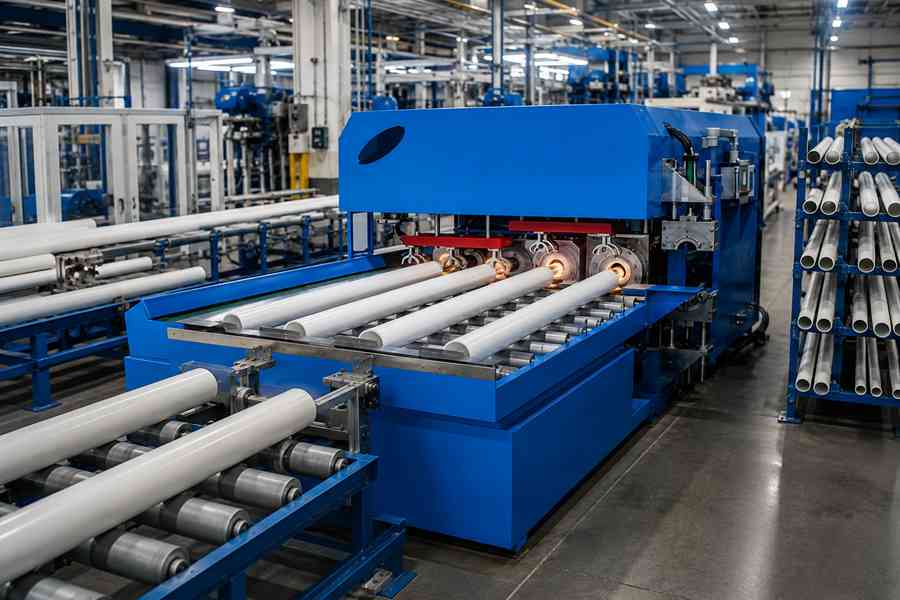
Reducing energy use in plastic pipe belling is not simply a matter of lowering heater power. Better results come from matching the machine to the pipe range, controlling heat more precisely, limiting idle losses, and keeping every production cycle stable.
Where Does a Plastic Pipe Belling Machine Use Energy?
A plastic pipe belling machine mainly consumes energy during heating, pipe movement, socket forming, cooling, and auxiliary operation. The heater is usually the most visible load, but compressed air, hydraulic units, cooling pumps, conveyors,
The main energy-consuming areas include:
- Heating the plastic pipe end
- Rotating and positioning the pipe
- Driving clamps and forming tools
- Supplying cooling air or water
- Operating hydraulic or pneumatic systems
- Keeping the machine active between production cycles
Five Ways to Reduce Belling Energy Use
| Energy-Control Area | Common Source of Waste | Practical Improvement |
| 1. Machine and Pipe Matching | Oversized equipment runs below its efficient range | Match capacity, diameter, and wall thickness |
| 2. Heating Control | Excessive temperature or heating time | Use zoned heating and pipe-specific recipes |
| 3. Idle-Time Management | Heaters and motors remain fully active during stops | Add standby modes and automatic shutdown logic |
| 4. Cycle Optimization | Unnecessary movement and long holding periods | Coordinate feeding, forming, and cooling |
| 5. Maintenance and Utilities | Heat loss, air leakage, and worn components | Maintain insulation, drives, nozzles, and air lines |
1. Match the Machine to the Plastic Pipe Range
An oversized belling machine does not automatically provide more efficient production. Large heaters, motors, and hydraulic units may consume unnecessary energy when the actual pipe range is much smaller than the machine’s design capacity.
Define the Real Production Range
Before purchasing equipment, confirm the plastic pipe specifications that will be processed most often:
- Minimum and maximum outside diameter
- Pipe wall-thickness range
- PVC, PP, PE, or other plastic material
- Socket type and required depth
- Expected production volume
- Number of size changes per shift
The most frequently produced pipes should fall near the machine’s normal working range. Occasional large-diameter orders should not determine the entire machine configuration unless they represent meaningful production volume.
Avoid Unnecessary Auxiliary Capacity
Cooling pumps, air blowers, hydraulic units, and conveyors should be sized for the actual production requirement. Oversized auxiliaries often operate continuously even when only part of their capacity is needed.
Variable-speed drives can reduce this waste by adjusting motor output to the current load. They are especially useful when the belling machine handles several pipe diameters with different cooling and movement requirements.
2. Improve Plastic Pipe Heating Control
Heating is a major energy-consuming stage because the pipe end must reach a suitable forming condition without becoming excessively soft. Poor control wastes heat and may also cause sagging, wrinkling, or uneven socket dimensions.
Heat Only the Required Area
The heated length should correspond to the socket depth and transition shape. Heating too much of the plastic pipe increases energy demand and weakens material outside the required forming zone.
An adjustable heating chamber is useful when one machine handles several socket lengths. The heater opening, pipe position, and active heating zones should change with the production recipe.
Store Recipes by Complete Pipe Specification
Two plastic pipes with the same outside diameter may have different wall thicknesses, colors, formulations, or pressure ratings. Using one general recipe can lead to unnecessary heating or repeated rejected sockets.
Each recipe should include:
- Heater temperature
- Active heating zones
- Heating duration
- Pipe rotation speed
- Heater-to-pipe distance
- Mandrel temperature
- Cooling duration
Stable recipes reduce operator trial and error. They also make energy performance more consistent after material or size changes.
3. Control Warm-Up and Idle Energy
A belling machine may consume significant electricity while producing no sockets. Long material changes, operator delays, upstream stoppages, and meal breaks can leave heaters, pumps, and motors running at full output.
Use Automatic Standby Modes
The control system should reduce heater output and stop unnecessary auxiliaries after a preset idle period. The machine can then return to production temperature before the next plastic pipe arrives.
A practical standby system may control:
- Heater output
- Hydraulic pump operation
- Cooling blower speed
- Water-pump activity
- Conveyor movement
- Pipe-rotation motors
The standby temperature should remain high enough for a quick restart but low enough to avoid full-load energy use.
Coordinate With the Extrusion Line
When the belling machine is connected to a plastic pipe extrusion line, unstable upstream output creates unnecessary waiting. Better communication between cutting, conveying, and belling stations reduces idle operation.
Sensors can signal when the next pipe is approaching. The machine can then prepare the heater, clamps, and forming system only when needed.
4. Optimize the Belling Cycle
Reducing cycle time can lower energy use per socket, but only when socket quality remains stable. Excessive speed may increase rejection rates and cancel any energy savings.
Remove Unnecessary Movement
Feeding, clamping, heating, forming, holding, cooling, and discharge should occur with minimal waiting between stages. Delays often come from conservative timer settings rather than actual process needs.
The cycle should be reviewed stage by stage:
| Cycle Stage | Possible Energy Waste | Optimization Focus |
| Pipe feeding | Slow or repeated positioning | Improve sensors and stop accuracy |
| Heating | Fixed time longer than required | Adjust by material and wall thickness |
| Forming | Excessively slow mandrel movement | Use controlled multi-speed motion |
| Holding | Timer includes unnecessary allowance | Base time on shape stability |
| Cooling | Full cooling used for every pipe size | Adjust flow and duration by recipe |
| Discharge | Machine waits for downstream handling | Coordinate conveyors and stacking |
Control Forming Resistance
If the pipe end is underheated, the mandrel requires greater force and the hydraulic or servo drive works harder. Overheating also wastes energy and can increase cooling time.
The correct heating condition allows the plastic pipe to expand smoothly with controlled force. Monitoring forming resistance can help detect when heating, tooling, or alignment has moved away from the intended setting.
5. Maintain the Machine and Utility Systems
Energy losses often develop gradually and remain unnoticed because the machine continues to operate. Dirty heaters, leaking air lines, worn bearings, and blocked cooling nozzles can all increase consumption.
Inspect Heating Components
Dust, plastic residue, damaged reflectors, and failed heating elements reduce heat-transfer efficiency. Operators may respond by increasing temperature or heating time, which raises energy use without correcting the cause.
Inspect the heating chamber regularly for:
- Damaged insulation
- Loose electrical connections
- Uneven element output
- Contaminated reflectors
- Incorrect heater distance
- Heat escaping around openings
Repair Compressed-Air Leaks
Pneumatic clamps, stops, and actuators may continue working even when the air system leaks. The compressor then operates longer to maintain pressure.
Leaks commonly occur around hoses, fittings, valves, and cylinder seals. Repairing small leaks can reduce utility waste while improving clamping and positioning stability.
What Buyers Should Check Before Purchasing
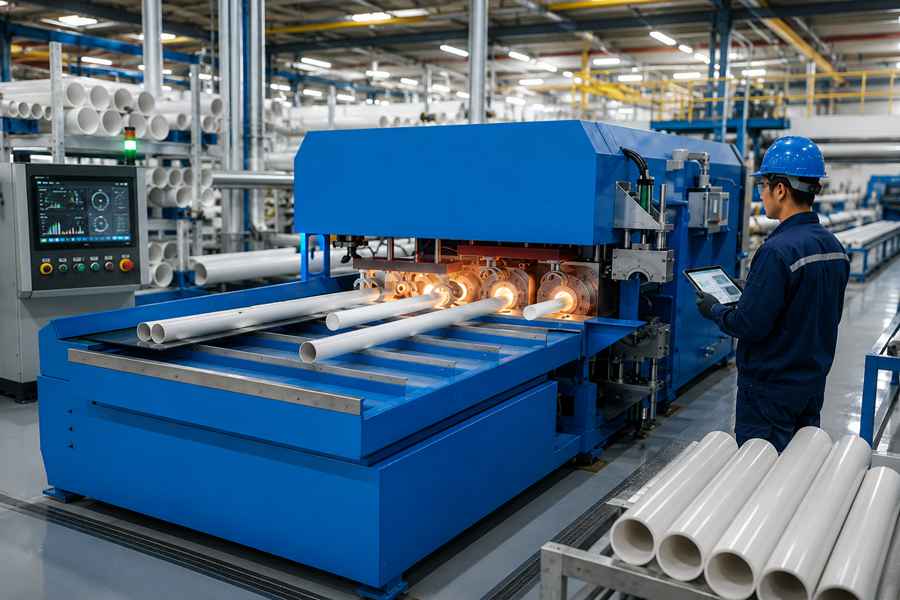
Energy efficiency claims should be verified under realistic plastic pipe production conditions. A quotation showing only installed power does not explain how much energy the machine uses per finished socket.
| Purchasing Check | What to Request | Why It Matters |
| Actual pipe test | Run the buyer’s pipe sizes and materials | Reveals real heating and cycle demand |
| Recipe control | Store settings by pipe specification | Reduces overheating and setup waste |
| Zoned heating | Independent heater-area adjustment | Directs heat only where needed |
| Standby mode | Automatic control during production stops | Limits non-productive consumption |
| Variable-speed drives | Adjustable pumps, blowers, and motors | Matches power to actual demand |
| Energy monitoring | Display or record production power use | Supports future process improvement |
| Insulation design | Enclosed heater with service access | Reduces heat loss without complicating maintenance |
Buyers should also ask how quickly the machine returns to production after standby. An energy-saving mode offers limited value if reheating takes too long and interrupts output.
How to Find Hidden Energy Waste
Rising energy use does not always mean the heater has become inefficient. It may indicate slower cycles, additional rejects, increased forming resistance, or longer cooling periods.
Common warning signs include:
- Heating time gradually becomes longer
- Socket quality changes after the machine warms up
- Hydraulic or servo load increases
- Cooling time must be extended
- Compressed-air pressure drops frequently
- Motors become hotter than normal
- Energy use rises while hourly output stays unchanged
Energy records should be reviewed together with production output and rejection data.