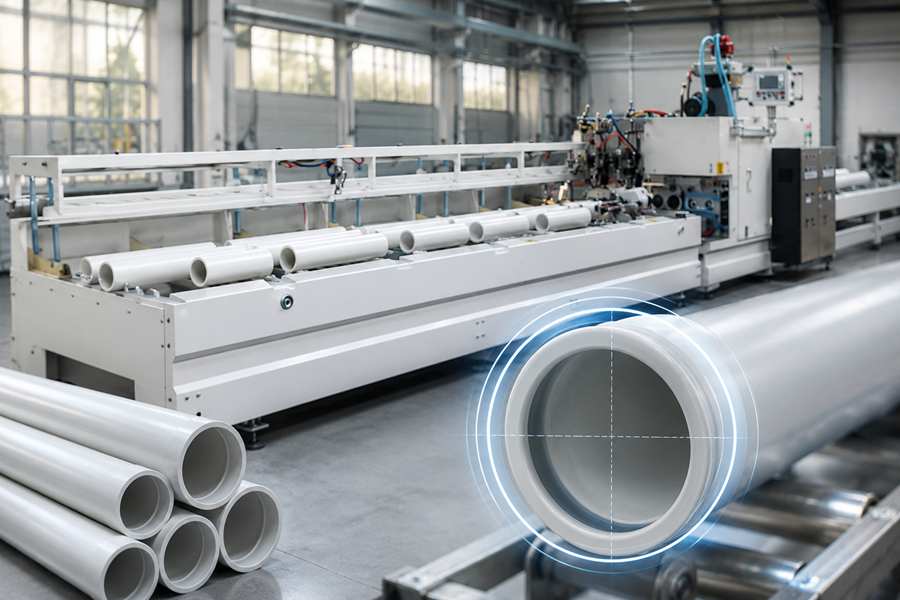
Reliable socket concentricity depends on keeping the plastic pipe correctly aligned while maintaining a stable forming process. Consistent control throughout each stage allows the socket to expand uniformly, connect smoothly, and deliver dependable joint performance.
What Is Socket Concentricity?
In plastic pipe processing, socket concentricity refers to the alignment between the center axis of the socket formed by a Belling Machine and the centerline of the original pipe body. It indicates whether the socket has expanded uniformly around the pipe during belling.
- Socket centerline:An imaginary axis extending through the middle of the expanded socket.
- Pipe centerline:The original central axis running through the unformed plastic pipe body.
- Concentric socket:The socket and pipe body have almost the same centerline, creating a relatively uniform radial distance around the circumference.
- Eccentric socket:The socket axis deviates from the pipe centerline, positioning the expanded section closer to one side.
- Concentricity measurement:The offset can be assessed by measuring the internal diameter, wall clearance, or radial distance at several points around the socket.
Common Problems Caused by Socket Eccentricity
Poor socket concentricity influences the connection performance of plastic pipes rather than only changing the appearance of the expanded end. A socket that forms off-center may produce uneven clearances and inconsistent contact throughout the joint area.
Common problems include:
- Unequal rubber-ring compression
- Increased pipe insertion difficulty
- Connection areas that are excessively loose or tight
- Inconsistent adhesive bonding clearance
- Poor alignment between joined plastic pipes
- Increased rejection levels during production
Concentricity should remain consistent during continuous production instead of being evaluated from a single qualified sample.
Main Factors Affecting Socket Concentricity
| Factor | Common Problem | Main Control |
| 1. Plastic Pipe Condition | Oval, curved, or uneven pipe ends | Examine ovality, straightness, and cutting accuracy |
| 2. Pipe Centering and Support | Pipe axis is not aligned with the mandrel axis | Adjust rollers, guides, stops, and clamping units |
| 3. Heating Uniformity | One side softens more quickly | Balance temperature, heating length, and pipe rotation |
| 4. Tooling and Forming | Mandrel shifts the pipe during entry or withdrawal | Manage tool runout, forming speed, and retraction |
| 5. Cooling and Inspection | Socket moves after forming or defects remain undetected | Apply even cooling and inspect multiple positions |
1. Control the Plastic Pipe Condition
A belling machine cannot fully compensate for a plastic pipe that is already oval, curved, or inaccurately cut. Existing dimensional variation often becomes more noticeable once the pipe end is heated and expanded.
Check these items before belling:
- Outside diameter measured in at least two directions
- Pipe straightness and end-section ovality
- Cutting angle, surface burrs, and melted edges
- Shape changes caused by storage pressure or stacking
The pipe end should remain flat, clean, and perpendicular to the pipe body. A slanted cut meets the forming mandrel unevenly and can force the socket toward one side.
2. Center and Support the Pipe
The feeding rollers, pipe stop, clamps, heater, and forming mandrel should remain aligned along a common centerline. An offset at any station may result in an eccentric socket.
Main control measures include:
- Adjust support rollers to the actual outside diameter of the pipe.
- Position supports close enough to limit sagging in long plastic pipes.
- Select self-centering clamps when processing several pipe sizes.
- Eliminate excessive movement in guides, rollers, and pipe stops.
- Prevent overly strong clamping pressure on thin-wall pipes.
During machine acceptance, buyers should ask for a practical tooling-change demonstration. The equipment should recover accurate centering without requiring repeated manual realignment.
3. Keep Heating Uniform
Uneven heat distribution causes one side of the plastic pipe to expand more easily than the other. The less-heated side produces greater resistance and may move the pipe away from the mandrel centerline.
Heating parameters should correspond to the pipe material, outside diameter, wall thickness, and required socket depth. Pipes sharing the same diameter may still need separate recipes when their wall thicknesses or formulations are different.
| Heating Item | Incorrect Setting | Possible Result |
| Circumferential temperature | One side receives more heat | Uneven socket expansion |
| Heating length | Heated section is too short | Excessive forming resistance |
| Heating length | Heated section is too long | Pipe-end sagging or wrinkling |
| Pipe rotation | Rotation slips or fluctuates | Irregular temperature distribution |
| Heating recipe | One setting is applied to every pipe | Unstable socket dimensions |
4. Control Tooling and Forming
A worn, contaminated, or incorrectly aligned forming mandrel directly transfers dimensional error to the softened plastic pipe socket. The tool condition should therefore be examined before operators adjust the heating settings.
Important inspection points include:
- Measure mandrel runout directly on the working surface.
- Remove accumulated plastic residue from the mold regularly.
- Examine bearings, drive shafts, mounting surfaces, and fasteners.
- Use a progressive mandrel entry profile.
- Maintain alignment between groove-forming parts and the main mandrel.
The mandrel should enter and retract along a steady central axis. Excessive speed, abrupt acceleration, or premature clamp release may push the softened socket sideways.
A practical forming cycle includes:
- Move the mandrel toward the pipe end.
- Expand the heated section gradually.
- Form the complete socket profile.
- Hold the pipe securely in position.
- Withdraw the mandrel with a smooth movement.
The maximum forming speed is not necessarily the most suitable operating speed. Repeatable socket dimensions provide greater production value than a minor reduction in cycle time.
5. Cool and Inspect the Socket
A formed plastic pipe socket can remain flexible after the mandrel has been withdrawn. Uneven cooling, early unclamping, or insufficient discharge support may still alter its concentricity.
Cooling nozzles should direct air or water evenly around the full socket circumference. The plastic pipe should remain properly supported until the transition section reaches sufficient dimensional stability.
Measure several locations after the socket has cooled completely:
- Socket opening
- Center section of the socket
- Rubber-ring groove or adhesive bonding zone
- Socket transition section
- Internal insertion stop
- Original pipe body beside the formed socket
| Inspection Result | Likely Cause |
| Thick side consistently appears in one position | Fixed misalignment in the clamp, heater, or mandrel |
| Thick side moves between production cycles | Pipe ovality, feeding play, or unstable heating |
| Socket is centered before cooling but shifts afterward | Uneven cooling or early support release |
| Groove is eccentric while the socket opening is acceptable | Misalignment of the groove-forming component |
| Forming resistance rises unexpectedly | Insufficient heating or contamination on the mold |
Inspect the largest and smallest internal diameters, wall-clearance distribution, socket depth, ovality, and runout. A single diameter measurement is not enough to verify the overall concentricity of the socket.
Troubleshooting Socket Eccentricity
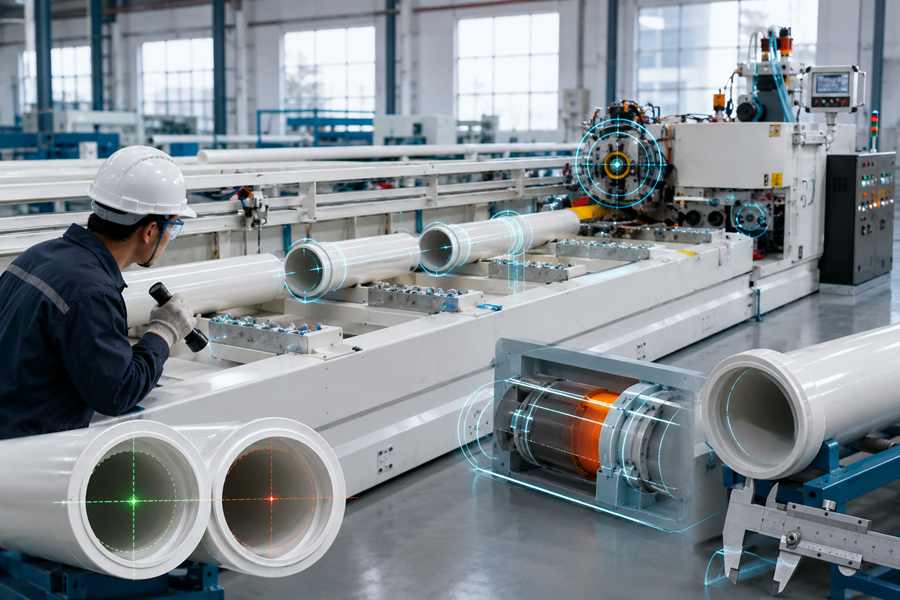
When socket concentricity moves beyond the specified tolerance, examine the plastic pipe belling process in the following sequence:
- Inspect pipe ovality, straightness, and cut-end squareness.
- Confirm the support roller height and pipe-feeding position.
- Check clamp alignment and applied clamping pressure.
- Measure temperature distribution around the heated pipe circumference.
- Examine mandrel installation, runout, wear, and surface cleanliness.
- Review forming speed, pressure, holding duration, and withdrawal motion.
- Check cooling nozzle coverage and the length of the cooling cycle.
- Measure the socket again after the material has cooled fully.
This troubleshooting order begins with frequent faults that are simpler and less costly to resolve. It also avoids unnecessary mold replacement when the real source is incoming pipe variation, incorrect positioning, unbalanced heating, or inconsistent cooling.
Stable socket concentricity relies on the complete plastic pipe belling cycle instead of a single part of the machine. Accurate pipe alignment, even heating, precise tooling, steady forming, and balanced cooling support more consistent results throughout continuous production.