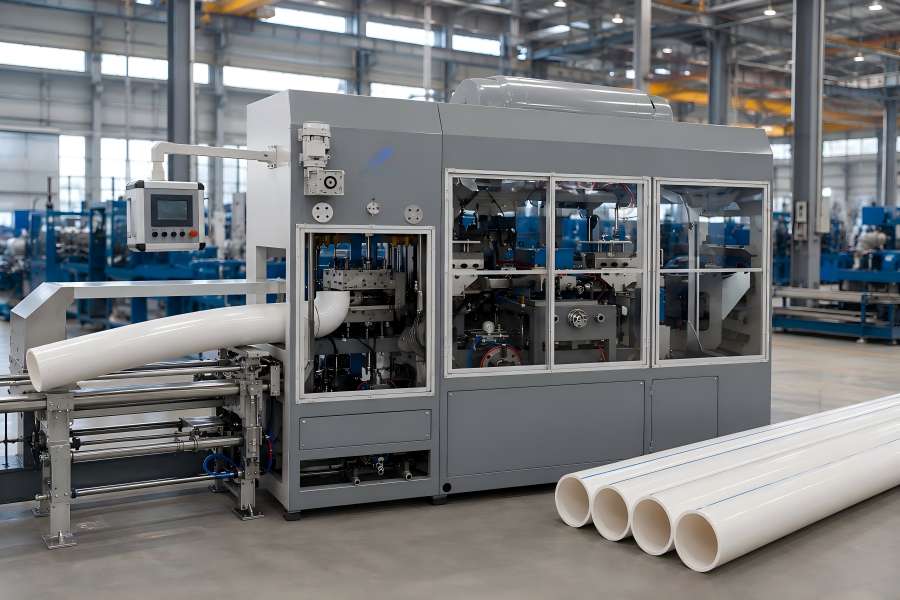
PVC and HDPE plastic pipes are extensively utilized in industrial systems, telecommunications, irrigation, and infrastructure. To meet complex installation needs, plastic pipe bending machines use controlled heating, precise forming, and automation to create accurate bends while maintaining pipe strength and production consistency.
Why Precision Matters in PVC and HDPE Processing
The precision of a pipe bending machine directly affects the functionality, longevity, and safety of the entire piping system.
Maintaining Flow Efficiency
Poorly formed bends can create internal restrictions that disrupt fluid flow. These restrictions increase pressure loss and reduce system efficiency.
Precision bending ensures:
- Smooth internal pipe surfaces
- Consistent cross-sectional dimensions
- Reduced turbulence
- Improved flow characteristics
This is especially important in water supply, drainage, chemical transport, and industrial fluid systems.
Reducing Leak Risks
Improper bending can create stress points that weaken the pipe wall.
Precision-controlled bending minimizes:
- Microcracks
- Material fatigue
- Structural distortion
- Long-term failure risks
As a result, piping systems maintain higher reliability throughout their service life.
Improving Installation Accuracy
Infrastructure projects often require pipes to fit exact layouts and engineering specifications.
Accurate bending provides:
- Better alignment
- Faster installation
- Reduced field modifications
- Improved project efficiency
This is particularly valuable in large-scale municipal and industrial projects.
Minimizing Material Waste
Incorrect bends frequently lead to rejected products.
Precision machinery helps manufacturers:
- Reduce scrap rates
- Improve material utilization
- Lower production costs
- Increase profitability
Challenges of Bending PVC and HDPE Pipes
Although PVC and HDPE are both thermoplastics, their material characteristics create unique processing challenges. Selecting the appropriate machine settings, tooling design, and production procedure requires an understanding of these distinctions.
PVC Bending Challenges
PVC offers good rigidity, strength, and dimensional stability, but improper heating can make it brittle. Therefore, PVC bending must be carefully controlled to prevent cracks, deformation, or internal stress.
Common challenges include:
- Surface cracking
- Wall collapse
- Ovalization
- Discoloration from overheating
- Internal stress buildup
To prevent these problems, PVC bending requires controlled temperature and forming speed. Uneven heating can cause deformation, rough surfaces, or inaccurate bend angles.
HDPE Bending Challenges
HDPE is more flexible than PVC but presents different processing difficulties. Because of its durability and impact resistance, it is extensively utilized in industrial piping, mining, water supply, gas distribution, and agricultural irrigation.
Manufacturers often face:
- Springback effects
- Shape recovery after bending
- Excessive deformation
- Uneven wall thickness
- Large-radius control difficulties
Precision machinery uses advanced algorithms and force control to manage HDPE springback, calculating the proper overbend angle and cooling time to achieve the required final shape.
Key Components That Enable Precision Bending
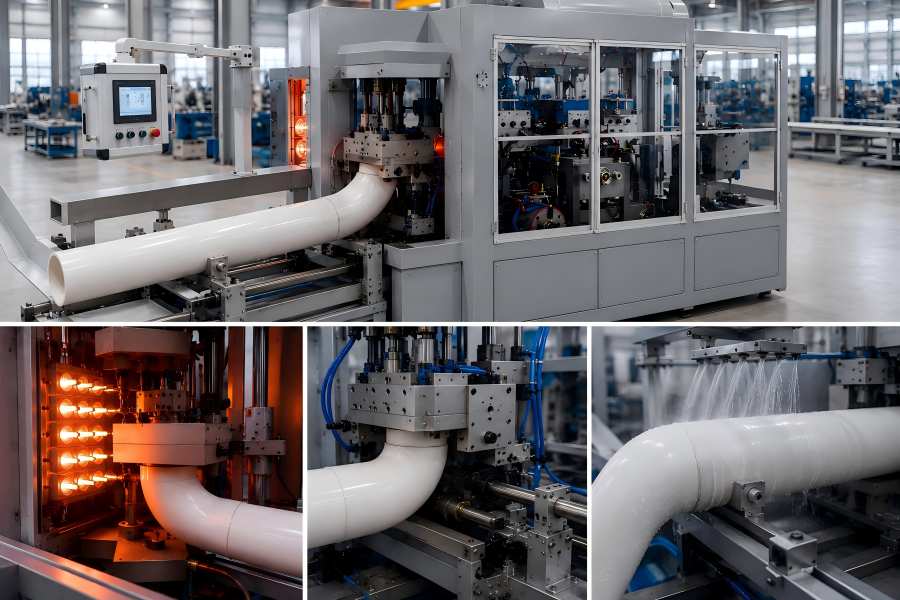
Modern plastic pipe bending machines incorporate multiple technologies that work together to achieve consistent results. Controlling pipe shape, temperature, movement, and ultimate dimensional precision is the responsibility of each component.
Advanced Heating Systems
Heating is one of the most critical factors in pipe bending accuracy. The pipe must be heated evenly across the bending zone so that the material softens without losing its strength or surface quality.
Modern machines may utilize:
- Infrared heaters
- Hot air systems
- Electric heating elements
- Induction-assisted heating zones
- Multi-zone temperature control
These technologies guarantee even heat distribution across the bending region.
Benefits include:
- Reduced overheating
- Improved material consistency
- Better bend quality
- Lower rejection rates
Multi-zone heating is particularly helpful for processing PVC and HDPE because varied pipe diameters and wall thicknesses need for varying heating durations. A thin-wall pipe may need fast and moderate heating, while a thick-wall pipe may require longer heating to reach stable forming conditions.
Precision Clamping Mechanisms
Pipe movement during bending can significantly affect dimensional accuracy. If the pipe slips, rotates, or shifts during the bending process, the final angle and bend position may deviate from the design requirement.
High-quality clamping systems provide:
- Stable pipe positioning
- Controlled pressure distribution
- Reduced slippage
- Improved repeatability
Proper clamping ensures the pipe follows the desired bending path without distortion. It also helps protect the pipe surface from damage by applying force evenly rather than concentrating pressure in one small area.
Computer-Controlled Bending Arms
Modern machines use servo-driven or CNC-controlled bending systems. These systems allow the bending arm to move with high accuracy and repeatability, reducing dependence on manual operation.
These technologies offer:
- Precise angle control
- Adjustable bending speeds
- Repeatable motion paths
- Automated production sequences
The result is highly accurate bend geometry across large production batches. When manufacturers need to produce hundreds or thousands of identical pipe sections, CNC-controlled bending ensures every piece meets the same specification.
Integrated Cooling Systems
After bending, the pipe must retain its new shape. If cooling is too fast, internal stress may remain inside the pipe. If cooling is too slow, the pipe may deform or experience springback.
Cooling systems help by:
- Stabilizing dimensions
- Preventing springback
- Reducing residual stress
- Improving consistency
Controlled cooling is particularly important for HDPE processing because the material is more elastic and may try to return toward its original shape after forming.
How Heating Control Ensures Precision
Temperature management is the foundation of successful plastic pipe bending. A stable heating process determines whether the pipe can be bent smoothly, whether the surface remains clean, and whether the final bend keeps its required shape.
Uniform Material Softening
Consistent heating softens the pipe evenly throughout the bending zone. This allows the pipe wall to stretch and compress in a balanced way during forming.
This prevents:
- Localized weak spots
- Uneven deformation
- Surface defects
- Structural inconsistencies
Uniform softening is especially important for larger pipe diameters, where the outer and inner pipe walls may heat at different rates. Advanced heating systems reduce this temperature difference and improve bending stability.
Preventing Material Degradation
Excessive temperatures can permanently damage thermoplastic materials. Overheated PVC may discolor or become brittle, while overheated HDPE may lose dimensional stability or surface quality.
Precision heating systems continuously monitor:
- Surface temperature
- Core temperature
- Heating duration
- Energy distribution
These controls help preserve material properties after bending. By keeping the pipe within an optimized temperature range, manufacturers can ensure the finished product remains strong, durable, and suitable for long-term use.
Optimizing Formability
Different pipe sizes and materials require different heating profiles. A small PVC electrical conduit and a large HDPE water pipe cannot be processed using the same heating method.
Modern machines allow operators to customize:
- Heating intensity
- Exposure time
- Temperature zones
- Process recipes
This flexibility improves bending accuracy across diverse product ranges. Once the correct parameters are established, they can be saved and reused for future production, improving consistency and reducing setup time.
The Role of CNC Technology in Pipe Bending Precision
CNC technology has transformed plastic pipe processing by replacing manual judgment with programmable accuracy. For manufacturers handling multiple product specifications, CNC systems make production easier to control and repeat.
Automated Bend Angle Control
Manual bending often introduces inconsistencies because each operator may apply slightly different force, timing, or angle control.
CNC systems automatically regulate:
- Bend angles
- Rotation positions
- Feed distances
- Forming sequences
This ensures every pipe matches design specifications. The system can stop at the exact programmed angle and compensate for material behavior, reducing the risk of overbending or underbending.
Multi-Angle Production
Many industrial pipe systems require multiple bends within a single component. These bends may need to occur at different distances, directions, or planes.
CNC machines can execute:
- Complex bend sequences
- Compound angles
- Three-dimensional configurations
- Custom geometries
This capability significantly expands manufacturing flexibility. Instead of producing only simple single-angle bends, manufacturers can supply customized pipe components for more complex installation environments.
Program Storage and Repeatability
Manufacturers frequently process recurring orders. Without a digital system, every repeat order may require manual setup and adjustment.
CNC control systems can store:
- Product specifications
- Heating parameters
- Bend sequences
- Production settings
Operators can quickly recall programs for future production runs, ensuring consistent results. This is especially useful for OEM orders, infrastructure projects, and standardized product lines where repeatability is a key quality requirement.
Preventing Common Pipe Bending Defects
Precision machines are specifically designed to minimize common defects. These flaws may lower pipe strength, flow performance, and installation dependability in addition to their aesthetic impact.
Pipe Flattening
The pipe becomes flattened when it bends and loses its circular shape. This can reduce internal flow area and weaken the pipe structure.
Advanced machines reduce flattening through:
- Internal support systems
- Controlled bending force
- Optimized heating profiles
- Precision mandrels
By supporting the pipe during bending, the machine helps maintain a more uniform cross-section and prevents excessive compression on the inner radius.
Wrinkling
Wrinkles may form on the inner radius of a bend when the material compresses unevenly. These wrinkles can create weak points and reduce the visual quality of the finished pipe.
Prevention methods include:
- Accurate temperature control
- Proper clamping
- Controlled bending speed
- Optimized tooling design
A stable bending speed gives the material enough time to deform smoothly without sudden stress concentration.
Cracking
Cracks are often caused by insufficient heating or excessive stress. PVC pipes are particularly sensitive to cracking if they are bent while too cold or forced into a radius that is too tight.
Precision equipment minimizes cracking by maintaining ideal forming conditions throughout the process. The machine ensures the pipe reaches the correct softness before bending and applies force gradually to avoid sudden stress.
Springback
Springback is especially common in HDPE pipes. If the bending force is removed, the pipe could partially return to its original shape.
Modern systems compensate through:
- Predictive bending algorithms
- Overbend calculations
- Material-specific programming
- Controlled cooling cycles
This allows the finished bend angle to match the target specification more closely after the pipe has cooled and stabilized.
Precision Bending for Different Pipe Sizes
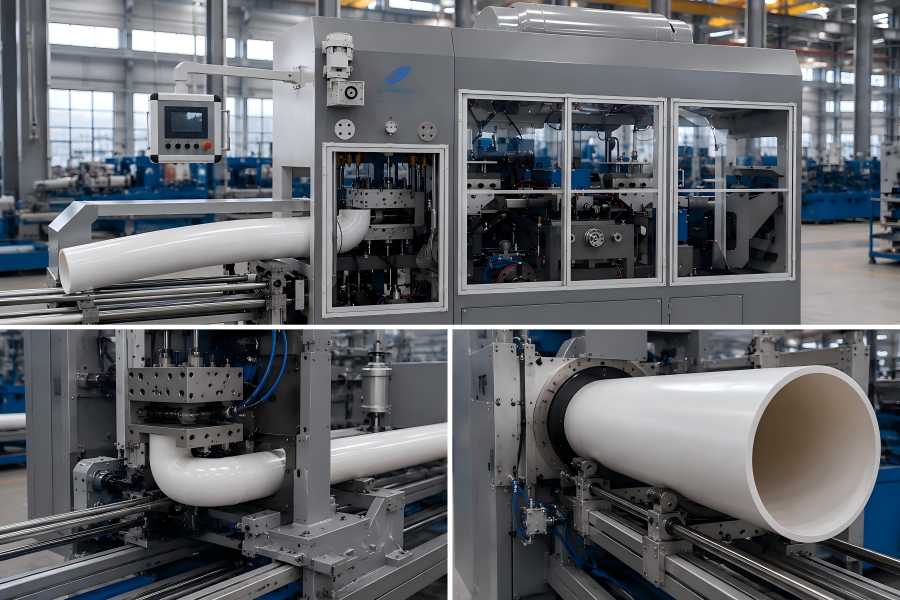
Pipe diameter significantly influences bending requirements. The machine must be adjusted according to pipe size, wall thickness, material type, and required bend radius.
Small-Diameter Pipes
Small pipes often require tight bending radii and high dimensional accuracy. They are commonly used in electrical conduits, indoor plumbing, cable protection, and compact industrial systems.
Precision systems help achieve:
- Accurate bend locations
- Consistent angles
- Smooth surfaces
- Minimal distortion
Applications include:
- Electrical conduits
- Telecommunications systems
- Residential plumbing
For small-diameter products, speed and repeatability are especially important because production volumes are often high.
Medium-Diameter Pipes
These pipes are common in municipal and industrial applications. They must balance flexibility, strength, and installation accuracy.
Requirements include:
- Structural stability
- Reliable flow performance
- Repeatable production
Automated bending systems ensure these standards are consistently met. Medium-diameter pipe bending often requires careful control of heating time and support tooling to prevent wall collapse.
Large-Diameter Pipes
Large pipes have more difficulties because of their size and thick walls. They require more heating energy, stronger clamping, and more stable bending support.
Precision machinery provides:
- Higher bending force
- Uniform heating
- Enhanced support structures
- Accurate dimensional control
These capabilities are essential for infrastructure projects and industrial pipelines. Large-diameter bending errors can be costly because the pipe material itself is more expensive and difficult to reprocess.
How Automation Improves Precision
Automation has become a major driver of quality improvements in pipe processing. It allows manufacturers to reduce manual dependency while improving production stability.
Reduced Human Error
Manual operations can introduce variability. Differences in operator experience, judgment, and handling methods may affect final product quality.
Automated systems ensure:
- Consistent execution
- Standardized procedures
- Improved accuracy
- Repeatable quality
This is particularly valuable for factories that run long production shifts or handle frequent batch orders.
Real-Time Monitoring
Modern machines continuously monitor:
- Temperature
- Bending force
- Position accuracy
- Cycle performance
This data enables immediate process adjustments when necessary. If temperature or bending position moves outside the preset range, the system can alert operators or stop production to prevent defective output.
Closed-Loop Control Systems
Advanced machines utilize feedback systems that automatically correct deviations. Instead of simply following a fixed motion path, the system can compare actual process data with target values.
Benefits include:
- Improved precision
- Reduced defects
- Better product consistency
- Enhanced production efficiency
Closed-loop control is one of the most important features for manufacturers seeking high-quality, repeatable pipe bending results.
Industry Applications Requiring High-Precision Pipe Bending
Many industries depend on precisely bent PVC and HDPE pipes. As project designs become more complex, demand for customized pipe shapes continues to grow.
Water Supply Systems
Water infrastructure requires reliable pipe connections and smooth flow paths. Poor bends may increase pressure loss or create weak areas in the network.
Precision bending supports:
- Municipal water networks
- Irrigation systems
- Water treatment facilities
- Distribution pipelines
Accurate bends help contractors reduce the number of fittings and improve installation efficiency.
Drainage and Sewerage
Accurate pipe geometry improves drainage efficiency and installation quality. Drainage systems often require pipes to follow specific slopes and routing directions.
Applications include:
- Stormwater systems
- Sewer networks
- Industrial wastewater treatment
- Underground drainage projects
Precision bending helps maintain proper flow direction while reducing unnecessary joints.
Telecommunications Infrastructure
Protective conduits often require complex routing. They must protect cables while allowing smooth installation and future maintenance.
Precision bending ensures:
- Cable protection
- Efficient installation
- Reduced connector usage
- Improved system reliability
Smooth bends are especially important for fiber optic cables, which can be sensitive to excessive bending stress.
Industrial Processing Facilities
Factories frequently use plastic piping for fluid transport. These systems may carry water, chemicals, compressed air, or process liquids.
Precision bends help optimize:
- Plant layouts
- Equipment connections
- Chemical transport systems
- Utility infrastructure
Customized bends allow pipes to fit around machines, walls, platforms, and other facility structures.
Agricultural Irrigation
Modern irrigation systems depend on accurately bent pipes to navigate varying terrain and field layouts.
Consistent bending improves system performance while reducing installation time. It also helps farmers and irrigation contractors build more reliable water delivery networks with fewer connection points.
Integration with Other Pipe Processing Equipment
Pipe bending machines are increasingly integrated into complete production lines. This integration helps manufacturers improve workflow efficiency and reduce manual handling between different processing stages.
These lines may include:
- Extrusion systems
- Cutting machines
- Socket-forming equipment
- Inspection stations
- Packaging systems
For example, a pipe may be bent before entering a Belling Machine to form a socket end for secure joining. This integration improves production efficiency and product consistency.
When bending, cutting, and socketing equipment work together, manufacturers can reduce transfer time, improve dimensional consistency, and increase output for customized pipe components used in infrastructure, irrigation, and industrial applications.