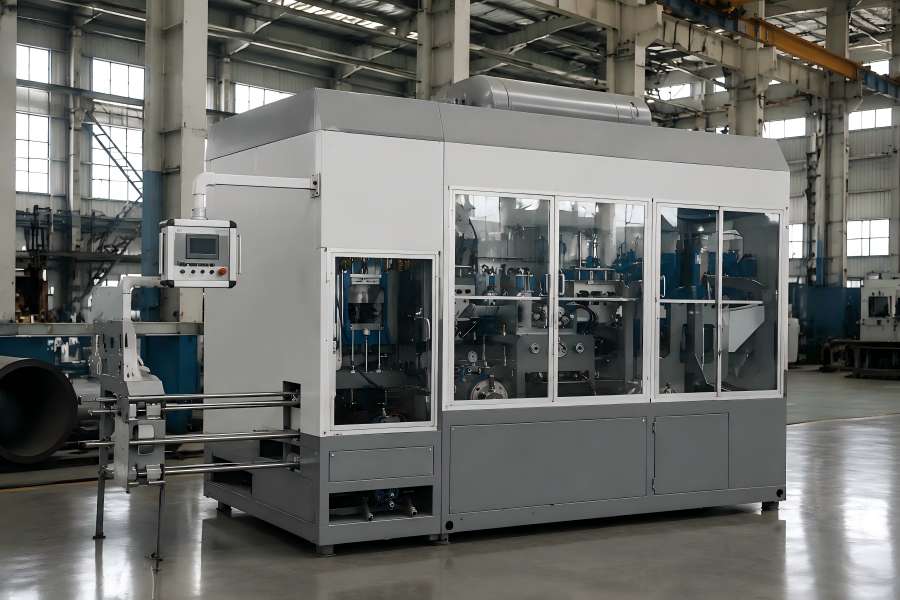
The demand for plastic pipe bending machines is growing as PVC, HDPE, PE, and PP-R pipes are widely used in construction, agriculture, water supply, drainage, and industrial pipeline systems. Heavy-duty bending machines help manufacturers produce customized curved pipes with stable quality, while factors like capacity, technology, automation, and tooling affect the final cost.
What Is a Heavy-Duty Plastic Pipe Bending Machine?
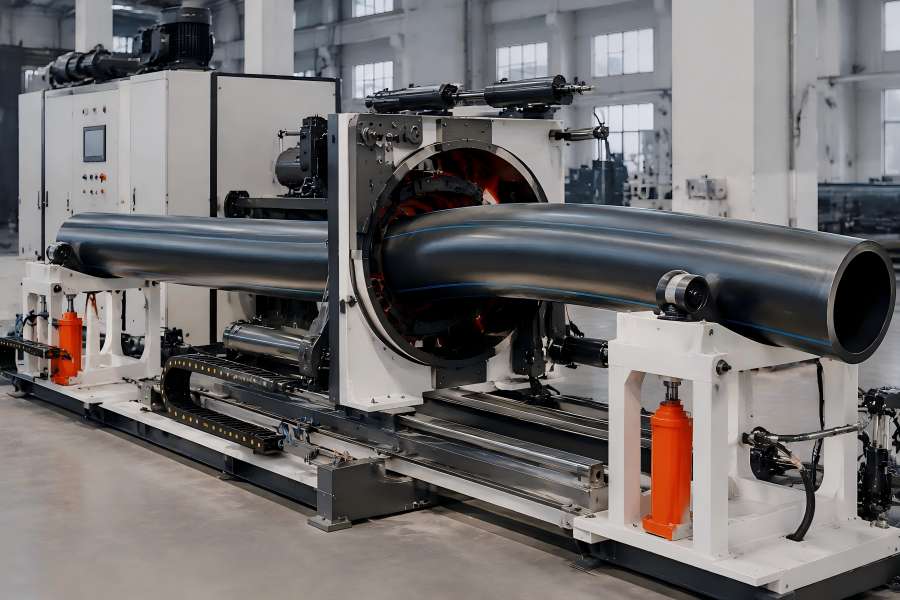
A heavy-duty plastic pipe bending machine is specialized equipment designed to bend large-diameter plastic pipes into specific shapes while maintaining structural strength and dimensional accuracy.
Unlike metal pipe bending equipment, plastic pipe bending machines mainly use controlled heating, forming molds, and cooling systems to reshape pipes. Since plastic materials become flexible after reaching a certain temperature, precise control of the heating and forming process is essential.
These machines are widely used for:
- PVC drainage pipes
- HDPE water supply pipes
- PE irrigation pipes
- PP-R plumbing systems
- Industrial plastic pipeline projects
The basic working process includes three main stages:
Pipe Heating
The plastic pipe is heated until it reaches a suitable forming temperature.
Different materials require different heating ranges:
- PVC pipe: approximately 120–150°C
- PE pipe: approximately 120–160°C
- HDPE pipe: approximately 130–160°C
- PP-R pipe: approximately 140–170°C
Proper temperature control helps prevent pipe deformation, surface damage, and uneven wall thickness.
Pipe Forming
After heating, the softened pipe is positioned in a customized bending mold, where controlled pressure forms it to the required angle and radius.
For large-diameter pipes, stronger forming systems are required because thicker plastic walls create higher resistance during bending.
Cooling and Stabilization
After forming, the pipe is cooled to maintain its final shape.
A stable cooling process improves:
- Bending accuracy
- Product consistency
- Surface quality
- Long-term performance
Average Price Range of Heavy-Duty Plastic Pipe Bending Machines
The price of a heavy-duty plastic pipe bending machine depends on pipe capacity, automation level, heating technology, and customization requirements.
Compared with large metal pipe bending systems, plastic pipe bending equipment usually requires a lower investment.
Typical price ranges include:
| Machine Type | Average Price Range |
| Semi-Automatic Plastic Pipe Bending Machine | USD 3,000–10,000 |
| Hydraulic Heavy-Duty Plastic Pipe Bending Machine | USD 10,000–30,000 |
| CNC Plastic Pipe Bending Machine | USD 25,000–60,000 |
| Customized Automatic Plastic Pipe Bending System | USD 50,000–100,000+ |
For small and medium-sized manufacturers, semi-automatic machines are suitable for basic PVC, PE, and small-diameter pipe processing.
Hydraulic heavy-duty machines are commonly selected for larger plastic pipes because they provide stronger bending force and better production stability.
CNC systems are designed for manufacturers requiring higher accuracy, multiple production programs, and continuous operation.
For example:
- A 110 mm PVC pipe bending machine may cost around USD 5,000–12,000.
- A 315 mm HDPE pipe bending machine may cost approximately USD 15,000–35,000.
- A 500 mm CNC plastic pipe bending system may require USD 40,000–70,000 depending on configuration.
Key Factors That Affect Heavy-Duty Plastic Pipe Bending Machine Price
Pipe Diameter Capacity
Pipe diameter is one of the most important factors affecting machine cost.
Small-diameter plastic pipes require less bending force, smaller heating systems, and simpler machine structures. However, large-diameter pipes need stronger frames, larger hydraulic systems, and higher-capacity heating units.
Typical price ranges include:
- 20–110 mm plastic pipe machines: USD 3,000–12,000
- 160–315 mm pipe machines: USD 10,000–30,000
- 400–630 mm heavy-duty machines: USD 30,000–70,000
For example, a 500 mm HDPE pipe requires much higher forming force than a small PVC pipe because of its larger diameter and thicker wall structure.
Large pipe processing equipment usually requires:
- Reinforced machine frames
- Higher hydraulic pressure
- Larger heating chambers
- Customized forming molds
Increasing machine capacity from 200 mm to 500 mm may increase equipment costs by approximately 50%–100%.
Manufacturers should select the proper capacity based on current production needs rather than purchasing oversized equipment.
Heating Technology and Temperature Control
Heating technology directly affects bending quality and machine pricing.
Plastic pipes require uniform heating because uneven temperature distribution may cause:
- Surface marks
- Pipe collapse
- Uneven wall thickness
- Reduced mechanical strength
Electric Heating System
Electric heating is commonly used because it provides stable temperature control and simple operation.
Advantages include:
- Accurate temperature adjustment
- Easy maintenance
- Suitable for various plastic materials
Depending on heating capacity, electric systems may increase machine costs by approximately USD 1,000–5,000.
Infrared Heating System
Infrared heating provides faster and more uniform heat transfer.
Compared with traditional methods, infrared systems can reduce heating time by approximately 20%–30%.
They are suitable for manufacturers requiring faster production cycles and improved efficiency.
Additional cost:
Approximately USD 3,000–8,000.
Hot Air Heating System
Hot air heating is often used for smaller and medium-sized plastic pipes.
It provides flexible operation and lower investment costs, although heating speed may be lower than infrared systems.
Automation Level and Control System
Automation level has a significant impact on the final equipment price.
Basic machines require operators to manually control:
- Pipe loading
- Heating time
- Bending operation
- Cooling process
These machines have lower purchase costs but require more labor.
Advanced systems may include:
- PLC control
- Touchscreen operation
- Servo positioning
- Automatic parameter storage
- Digital temperature monitoring
Typical additional costs include:
| Control System | Additional Cost |
| Basic Control Panel | Included |
| PLC Touchscreen Control | USD 2,000–6,000 |
| CNC Control System | USD 10,000–25,000 |
| Fully Automatic Integration | USD 30,000+ |
For medium-scale manufacturers, PLC-controlled hydraulic machines often provide a good balance between investment and production efficiency.
For high-volume production, CNC systems minimize manual operation and ensure greater product consistency.
Automation may reduce labor requirements by approximately 40%–60%.
Machine Structure and Component Quality
The structure and component quality of a heavy-duty plastic pipe bending machine directly affect stability, bending accuracy, and service life.
Machines designed for larger pipes require stronger construction and reliable components to maintain consistent performance during long-term operation.
Reinforced Machine Frame
Heavy-duty machines use reinforced steel frames to improve structural stability and reduce vibration during bending.
A stronger frame helps:
- Maintain bending accuracy
- Support larger pipe sizes
- Extend machine service life
Compared with standard models, reinforced structures require more materials and manufacturing processes, increasing equipment costs by approximately 20%–40%.
Hydraulic and Drive Components
High-quality hydraulic and drive systems provide stable bending force and smoother operation, especially when processing large-diameter plastic pipes.
Reliable components help:
- Reduce operating errors
- Improve production consistency
- Support continuous operation
Depending on cylinder size, motor power, and system configuration, upgraded components may increase machine costs by USD 3,000–10,000.
Precision Control Components
Precision components such as servo motors, positioning systems, and control units improve bending repeatability and product quality.
Although these upgrades increase initial investment, they help manufacturers achieve more accurate processing and reduce material waste during long-term production.
Mold and Tooling Requirements
Plastic pipe bending machines usually require customized molds according to pipe size, material type, and bending radius.
The mold design directly affects:
- Bending accuracy
- Surface quality
- Production efficiency
Typical mold costs include:
- Small pipe mold: USD 300–1,500
- Medium pipe mold: USD 1,500–4,000
- Large industrial mold: USD 4,000–10,000
Manufacturers producing multiple pipe specifications may require several mold sets.
For example, producing 50 mm, 110 mm, 200 mm, and 315 mm pipes may require additional mold investment of approximately USD 5,000–15,000.
Although customized tooling increases initial costs, it improves production flexibility and reduces material waste.
Plastic Pipe Material Requirements
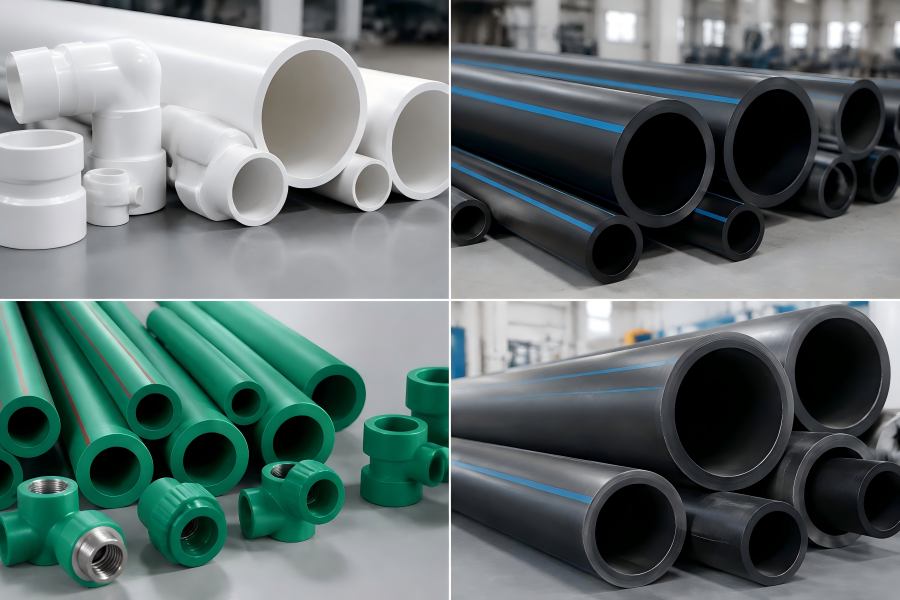
Different plastic pipe materials have different flexibility, heat resistance, and forming requirements, which directly affect machine configuration, heating systems, and tooling selection.
PVC Pipe
PVC pipes are commonly used in drainage, electrical conduit, and water supply applications. They require stable heating control to achieve smooth bending and prevent deformation.
Typical equipment price:
USD 5,000–25,000.
HDPE Pipe
HDPE pipes are commonly used in gas pipelines, irrigation, and industrial applications. Due to their higher toughness, they require stronger bending force, reinforced structures, and customized molds.
Typical equipment price:
USD 15,000–60,000.
PP-R Pipe
PP-R pipes are primarily used in hot and cold water supply systems. Their higher forming temperature requires precise heating and cooling control for accurate bending.
Typical equipment price:
USD 10,000–40,000.
PE Pipe
PE pipes are used in irrigation, water distribution, and industrial transportation. Large-diameter PE pipes require powerful bending systems to maintain shape accuracy after forming.
Typical equipment price:
USD 8,000–40,000.
Customization Requirements
Plastic pipe manufacturers often require customized bending solutions based on pipe specifications, production processes, and application requirements.
Customization can affect machine structure, control systems, tooling design, and overall equipment cost.
Pipe Size Range
Machines can be customized to accommodate different pipe diameter requirements:
- Small pipes: 20–110 mm
- Medium pipes: 110–315 mm
- Large pipes: 315–630 mm
Larger diameter ranges usually require stronger structures, higher bending force, and upgraded heating systems.
Special Bending Shapes
Some applications require customized bending angles, radii, and forming programs to meet specific installation requirements.
Customized designs help improve:
- Bending accuracy
- Product consistency
- Production flexibility
Production Line Integration
For large-scale manufacturers, bending machines can be integrated with:
- Pipe extrusion lines
- Cutting equipment
- Inspection systems
Integrated solutions improve automation levels and reduce manual operation requirements, but they may increase total investment depending on project complexity.
How to Choose the Right Heavy-Duty Plastic Pipe Bending Machine
Selecting the right heavy-duty plastic pipe bending machine based on production needs and pipe specifications helps improve bending quality, reduce costs, and support future expansion.
Confirm Pipe Specifications
Manufacturers should evaluate key pipe parameters, including:
- Pipe material
- Diameter range
- Wall thickness
- Required bending radius
These factors determine the required heating capacity, bending force, and mold configuration.
Match Machine Capacity with Production Needs
The machine capacity should match the actual production volume and application requirements.
For small-batch production, semi-automatic machines may provide better cost efficiency. For continuous manufacturing, hydraulic or CNC systems can offer higher productivity and more stable performance.
Consider Automation Requirements
Automation level should be selected based on labor availability and production targets.
PLC-controlled systems are suitable for manufacturers seeking improved efficiency, while CNC and automatic systems are better for high-volume production with multiple pipe specifications.
Evaluate Future Expansion
Manufacturers should consider potential changes in product demand when selecting equipment.
Choosing a machine with suitable expansion capability can help accommodate larger pipe sizes, new applications, or increased production capacity in the future.
Compare Overall Investment Value
The lowest purchase price does not always mean the best choice. Manufacturers should also consider energy consumption, maintenance requirements, production efficiency, and technical support to achieve better long-term value.
Choosing the Right Solution for Plastic Pipe Bending Needs
The cost of a heavy-duty plastic pipe bending machine depends on factors such as pipe diameter, material type, heating technology, automation level, machine structure, tooling requirements, and customization needs.
For small manufacturers, equipment priced between USD 3,000 and USD 10,000 can meet basic PVC and PE pipe processing requirements. Medium and large manufacturers may choose hydraulic or CNC systems ranging from USD 10,000 to USD 60,000 for higher production capacity and precision.
For companies requiring advanced automation, customized systems priced from USD 50,000 to USD 100,000+ can provide improved efficiency and long-term production value.