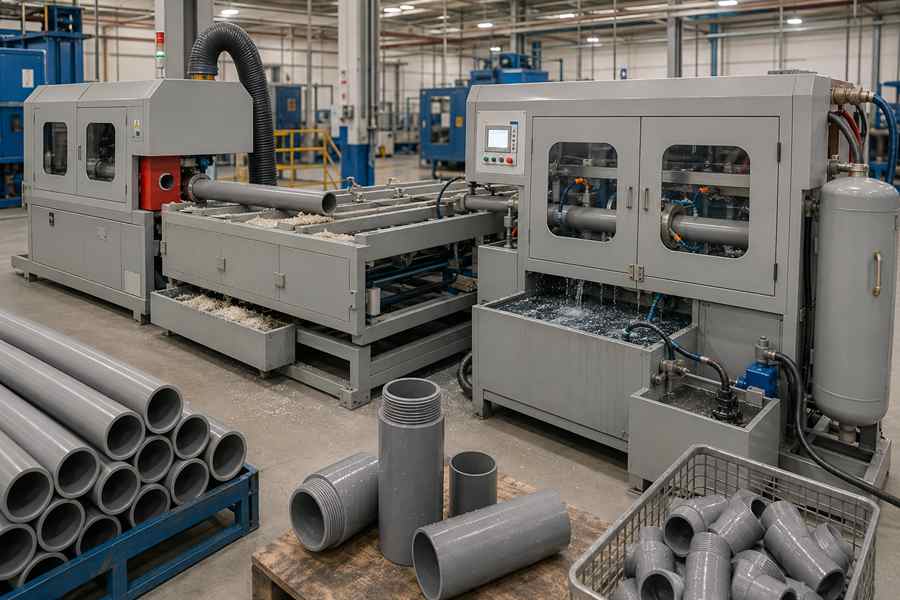
Dry cutting provides a simple and clean approach to plastic pipe threading, while cooled cutting offers stronger heat control for demanding production. The choice should be based on material behavior, thread depth, pipe size, production duration, and cleaning needs.
Comparing Dry and Cooled Cutting
| Comparison Item | Dry Cutting | Cooled Cutting |
| Heat control | Tool settings and airflow | Continuous cooling medium |
| Machine structure | Simpler configuration | Requires pumps, tanks, and filters |
| Finished pipe | Dry after processing | May require cleaning or drying |
| Chip condition | Dry dust or loose chips | Wet chips or mixed residue |
| Tool temperature | More sensitive to heat buildup | More stable during long production |
| Best fit | Moderate cutting load | Deep threads or continuous output |
When selecting a pipe threading machine, buyers should compare qualified output rather than cutting speed alone. Cleaning time, tool replacement, rejected pipes, and post-processing also affect real productivity.
Dry Cutting for Plastic Pipe Threading
Dry cutting removes plastic material without applying liquid to the thread area. A sharp cutter, suitable feed rate, controlled spindle speed, and effective extraction are essential for stable results.
This method is often suitable when the plastic pipe produces clean chips and does not soften excessively. It also supports production lines where the threaded pipe must remain dry after processing.
Main Advantages
Dry cutting requires fewer auxiliary components. There is no need for a coolant tank, circulation pump, liquid separator, or pipe-drying station.
Its main benefits include:
- Simpler machine construction
- Easier daily maintenance
- No liquid residue on the plastic pipe
- Faster transfer to inspection or packaging
- Lower fluid-management requirements
- Easier integration into dry production lines
Dry chips can usually be collected through local suction. The system should capture waste near the cutter before it enters the thread, clamp, or pipe interior.
Main Limitations
Heat buildup is the main challenge. Excessive cutting speed, deep tool engagement, or a worn cutter can soften the plastic and reduce thread accuracy.
Possible problems include:
- Melted thread edges
- Rough or smeared surfaces
- Plastic buildup on the cutter
- Fine dust around the machine
- Higher cutting resistance
- Shorter tool life
Dry cutting may require slower feeding, staged cutting, or stronger airflow for deeper thread profiles. A process that works on one pipe may become unstable after the cutter temperature rises during repeated cycles.
Cooled Cutting for Plastic Pipe Threading
Cooled cutting applies a controlled cooling medium near the cutter. The liquid removes heat, reduces friction, and helps prevent softened plastic from attaching to the tool.
The nozzle must direct cooling toward the actual cutting contact. A large fluid volume provides limited value when most of it misses the thread-forming area.
Main Advantages
Improved heat control is the main benefit of cooled cutting. A more stable tool temperature can support consistent thread dimensions during longer production runs.
Key advantages include:
- Reduced cutting temperature
- Less plastic sticking
- Cleaner thread edges
- Better control of deep threads
- More stable continuous production
- Potentially longer tool life
The cooling flow can also move chips away from the cutter. However, the chip-and-liquid mixture must be separated before the fluid returns to the cutting area.
Main Limitations
Cooled cutting needs additional equipment and regular maintenance. Pumps, nozzles, tanks, filters, and fluid levels must remain stable throughout production.
Common requirements include:
- Coolant circulation system
- Chip separation
- Fine fluid filtration
- Adjustable delivery nozzles
- Tank cleaning
- Pipe drying or surface cleaning
Dirty cooling fluid may carry plastic particles back toward the finished thread. This can scratch the pipe surface or reduce thread quality even when cutting temperature remains low.
Which Method Fits Your Plastic Pipe?
The correct choice depends on material behavior, thread geometry, pipe dimensions, production duration, and final cleaning requirements. Cooling should solve a genuine heat problem rather than compensate for poor tooling or unstable clamping.
Plastic Material Behavior
Dry cutting works well when the plastic remains stable under friction and produces short, loose chips. A sharp cutter and effective extraction can keep the thread clean.
Cooled cutting suits plastics that soften or stick as temperature rises. Cooling reduces smearing and helps preserve clear thread edges.
Thread Depth and Profile
Shallow or standard threads generate less heat, making dry cutting easier to control. Correct feed speed also prevents chips from damaging the surface.
Deeper or wider threads create more resistance and longer tool contact. Cooled cutting limits heat buildup and improves dimensional consistency.
Pipe Diameter and Wall Thickness
Dry cutting is practical for smaller plastic pipes with moderate wall thickness. It also avoids coolant residue inside the thread grooves.
Larger diameters and thicker walls place greater load on the cutter. Cooled cutting stabilizes tool temperature, while proper clamping prevents pipe deformation.
Production Duration
Dry cutting may perform well during short batches because the tool has time to cool between runs. Continuous production can gradually raise the cutter and spindle temperature.
Cooled cutting may provide more stable results during long shifts. Its benefit should still be weighed against fluid preparation, filter maintenance, and pipe-drying time.
Cleaning Requirements
Dry cutting normally leaves loose chips or dust that can be removed by suction. The threaded pipe can often move directly to measurement or packaging.
Cooled cutting may leave liquid inside thread grooves or the pipe. Applications requiring a clean, dry surface may need an additional air-blowing or drying stage.
Common Problems and Practical Adjustments
| Threading Problem | Likely Cause | Practical Adjustment |
| Melted thread edges | Excessive heat or dull cutter | Reduce speed, replace the tool, or add cooling |
| Rough thread surface | Incorrect feed or chip buildup | Adjust feeding and improve chip removal |
| Plastic sticks to cutter | Tool temperature is too high | Improve cooling or shorten cutting contact |
| Chips remain in threads | Weak extraction or flushing | Reposition the suction or cooling nozzle |
| Thread depth varies | Pipe movement or tool wear | Check clamps, guides, and cutter condition |
| Surface remains wet | Excessive cooling flow | Reduce fluid volume or add drying |
Troubleshooting should begin with the cutting tool, clamping system, and processing parameters. Changing from dry to cooled cutting will not correct inaccurate positioning or an unsuitable thread cutter.
How to Evaluate Threading Performance Before Purchase
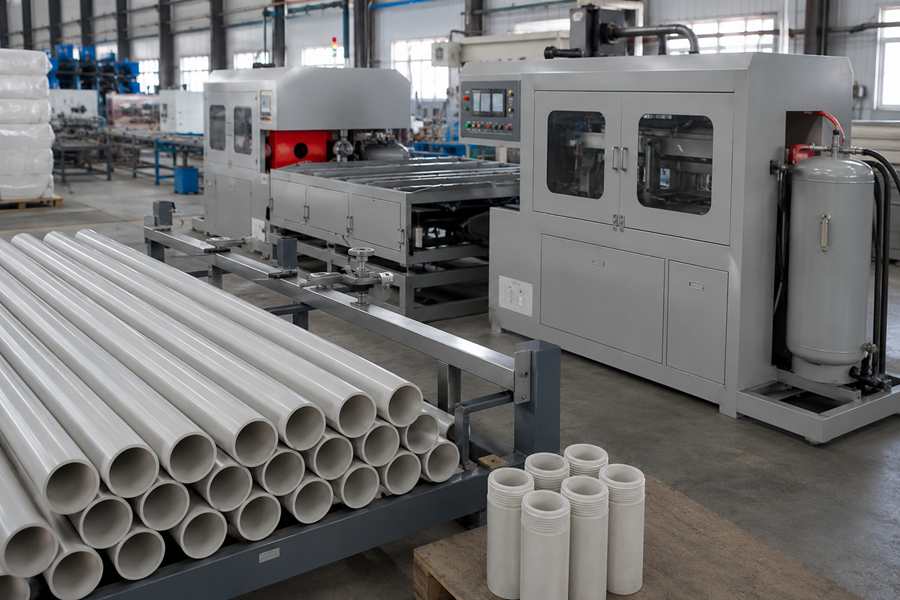
A machine trial should use the buyer’s actual plastic pipe material, diameter, wall thickness, and thread specification. Testing only one prepared sample cannot show whether heat and chip control remain stable.
The trial should record:
- Thread pitch and depth
- Entry and exit edge quality
- Surface smoothness
- Pipe roundness after clamping
- Chips remaining in the thread
- Cycle time per qualified pipe
- Cutter cleaning frequency
- Tool life during repeated processing
For dry cutting, buyers should inspect dust extraction and tool temperature after continuous production. The thread should remain stable as the machine reaches its normal operating condition.
For cooled cutting, buyers should check nozzle position, filtration, tank access, chip separation, and pipe-drying time. Cooling should improve thread consistency without creating excessive cleaning work.
Making the Final Choice
Dry cutting is usually suitable when plastic pipe threads remain clean and dimensionally stable without excessive heat. It is also practical when simple maintenance and a dry finished surface are important.
Cooled cutting is more suitable when deep threading, long cutting contact, or continuous operation causes melting and tool buildup. The cooling system should increase qualified output enough to justify its additional equipment and maintenance.
The fastest cutting method is not always the most economical. A slightly slower process with fewer rejected threads, cleaning stops, and cutter changes may deliver lower production costs.