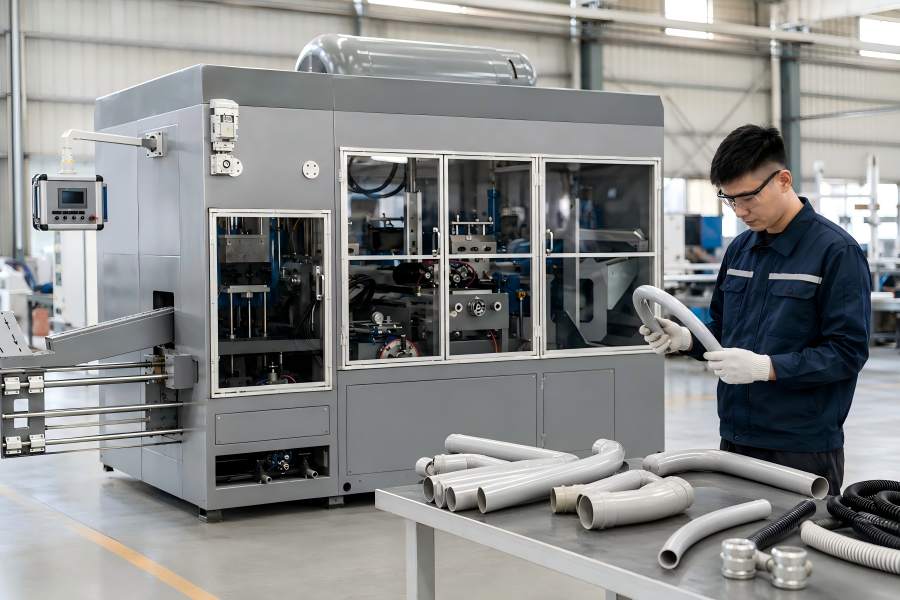
Pipe bending of plastic pipes like PVC, PE, and PP can cause defects such as deformation, cracking, and surface damage if process conditions are not controlled. Proper temperature, tooling, and settings are essential to ensure accurate angles, smooth curves, and stable wall thickness.
Pipe Wrinkling
Pipe wrinkling usually appears on the inner side of the bend, where the pipe wall is compressed. The surface may show waves, folds, or uneven lines. In serious cases, wrinkles may reduce the internal flow area and weaken the pipe structure.
Common causes
- Bending radius is too small
- Pipe wall thickness is too thin
- Heating temperature is too high
- Heating is uneven around the pipe
- Pipe is not properly supported during bending
- Bending speed is too fast
- Mold size does not match the pipe diameter
How to avoid it
- Choose a suitable bending radius according to pipe diameter and wall thickness
- Use proper bending molds to support the pipe shape
- Control heating temperature carefully to avoid excessive softening
- Ensure uniform heating across the full bending area
- Reduce bending speed for large-diameter or thin-wall pipes
- Test sample pipes before mass production
- Use a pipe bending machine designed for plastic pipe materials
For high-volume production, stable mold design and automatic temperature control can help reduce wrinkling and improve bending consistency.
Pipe Flattening
Pipe flattening means the pipe loses its round shape after bending. The cross-section may become oval or locally pressed. This defect can affect appearance, reduce flow capacity, and make the pipe difficult to connect with fittings.
Common causes
- Insufficient pipe support during bending
- Incorrect bending mold size
- Excessive bending force
- Overheating in the bending area
- The pipe wall thickness does not match the required bending angle
- The bending radius is too tight
- Improper clamping and positioning
How to avoid it
- Use bending molds that match the pipe diameter accurately
- Avoid bending angles or radii beyond the pipe’s material limit
- Control heating temperature and heating time
- Improve clamping stability before bending
- Use supporting structures to maintain pipe roundness
- Select pipes with suitable wall thickness for demanding bending applications
- Inspect the first finished pipe before starting batch production
A high-quality pipe bending machine should keep the pipe stable during forming and help reduce ovality caused by uneven pressure.
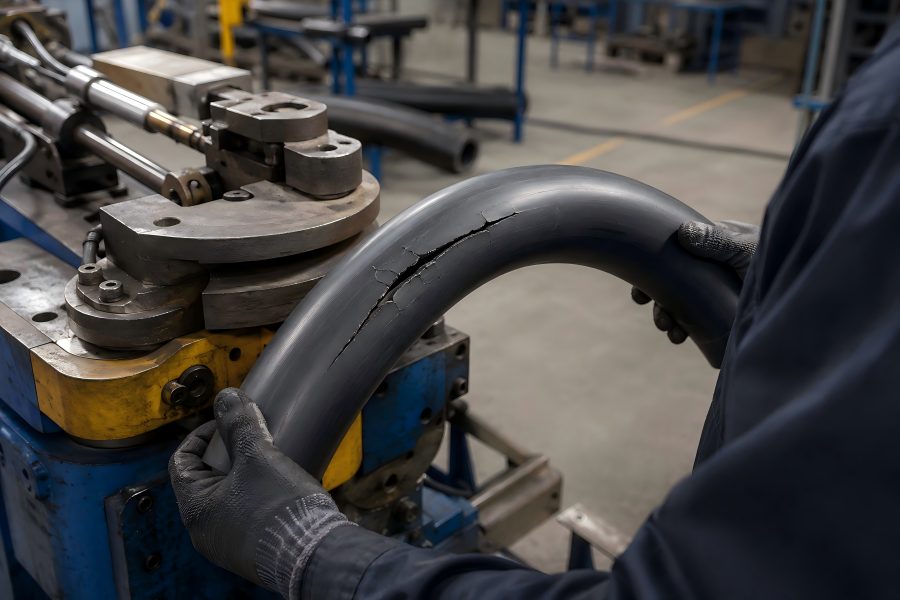
Cracking or Splitting
Cracking is one of the most serious pipe bending defects. It typically occurs on the outer side of the bend, where the material is stretched during forming. Even small cracks may reduce pipe strength and cause failure during installation or long-term use.
Common causes
- Heating temperature is too low
- Pipe material is brittle or aged
- The radius of bending is too limited.
- The speed of bending is too quick.
- Pipe wall thickness is uneven
- Material is not suitable for the required bending angle
- Pipe is exposed to cold conditions before bending
How to avoid it
- Set the proper heating temperature for PVC, PE, PP, or other pipe materials
- Avoid using brittle or poorly stored pipe materials
- Increase the bending radius when necessary
- Bend the pipe slowly and smoothly
- Check incoming pipe quality before production
- Avoid sudden force during the bending process
- Keep production conditions stable, especially in cold environments
If cracking happens frequently, manufacturers should review both the material quality and the machine’s heating control system.
Inner Wall Collapse
Inner wall collapse occurs when the inner side of the bend sinks inward. This reduces the internal diameter and may affect the pipe’s functional performance, especially in drainage, airflow, cable protection, or fluid transmission applications.
Common causes
- Heating temperature is too high
- Heating time is too long
- Pipe wall is too thin
- Bending radius is too small
- Lack of internal or external support
- Bending pressure is not properly controlled
- Pipe material has poor structural stability
How to avoid it
- Avoid overheating the pipe before bending
- Use a suitable bending radius for the pipe size
- Improve mold support in the bending area
- Reduce bending pressure if deformation appears
- Use thicker-wall pipes for applications requiring tight bends
- Adjust heating time according to pipe diameter and wall thickness
- Allow the pipe to cool in a fixed shape after bending
For larger pipe diameters, the bending process should be slower and more stable to prevent local collapse.
Wall Thinning
Wall thinning happens when the outer side of the pipe is stretched too much during bending. This reduces wall thickness and may weaken the pipe. In pressure-related or load-bearing applications, excessive wall thinning can shorten service life and increase the risk of failure.
Common causes
- Bending radius is too tight
- Excessive stretching on the outer wall
- Bending speed is too high
- Material ductility is poor
- Heating temperature is not suitable
- Pipe wall thickness is not enough
- Bending angle exceeds the pipe’s forming limit
How to avoid it
- Select a larger bending radius when possible
- Use pipe materials with good flexibility and stable quality
- Control bending speed to reduce sudden stress
- Set the proper heating temperature for the material
- Avoid excessive stretching during forming
- Check wall thickness after trial bending
- Use suitable pipe specifications for the required application
Manufacturers should pay special attention to wall thinning when producing pipes for industrial systems or long-term outdoor use.
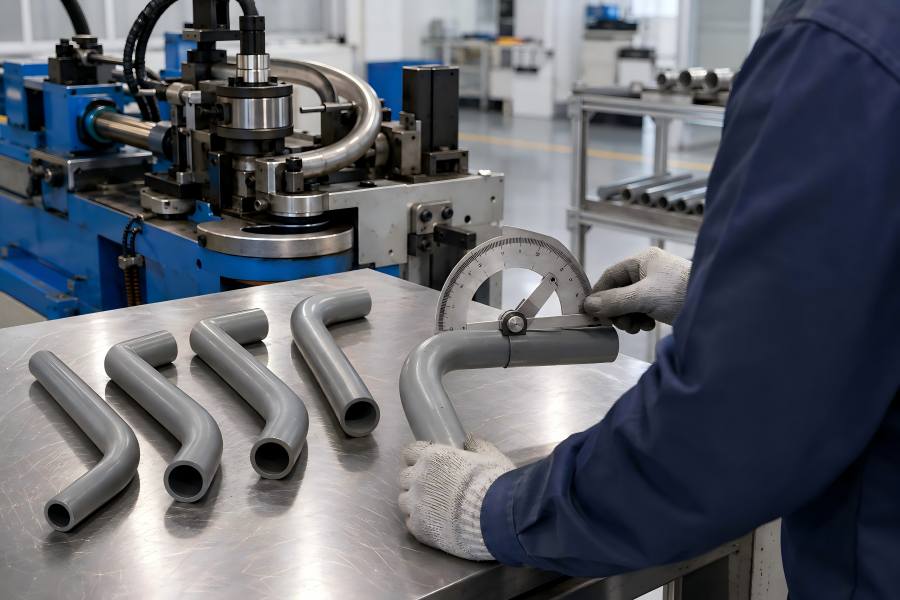
Inaccurate Bending Angle
An accurate bending angle is important for installation. If the final angle is too large or too small, the pipe may not fit the required layout. This may result in rework, material waste, and customer complaints.
Common causes
- Incorrect machine parameter settings
- Springback after bending
- Unstable clamping
- Pipe movement during forming
- Inconsistent heating and cooling
- Operator setup errors
- Different material batches with different flexibility
How to avoid it
- Calibrate the bending angle before production
- Consider springback compensation in machine settings
- Clamp the pipe firmly before bending
- Keep heating and cooling time consistent
- Use trial bending to confirm final angle accuracy
- Record process parameters for different pipe sizes
- Use automatic angle control for batch production
For common bending angles such as 30°, 45°, 60°, and 90°, manufacturers should create standard parameter records to improve repeatability.
Springback After Bending
Springback refers to the pipe partially returning to its original shape after bending. For example, a pipe bent to 90° may return to 87° or 88° after cooling. This affects angle accuracy and product consistency.
Common causes
- Material has strong elastic recovery
- Heating temperature is too low
- Cooling time is too short
- Bending angle is not compensated
- Pipe is released too early after bending
- Inconsistent pipe material properties
- Insufficient forming time
How to avoid it
- Use angle compensation during machine setup
- Heat the pipe evenly before bending
- Hold the pipe in position during cooling
- Extend cooling time when necessary
- Test springback behavior before mass production
- Keep process parameters stable
- Use a pipe bending machine with accurate angle control
Automatic pipe bending equipment can reduce springback-related errors by providing repeatable bending movement and controlled forming cycles.
Uneven Bend Radius
An uneven bend radius means the curve is not smooth. Some parts may appear sharper, while others look more gradual. This affects appearance and may create weak points in the pipe.
Common causes
- Uneven heating along the bending area
- Poor pipe positioning
- Pipe slips during bending
- Mold shape is not suitable
- Heating area is too short
- Inconsistent bending speed
- Poor synchronization between feeding and forming
How to avoid it
- Ensure the heating area covers the full bending section
- Position and clamp the pipe accurately
- Use a mold designed for the target bend radius
- Maintain stable bending speed
- Avoid manual pulling or uneven force during bending
- Check machine movement and guiding components
- Use sample inspection to confirm curve consistency
A smooth and uniform bend radius is especially important for commercial pipe products where appearance and installation accuracy matter.
Surface Burn Marks
Surface burn marks may appear as yellowing, dark spots, glossy melted areas, or rough surfaces. They are common in plastic pipe bending when the pipe is overheated.
Common causes
- Excessive heating temperature
- Heating time is too long
- Uneven heating equipment
- Pipe is too close to the heater
- Poor temperature sensor accuracy
- Operator does not adjust settings for different pipe sizes
- Heat is concentrated in one area
How to avoid it
- Set heating temperature according to pipe material and wall thickness
- Avoid excessive heating time
- Keep a suitable distance between pipe and heating source
- Check temperature sensors regularly
- Use heating systems with uniform heat distribution
- Adjust parameters when changing pipe diameter or material
- Inspect surface quality during trial bending
For plastic pipe manufacturers, stable heating control is one of the most important factors in preventing burn marks.
Surface Scratches and Mechanical Damage
Surface scratches, dents, and marks can occur during feeding, clamping, bending, or unloading. Even when the bending angle is correct, surface damage may reduce product value and cause customer rejection.
Common causes
- Rough mold surface
- Dirty guide rollers or clamping parts
- Sharp edges on machine-contact areas
- Excessive clamping pressure
- Improper pipe handling
- Debris inside the machine
- Pipe rubbing against machine components
How to avoid it
- Clean molds, clamps, and guide parts regularly
- Remove sharp edges from contact areas
- Use smooth and material-friendly support components
- Adjust clamping force according to pipe size
- Keep the work area clean
- Avoid dragging pipes on rough surfaces
- Inspect machine-contact parts before production
For products with higher appearance requirements, protective handling and proper storage after bending are also important.
Preventive Strategies for Long-Term Stable Pipe Bending
Solving bending defects after they appear is necessary, but preventing them is more valuable. A strong preventive approach helps reduce waste, improve product consistency, and enhance production reliability.
Key preventive strategies include:
- Choose a pipe bending machine suitable for the pipe material and size range
- Use proper molds for different pipe diameters and bending angles
- Control heating temperature, heating time, and cooling time carefully
- Check pipe quality before bending
- Standardize bending parameters for PVC, PE, PP, and other materials
- Perform trial bending before mass production
- Monitor bending angle, surface quality, and pipe roundness during production
- Keep molds, clamps, rollers, and guide parts clean
- Maintain the machine regularly
- Train operators to understand common defects and adjustment methods
Manufacturers that treat pipe bending as a controlled forming process rather than a simple shaping step usually achieve better product quality and more stable production.