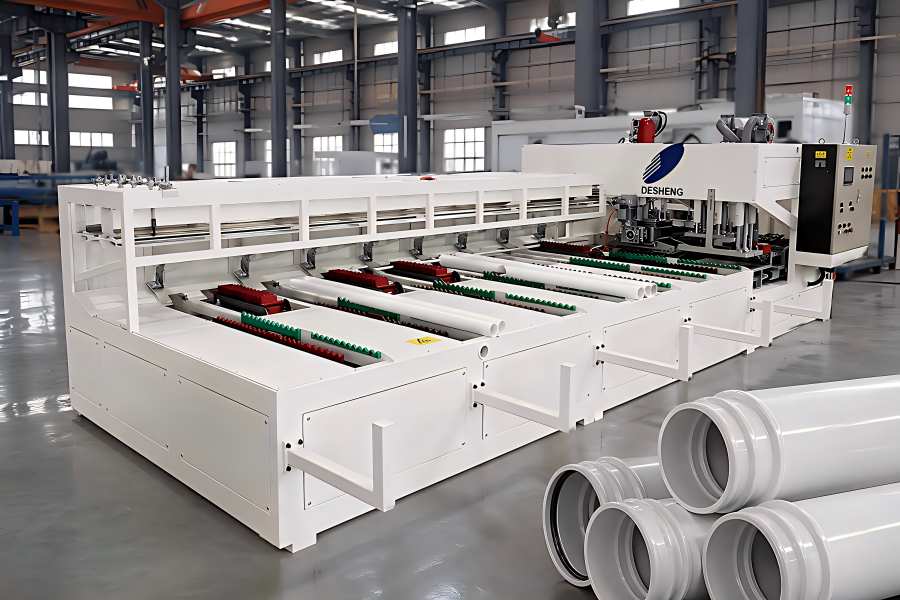
In PVC pipe production, connection quality is just as important as pipe quality itself. A belling machine forms the socket end that enables secure, efficient joining. The right machine helps manufacturers improve sealing performance, installation efficiency, and production consistency across drainage, water supply, and other PVC pipe applications.
How a PVC Pipe Belling Machine Works?
Although specific machine designs vary, the basic working process of a PVC pipe belling machine usually includes several stages.
Pipe feeding and positioning
The cut PVC pipe is transferred into the belling machine and positioned accurately so that the pipe end aligns with the heating and forming system.
Heating the pipe end
The pipe end is heated in a controlled way, usually through a heating oven, heater box, infrared system, or hot air heating chamber. The goal is to soften the pipe end enough for reshaping without overheating or damaging the material.
Socket forming
Once the pipe end reaches the correct temperature, a forming tool expands and shapes it into the desired socket geometry. Depending on the machine and socket type, this may involve a mandrel, forming head, internal pressure, or mold-assisted shaping process.
Cooling and fixing the shape
After forming, the pipe end is cooled to stabilize the new shape. Maintaining dimensional precision and avoiding distortion requires proper cooling.
Pipe discharge
The finished belling pipe is removed from the machine and transferred for inspection, stacking, or further processing.
Each of these stages must be controlled carefully. In PVC pipe production, even a small temperature or alignment error can affect socket quality.
Main Socket Types Produced by Belling Machines
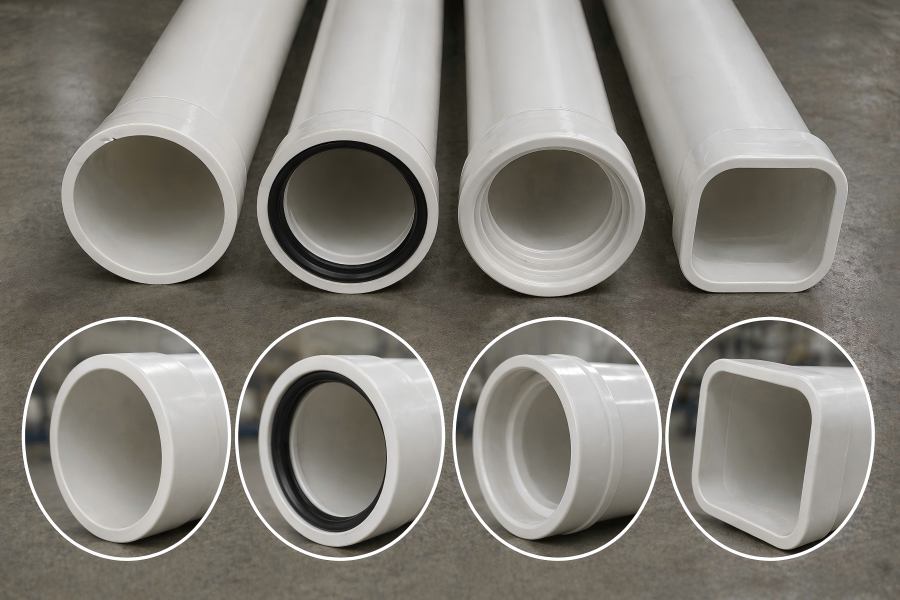
PVC pipe belling machines can produce different socket types depending on the intended joining system and market requirements.
Plain socket
A plain socket is a simple expanded end without a rubber ring groove. This type is commonly applied in situations that require solvent cement or adhesive bonding.
Rieber socket
A Rieber socket includes an integrated rubber ring sealing system formed during the belling process. This design provides reliable sealing and is widely used in pressure and drainage applications. Producing Rieber sockets generally requires more specialized machine capability.
U-type socket
A U-type socket is a common socket design used in many PVC and UPVC pipe systems. It is often designed to work with rubber sealing rings and specific insertion standards.
Square socket or straight socket variations
Some applications use simpler socket geometries depending on pipe standard, wall thickness, and joining method.
The type of socket required has a direct impact on machine selection. Not every belling machine is suitable for every socket type.
Types of Belling Machines Used in PVC Pipe Production
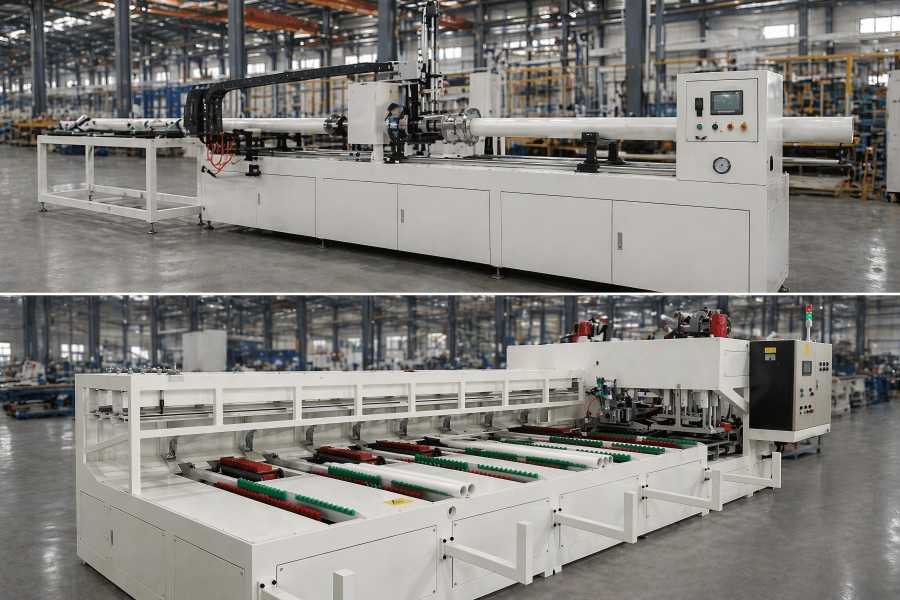
Belling machines can be categorized in different ways, with automation level being one of the most practical criteria.
Semi-automatic belling machines
Semi-automatic machines usually require more operator involvement in loading, positioning, or unloading the pipe. They are often suitable for smaller production volumes or manufacturers with more flexible but less automated production lines.
| Pros | Cons |
| Lower investment cost | More labor dependence |
| Simpler structure | Lower efficiency than fully automatic models |
| Suitable for smaller factories | Greater operator impact on consistency |
| Good for custom or short-run production | Less ideal for high-volume output |
Automatic belling machines
Automatic belling machines are designed for higher efficiency and more stable production. They are capable of automating pipe feeding, heating, forming, cooling, and discharge with minimal manual involvement.
| Pros | Cons |
| Higher production efficiency | Higher initial cost |
| Better socket consistency | More complex control systems |
| Lower labor dependence | Greater maintenance and setup requirements |
| Suitable for mass production | Higher technical demands |
| More stable process control |
For medium- to large-scale PVC pipe manufacturers, automatic belling machines are often the preferred choice because of their productivity and repeatability.
Why PVC Pipe Requires Controlled Belling
PVC is a thermoplastic material with good rigidity, chemical resistance, and processing flexibility, but it also requires careful thermal control during end processing. Unlike some softer plastics, PVC can become unstable if the heating process is not controlled correctly.
During belling, PVC pipe processing must avoid:
- Overheating that causes surface burning or deformation
- Underheating that causes incomplete forming
- Uneven heating that leads to asymmetrical sockets
- Excessive stress that may weaken the socket area
- Improper cooling that changes final dimensions
This is why the design and control quality of the belling machine matter so much. A good machine does not simply heat and expand the pipe end. It creates a controlled process that protects material performance while achieving the required socket dimensions.
Key Considerations for Choosing a Belling Machine
When selecting a belling machine for PVC pipe production, manufacturers should evaluate more than just price. The machine must match the pipe specification, socket requirements, production volume, and target market needs.
Pipe diameter range
Different machines support different pipe diameter ranges. Some machines are suitable for small-diameter pipes, while others are engineered for medium or large pipe applications.
Manufacturers should make sure the machine covers their main product sizes and possible future expansion needs.
Socket type compatibility
The machine must be compatible with the socket style required by the market. For example, plain socket production is different from Rieber socket production. Choosing the wrong machine type can limit product capability.
Production capacity
A machine should match the output level of the extrusion line. A slow belling machine may limit overall production efficiency.
Automation level
For high-volume PVC pipe production, automatic machines usually provide better efficiency and consistency. For smaller runs or more budget-sensitive operations, semi-automatic equipment may still be practical.
Heating system performance
Stable and evenly distributed heating plays a crucial role in socket quality. A good machine should provide reliable temperature control suited to PVC processing.
Cooling and shape stability
The cooling process must be fast enough for production efficiency but controlled enough to preserve socket geometry. Poor cooling design can lead to deformation or inconsistent dimensions.
Changeover convenience
If the factory produces different pipe sizes or socket types, easy changeover becomes important. Faster setup means less downtime and better overall productivity.
Machine stability and construction quality
A well-built and rigid machine typically delivers more consistent performance and has a longer service life. Mechanical stability affects alignment, repeatability, and maintenance cost.
Control system and ease of use
Modern belling machines often use programmable control systems. A user-friendly system can reduce operator error and improve adjustment efficiency.
Service and spare parts support
Even a good machine requires maintenance and occasional parts replacement. Reliable supplier support is important for minimizing downtime.
Common Problems in PVC Pipe Belling and Their Causes
Like any pipe processing equipment, a belling machine can experience production issues. Understanding these common problems helps manufacturers improve operation and machine selection.
Inconsistent socket size
If socket dimensions vary from pipe to pipe, installation problems may occur. This often results from unstable heating, poor positioning, inconsistent forming pressure, or inadequate cooling.
Deformed or uneven sockets
Asymmetrical or misshapen sockets can happen when heating is uneven, the pipe is not aligned properly, or forming is not completed smoothly.
Surface burning or discoloration
This is usually caused by excessive heating or poor temperature control. PVC is sensitive to overheating, so proper thermal management is essential.
Cracks at the socket area
Cracks may result from insufficient heating, excessive expansion force, poor material condition, or cooling stress. This is a serious defect because it affects joint reliability.
Rubber ring groove issues
For machines producing ring-seal sockets, incorrect groove formation can create sealing failure or difficulty in ring placement. Precision in forming is especially important for this type of product.
Low production efficiency
Frequent adjustments, unstable operation, or slow changeover can reduce the effective output of the machine. This is often a concern for factories trying to scale production.
A good belling machine helps reduce these issues through stable temperature control, accurate forming, and repeatable automation.
The Importance of Belling Machines in PVC Pipe Installation Quality
Manufacturers sometimes focus mainly on factory production efficiency, but the real test of a belling machine is what happens at the installation site. A correctly formed socket improves the customer’s experience by making pipe joining easier, faster, and more reliable.
This matters because installers and project contractors value:
- Smooth insertion of the mating pipe
- Reliable sealing performance
- Uniform socket depth
- Reduced need for forceful correction on-site
- Lower risk of leakage or joint failure
A poorly belled pipe can create frustration during installation even if the pipe itself looks acceptable. For this reason, the quality of the belling machine directly influences how customers perceive the overall pipe brand.
Maintenance Considerations for PVC Pipe Belling Machines
To keep a belling machine performing well, regular maintenance is essential. This helps prevent quality problems, unexpected downtime, and premature wear.
Important maintenance areas include:
- Heating system inspection
- Mold and forming tool cleaning
- Alignment checks
- Lubrication of moving parts
- Control system monitoring
- Cooling system performance
- Seal and pneumatic component inspection
Routine maintenance helps ensure that the machine continues producing sockets with stable dimensions and surface quality.