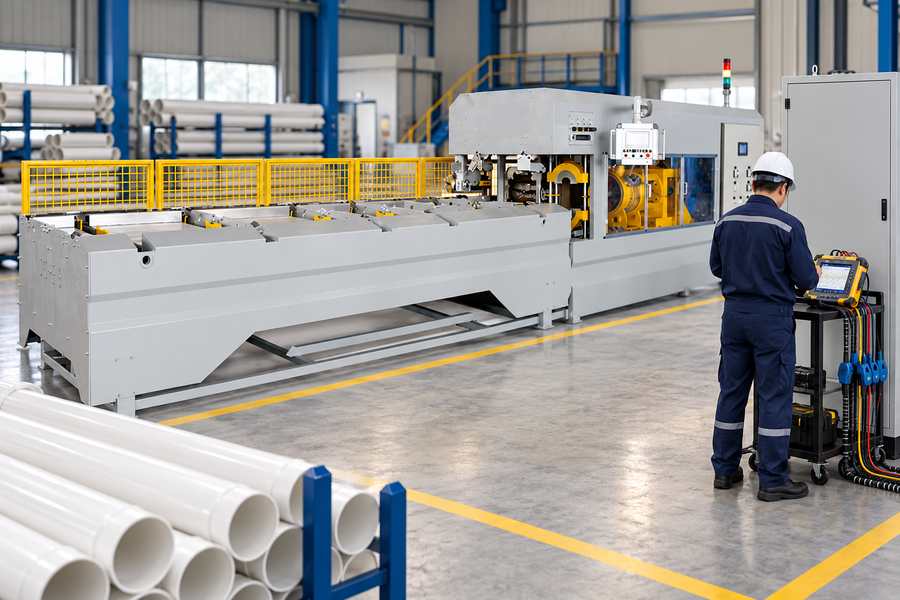
Installed power describes the electrical ratings connected to a belling machine, not the demand recorded throughout production. Heating, positioning, forming, cooling, and waiting periods create a changing load profile.
Buyers comparing quotations need consistent measurement boundaries, representative operating data, and energy per accepted socket. Otherwise, a lower listed kilowatt figure may conceal higher electricity consumption during real production.
Separate the Connected Machine Rating from Measured Electrical Demand
What Installed Power Actually Represents
Installed power usually refers to a declared total of connected equipment ratings. The quotation must explain how that total was assembled before buyers treat it as comparable data.
Depending on the configuration, the list may include heating elements, electric drives, pumps, control equipment, and dedicated auxiliaries. Some suppliers also distinguish total connected load from rated machine input.
A heater rated for a particular maximum input does not necessarily draw that input continuously. Likewise, a motor rarely delivers its full rated shaft output throughout every machine cycle.
Adding component nameplate figures therefore does not produce a reliable running-power estimate. It also cannot establish which loads will operate simultaneously during startup or forming.
Request the actual load schedule behind the quotation. Each entry needs an equipment description, quantity, rated figure, units, and indication of whether it represents electrical input or mechanical output.
Electrical Figures That Must Not Be Mixed
The word “power” can describe several different quantities. Comparing figures with identical units is still misleading when their measurement methods or operating periods differ.
| Figure | What it describes | Buyer verification |
| Installed power, kW | Declared connected rating under the supplier’s stated convention | Ask for the component list and summation basis |
| Motor shaft rating, kW | Mechanical output rating at the shaft | Do not count it as measured input kW |
| Input real power, kW | Electrical power drawn at a defined boundary and moment or interval | Identify meter location and measurement method |
| Cycle-average power, kW | Average real input over a stated production window | Record duration, production state, and exclusions |
| Peak demand, kW | Maximum average real power within an agreed demand interval | Record interval length; distinguish instantaneous peaks |
| Apparent power, kVA | Supply-side voltage-current loading, including reactive effects | Obtain measured or declared values with conditions |
| Energy, kWh | Total electrical consumption during a defined period | Read the energy register at the same boundary |
| Energy per accepted socket, kWh/socket | Measured energy divided by acceptable finished socket count | Verify counting and inspection rules |
A recorded instantaneous spike is not the same as peak demand averaged over a specified interval. Neither can replace the average input power used to evaluate production energy.
The power factor and operating behavior of drives can affect the relationship between kW and kVA. Electrical supply assessment consequently needs more than an installed-kW total.
Why Does Running Power Change During a Belling Cycle?
Heating Loads During Startup and Production
Heating is often one of the most visible electrical loads, but its behavior depends on the heater arrangement and production recipe specified for the machine.
During a cold start, heaters may remain energized while tooling and heating zones reach their targets. That period can differ substantially from repeated production cycles after stabilization.
During production, control systems may switch or regulate heater outputs to maintain temperature. A heater’s rated capacity tells buyers its potential input, not its measured duty cycle.
Pipe material, wall thickness, socket geometry, and feed rhythm influence the heating requirement. Their effects must be tested with the actual configuration rather than assumed from a catalog rating.
If pipe arrivals stop, some zones may continue maintaining temperature. Record whether idle time is included, because an apparently low production average can exclude costly waiting periods.
Movement, Forming, Cooling, and Waiting Loads
Yuyu Machinery describes the belling process through positioning, clamping, heating, forming, cooling, mold retraction, and ejection. These steps provide a useful framework for reviewing possible electrical loads.
Positioning equipment may draw power briefly when moving a pipe. Clamping and forming demand depends on the quoted actuation system, not on a universal belling-machine arrangement.
Where hydraulic equipment is provided, its electric power unit may operate differently from individual actuators. Where compressed air is used, compressor electricity may be consumed outside the machine boundary.
Cooling may involve pumps, fans, or externally supplied water. Confirm the actual cooling method and whether dedicated circulation equipment is listed among machine electrical loads.
Some stages overlap while others wait for a mold, pipe, or conveyor. A power trace with timestamps helps distinguish genuine demand peaks from average-cycle consumption.
A machine with faster cycles can finish more sockets while drawing more power at certain moments. Accepted output is therefore essential when buyers interpret the electrical measurements.
What Must Be Included in an Installed-Power Comparison?
Confirm the Electrical Load List and Quoted Configuration
Two machines described as suitable for the same pipe diameter may have different tooling, heating layouts, and automation arrangements. Their installed figures are not automatically comparable.
Start with the specified pipe material, diameter, wall thickness, socket shape, and production rate. Then compare the equipment actually offered for that operating duty.
Request the quoted electrical load list alongside the equipment arrangement drawing. Match each major consumer to an identified machine module or auxiliary, noting optional components separately.
Custom molds or control software may change operation without a predictable change in electrical rating. Ask what is included instead of assigning a standard power effect to customization.
A motor label may state shaft output rather than supply input. If a quotation adds shaft ratings directly to heater input ratings, request a corrected or clearly qualified basis.
Check that any alternative quotation uses the same understanding of installed power. A lower figure obtained by excluding a pump is not evidence of a more efficient process.
Fix the Measurement Boundary Before Reviewing Numbers
The electrical boundary is the point, or defined set of points, at which power and energy are measured. Its location determines what the resulting values represent.
Request a single-line diagram identifying the machine supply interface and any separately fed auxiliaries. The drawing must make included loads and excluded external systems recognizable.
Review the following boundaries with the supplier:
- Heating and motion: Are all heaters, drives, controls, and dedicated power units included?
- Cooling: Are circulating pumps or fans supplied with the machine, installed externally, or shared?
- Compressed air: Is compressor electricity excluded, even when pneumatic forming or actuation consumes air?
- Materials handling: Are conveyors, feeding equipment, and unloading mechanisms part of the metered package?
- Shared utilities: Can electricity for common plant systems be measured or reasonably allocated and reported separately?
Voltage, frequency, phase arrangement, and rated input details belong on the approved equipment documentation. They do not, by themselves, indicate production energy use.
Qualified electrical personnel must evaluate supply capacity, conductors, protective devices, and installation requirements. A purchasing comparison is not a substitute for that design work.
How Should Buyers Verify Actual Running Power?
Measure Power Across Representative Operating States
A useful power test reproduces the quoted production duty rather than relying on a brief no-load demonstration. Document the pipe specification and socket acceptance criteria first.
Record the tooling arrangement, heating recipe, operating mode, machine configuration, and which utilities are connected. Without those facts, a reported average kW is difficult to reproduce.
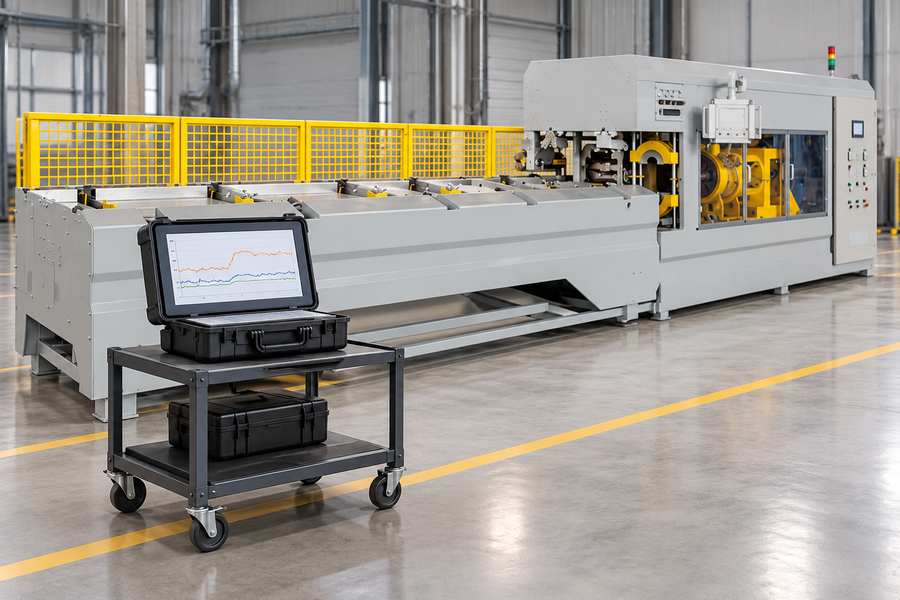
Use suitable calibrated measurement equipment at the agreed boundary. Capture real power, accumulated energy, and relevant apparent-power measurements using documented sampling and averaging methods.
An agreed test protocol can separate the following states without implying that any particular machine includes every listed function:
- Cold start: Record energy and elapsed time until the specified operating condition is reached.
- Stabilized production: Measure multiple consecutive cycles after conditions have settled, with accepted output counted.
- Normal interruptions: Record heater holding, waiting, or other common idle states for the intended production schedule.
- Highest demand: State whether the reported maximum is instantaneous or averaged over a defined demand interval.
- End of test: Record meter totals, start and stop times, accepted pieces, rejected pieces, and operator interventions.
A single high sample cannot establish recurring demand, and a short average may miss long heater-holding periods. Report both the trace and the averaging window.
Inspect time alignment between meter readings and the machine event log. Unexplained steps in the power trace may indicate an auxiliary activating or a test boundary changing.
When a meter provides only a total energy register, average real input power can be determined by dividing measured kWh by elapsed hours. State that time window explicitly.
Calculate Energy per Accepted Socket
Energy per accepted socket connects electrical consumption with usable production. It prevents a low-power but slow machine from receiving an automatic advantage over faster equipment.
Energy per accepted socket (kWh/socket) = measured energy (kWh) ÷ number of accepted sockets.
For a hypothetical test, suppose a machine consumes 19 kWh during two hours and produces 92 sockets, of which 88 pass inspection.
Its hypothetical average input is 9.5 kW, while energy per accepted socket is approximately 0.216 kWh. Dividing by all 92 produced sockets would understate usable-output consumption.
That calculation is meaningful only for the declared test boundary and test period. It does not estimate unmetered compressor operation, cooling utilities, or other excluded energy.
State whether startup energy is included in the numerator. A warmed-up production test and a short daily batch can have markedly different per-socket results.
An inspection record must connect each rejection to an agreed acceptance criterion. Otherwise, two tests could produce different energy figures merely because their output-counting rules differ.
How Can Buyers Compare Two Belling Machine Quotations Fairly?
Use One Worksheet for Both Proposed Machines
An equipment comparison is reliable only when each supplier answers the same questions. Keep blank entries visible rather than filling them with assumptions drawn from other models.
| Comparison item | Quotation A | Quotation B | Evidence to request |
| Pipe and socket specification | Record | Record | Approved product drawing and recipe |
| Installed rating, kW | Record | Record | Load schedule with calculation basis |
| Metering boundary and auxiliaries | Record | Record | Electrical diagram and inclusion list |
| Steady-production average, kW | Record | Record | Dated meter log and test duration |
| Peak demand, kW; interval | Record | Record | Time-stamped demand report |
| Apparent power, kVA | Record | Record | Stated measurement conditions |
| Accepted sockets per hour | Record | Record | Production and inspection records |
| Energy per accepted socket | Calculate | Calculate | kWh register and accepted count |
| Warm-up and idle energy | Record | Record | Separate operating-state logs |
| Excluded external loads | Record | Record | Utility schedule and boundary notes |
First reconcile inconsistent inclusions. If one package uses an external cooling pump and the other includes its pump, record the missing load before comparing totals.
Next verify production equivalence. Identical hourly acceptance rates, different wall thicknesses, or different socket geometries can each change the interpretation of measured running power.
Understand Why Lower Running kW May Not Mean Lower Energy Cost
Consider a separate hypothetical comparison using identical pipe specifications, acceptance rules, and electrical measurement boundaries, but different rates of accepted production.
Machine A averages 9.5 kW and delivers 50 accepted sockets per hour, giving 0.190 kWh/socket. Machine B averages 8 kW and delivers 35, giving approximately 0.229 kWh/socket.
B has lower running power, yet A uses less measured energy per accepted socket under those hypothetical conditions. Neither example establishes performance for an actual Yuyu Machinery model.
A buyer also needs the intended shift pattern. Frequent short runs magnify warm-up contributions; long waits can magnify idle consumption, even when steady-cycle energy is low.
Electricity tariffs may treat consumed kWh and demand-related charges differently. Use the site’s actual tariff structure rather than converting a nameplate kW figure directly into annual cost.
Look for missing rejection data, unusually short test windows, and output counts taken before final inspection. Those omissions can reverse an apparent efficiency advantage.
What Power Requirements Belong in the Purchase Specification?
Define Ratings, Operating Duty, and Reporting Boundaries
Convert the comparison method into written purchase requirements. Otherwise, the supplier and buyer may accept different interpretations of the same performance statement after delivery.
Specify the pipe and socket drawings, operating recipe, production mode, and expected utilization pattern. Record which details are fixed and which require approval before testing.
For each quoted electrical figure, state the units, definition, equipment coverage, and evidence required. Separate declared installed ratings from measured production values rather than creating one ambiguous “power consumption” requirement.
The purchase specification can request an electrical load schedule, single-line diagram, metering plan, and utility inclusion table. These are proposed deliverables to agree, not assumed standard equipment.
Agree on Acceptance Evidence and Handling of Deviations
Specify representative test material, stabilization conditions, test duration, sampling method, and acceptance inspection. Agree how interruptions, rejects, warm-up, and external utility use appear in the report.
Set any project-specific performance limits through the procurement agreement, based on the required production duty. Avoid inserting generic kW limits or unsupported socket-energy guarantees.
The acceptance package can include the following records:
- Electrical results: Time-stamped real-power measurements, peak-demand interval, kVA where needed, and start-to-end kWh readings.
- Production results: Cycle counts, accepted and rejected sockets, throughput, and the inspection criteria applied.
- Test configuration: Electrical boundary, auxiliary list, machine settings, pipe specification, and tooling identification.
- Exceptions: Missing measurements, abnormal stops, permitted exclusions, and the agreed method for repeating incomplete tests.
Discuss the test plan during procurement, including what assistance is available through Yuyu Machinery’s technical service and consultation. Confirm deliverables for the actual purchase rather than assuming a particular power test is included.
A final evaluation needs three separate answers: what is electrically installed, what the machine draws during defined operating states, and how much measured energy produces one accepted socket.
Only then can differences in quoted power support a defensible purchase decision, with outstanding utility loads and electrical installation requirements assigned to qualified reviewers.