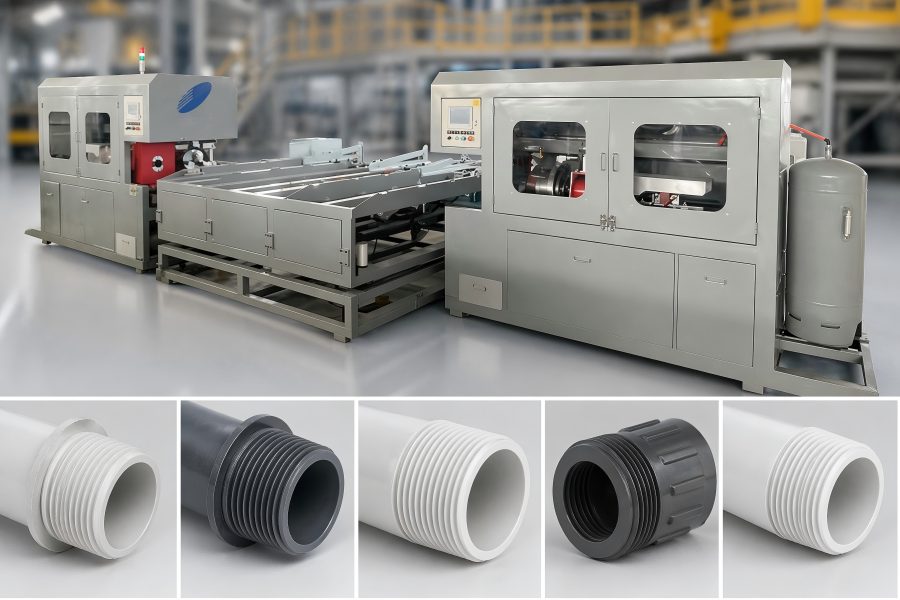
In plastic pipe manufacturing, thread quality directly affects sealing, connection reliability, and service life. Even if the pipe size and material are correct, the wrong thread standard can still cause leaks, difficult installation, and product rejection. That is why plastic pipe threading machines must produce accurate, standard-compliant threads consistently.
What a Plastic Pipe Threading Machine?
A plastic pipe threading machine is used to machine threads on the ends of plastic pipes so that the pipes can connect to fittings, valves, couplings, or other threaded pipe sections. Depending on the machine design, the threading process may involve cutting, shaping, or controlled mechanical forming.
However, the machine itself does not automatically create the “correct” thread. The final thread standard is determined by several factors, such as:
- Threading dies or cutting tools
- Machine settings
- Pipe clamping accuracy
- Feed control
- Speed control
- Thread depth adjustment
- Calibration and inspection
This means that the same machine may be capable of producing different thread standards if it is properly designed and configured. It also means that an unsuitable machine, incorrect tooling, or poor setup can lead to non-standard threads even when the operator believes the process is correct.
Main Types of Thread Forms Relevant to Plastic Pipe Threading
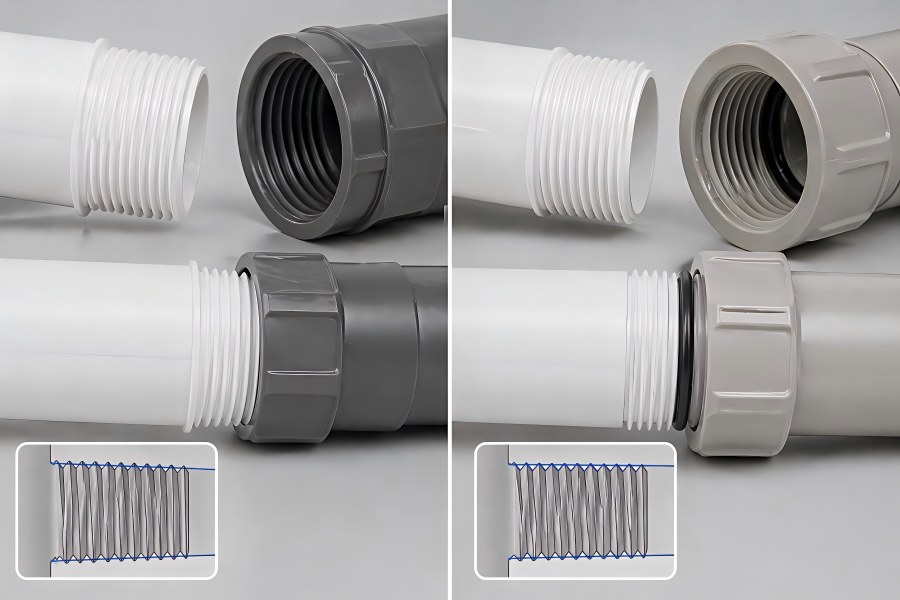
Before discussing specific standards, it helps to understand the two major thread form categories commonly seen in pipe threading.
Tapered Threads
Tapered threads become slightly smaller in diameter along the threaded length. The male and female threads gradually tighten as they come into contact. This design helps create a secure fit and often contributes to sealing performance.
Tapered threads are commonly used where leak resistance is important, such as:
- Water supply systems
- Plumbing lines
- Irrigation systems
- Industrial fluid transfer
- Air and gas-related connections
For plastic pipes, tapered threads are widely used, but they must be cut carefully. Excessive interference during installation can place stress on the plastic fitting or pipe end.
Parallel Threads
Parallel threads keep the same diameter throughout the thread length. They usually do not seal by thread interference alone and often rely on additional sealing elements such as washers, O-rings, gaskets, or bonded seals.
Parallel threads are common in:
- Mechanical connections
- Reusable fittings
- Some fluid systems using sealing rings
- Applications where precise alignment matters
A plastic pipe threading machine must be able to distinguish between tapered and parallel thread requirements because the tooling geometry and machining setup are different.
Common Thread Standards Used in Plastic Pipe Threading Machines
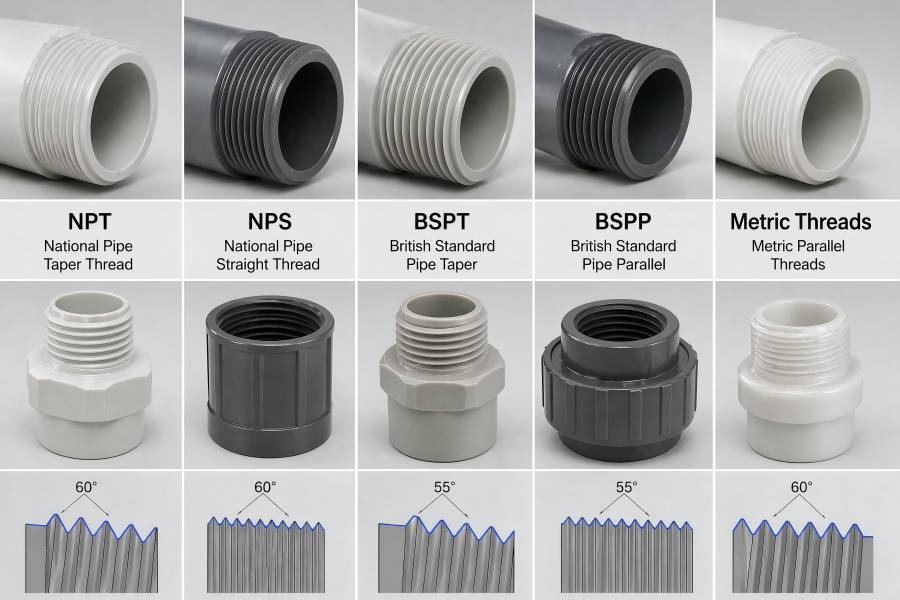
In plastic pipe production, the most relevant thread standards are often those used in plumbing, industrial pipe systems, and export-oriented connections. The most common ones include NPT, BSPT, BSPP, and in some cases metric threads or other application-specific forms.
NPT – National Pipe Taper Thread
NPT is one of the most common pipe thread standards in the United States and in markets influenced by American piping practices. It is a tapered thread system widely used in pressure-related pipe connections.
Main features of NPT:
- Tapered thread form
- 60-degree thread angle
- Measured in inch-based dimensions and threads per inch
- Commonly used for plumbing, industrial pipe systems, and general pipe connections
NPT is important for plastic pipe manufacturers supplying North America. If a plastic pipe threading machine is expected to produce threaded plastic pipes for U.S. markets, NPT capability is often necessary.
However, because plastic materials are not as strong as metal, NPT threads on plastic pipes require careful control. If the thread is too deep or too aggressive, the pipe wall may weaken. If the fit is too tight, installation torque may create stress cracking. This makes machine precision especially important.
NPS – National Pipe Straight Thread
Although NPS and NPT are linked, NPS use a straight thread instead of a tapered one. Because it is parallel, it generally does not create a seal through thread interference alone.
Main features of NPS:
- Parallel thread form
- 60-degree thread angle
- Usually requires a separate sealing method
- Used where mechanical fit is more important than taper-based sealing
In plastic pipe applications, NPS may be used in certain joining systems or equipment interfaces. A plastic pipe threading machine producing NPS threads must maintain accurate diameter and pitch while avoiding taper.
BSPT – British Standard Pipe Taper
BSPT is another major pipe thread standard used in many regions outside North America. It is common in Europe, Asia, the Middle East, Africa, and other export markets.
Main features of BSPT:
- Tapered thread form
- 55-degree thread angle
- Different thread profile from NPT
- Common in plumbing, irrigation, and industrial piping systems
For plastic pipe manufacturers focused on international business, BSPT support is often very important. Many export orders depend on compatibility with BSP thread systems.
Despite being tapered pipe threads, BSPT and NPT are not the same. The thread angle and profile differ, and they are generally not interchangeable. A plastic pipe threading machine must use the correct dies and setup for each one.
BSPP – British Standard Pipe Parallel
BSPP is the parallel version in the British pipe thread family. It is widely used in many international fluid systems and often works with sealing washers or O-rings.
Main features of BSPP:
- Parallel thread form
- 55-degree thread angle
- Often combined with sealing components
- Common in industrial and utility applications
For a plastic pipe threading machine, BSPP production requires stable dimensional control because the thread itself does not rely on taper for sealing. The thread must be machined consistently so that fittings mate correctly and sealing elements function as intended.
Metric Threads
Metric thread systems are more common in mechanical and equipment-related assemblies than in traditional pipe joining, but they can still appear in plastic pipe accessories, machine-integrated piping components, and specialized custom applications.
Main features of metric threads:
- Usually parallel thread form
- 60-degree thread angle
- Dimensions based on millimeters
- Common in machinery and technical assemblies
A plastic pipe threading machine with flexible tooling or programmable controls may support metric threading when needed. This can be useful for manufacturers making customized plastic pipe products or technical components rather than only standard plumbing pipe.
Application-Specific and Regional Variants
In some markets, plastic pipe systems may involve industry-specific thread forms or local dimensional conventions. For example, some fittings may follow company-specific or sector-specific requirements in irrigation, pool equipment, filtration systems, chemical dosing systems, or electrical conduit systems.
In such cases, understanding the thread standard goes beyond knowing a label such as NPT or BSPT. Manufacturers must review:
- Required thread dimensions
- Pipe wall thickness limits
- Fit tolerance
- Sealing method
- Installation torque considerations
- End-use pressure conditions
A good plastic pipe threading machine supplier should be able to confirm whether the machine can handle such specialized requirements.
Key Differences Between Major Thread Standards
Understanding the names of thread standards is only the first step. To operate a plastic pipe threading machine effectively, manufacturers need to understand what actually makes these standards different.
Thread angle
Thread angle affects the cutter profile and the way the mating threads engage. NPT and metric systems typically use a 60-degree angle, while BSP thread systems usually use a 55-degree angle.
Taper or parallel design
Tapered standards such as NPT and BSPT narrow along the thread length, while parallel standards such as NPS and BSPP keep a constant diameter. This changes both machining and sealing behavior.
Measurement system
Some standards are based on inch dimensions and threads per inch, while others use millimeter-based measurements and pitch values.
Sealing method
Some threaded connections seal through interference between tapered threads, while others depend on washers, tapes, gaskets, or O-rings.
Market usage
Different regions often expect different standards. North America commonly uses NPT. Many international markets use BSPT or BSPP. Some technical products may rely on metric systems.
It is evident from these variations that there isn’t a single plastic pipe thread standard. The machine, the tooling, and the production plan must all be matched to the actual requirement.
How Thread Standards Influence Plastic Pipe Threading Machine Selection
When choosing a plastic pipe threading machine, thread standard compatibility should be one of the first evaluation criteria. Many buyers focus first on pipe diameter range, speed, or automation level, but thread capability is equally important.
Tooling support
The machine must support threading dies or cutting tools designed for the required standards. This includes the right thread angle, pitch, and taper profile.
Adjustment flexibility
If the factory produces pipes for different export markets, the machine should allow relatively easy conversion between thread standards.
Thread depth control
Plastic pipe walls can be sensitive to overcutting. A good machine must control thread depth accurately so the final product meets the standard without weakening the pipe.
Pipe clamping and alignment
Improper clamping can deform a plastic pipe before threading even begins. The machine should hold the pipe securely without crushing or distorting it.
Automation and repeatability
For larger production volumes, an automatic plastic pipe threading machine often provides better consistency than manual or semi-automatic equipment.
Material adaptability
Different plastic materials behave differently during threading. PVC, UPVC, CPVC, PPR, PE-based materials, and certain engineering plastics may require different cutting conditions.
The Role of Dies and Cutting Tools
The threading die is one of the most important components in a plastic pipe threading machine. The die determines the shape of the thread and strongly influences surface quality, dimensional accuracy, and production stability.
For plastic pipe threading, dies should be:
- Matched to the required thread standard
- Sharp and well-maintained
- Suitable for the specific plastic material
- Easy to replace when changing standards
- Properly aligned with the pipe axis
Worn or incorrect dies can cause thread tearing, rough surfaces, inconsistent pitch, shallow profiles, or dimensional mismatch. In plastic pipe production, such defects may not always look severe at first glance, but they can lead to connection failure during assembly.
Quality Control for Thread Standards
Producing threads to standard is not only a machining task but also a quality control task. Plastic pipe manufacturers should verify thread quality through consistent inspection methods.
Typical thread inspection may include:
- Go/no-go gauges
- Pitch verification
- Major and minor diameter measurement
- Taper inspection for tapered threads
- Visual inspection for damage or burrs
- Functional testing with matching fittings
- Leak testing when required
Because plastic is more easily damaged than metal, inspection should also check for:
- Cracks at the thread root
- Surface tearing
- Ovality caused by poor clamping
- Overcutting that weakens the pipe end
A reliable plastic pipe threading machine should fit into a production system that supports these inspection routines efficiently.