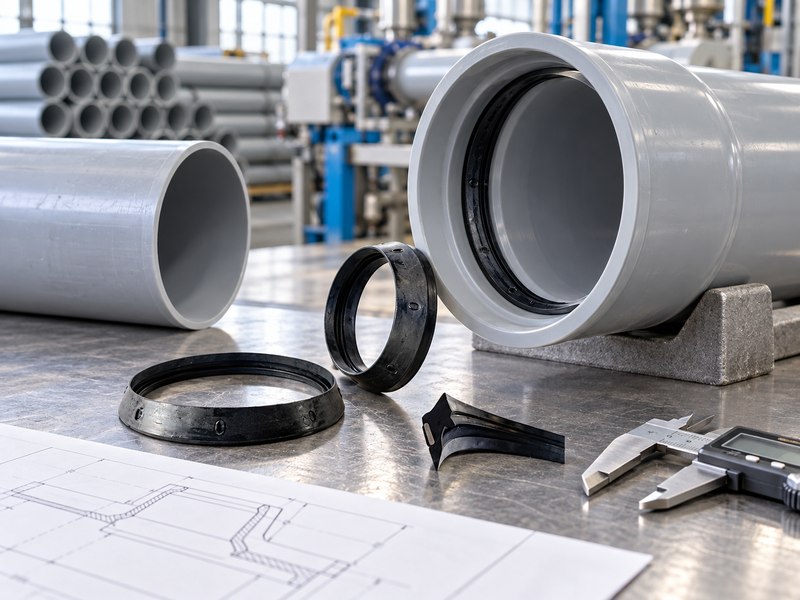
Buyers should confirm the gasket drawing, compound grade, dimensional tolerances, hardness test method, service conditions, installation procedure, and joint acceptance tests. An EPDM designation identifies the rubber family; it does not confirm that a particular ring will fit the socket, remain seated during insertion, or seal throughout the specified operating conditions.
A purchase order reading “EPDM gasket, DN200” leaves the supplier to interpret several critical details. Two rings carrying that description may have different profiles, reinforcement, hardness, and intended joint designs.
Start With the Joint Drawing and Application
Specify the complete connection before selecting the gasket. Nominal diameter helps identify a product family but does not define the sealing gap.
| Specification Item | Information to Confirm |
| Pipe system | Material, dimensional series, application, and applicable joint standard |
| Spigot | Actual outside-diameter range, ovality, chamfer, and surface condition |
| Socket | Internal dimensions, groove profile, entry geometry, and insertion depth |
| Gasket | Profile drawing, size, orientation, compound code, and reinforcement |
| Service | Medium, temperature, pressure, vacuum, and permitted movement |
| Acceptance | Drawing revision, test methods, limits, and required documentation |
When discussing custom belling-machine configurations, submit the mating pipe and gasket drawings together. R-type, rectangular, and Rieber descriptions do not establish interchangeable groove geometry.
Identify who approves the interface: the pipe manufacturer, gasket designer, equipment supplier, or system owner. Record that responsibility before tooling is released.
Match the Seal Profile to the Socket Groove
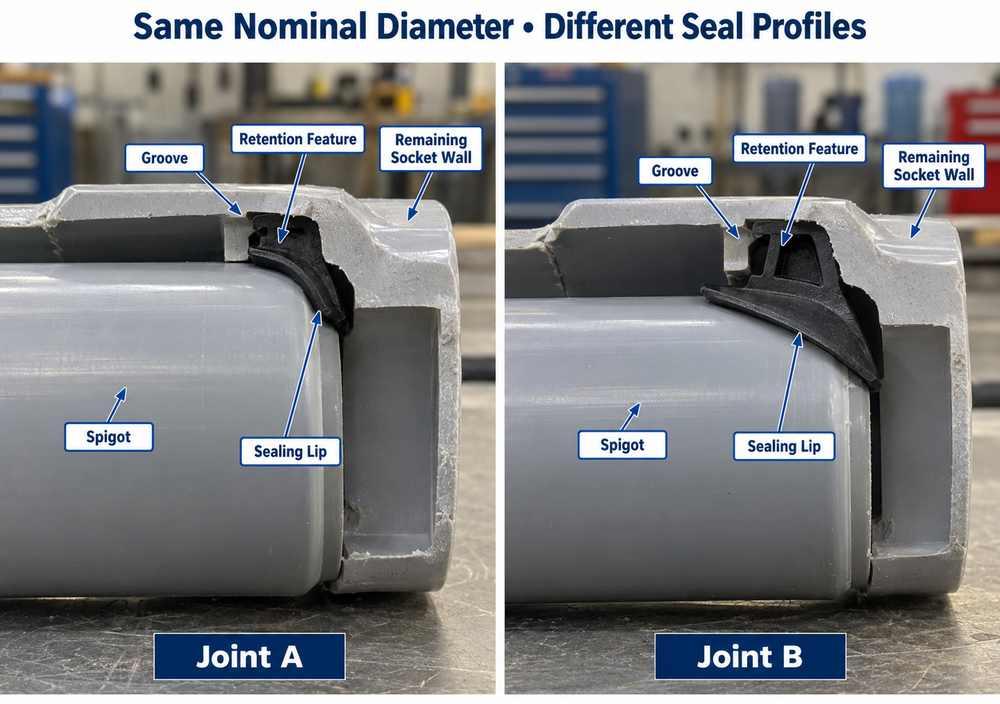
An O-ring, teardrop profile, dual-lip seal, or proprietary profile such as a Sliptite-type design can deform differently during assembly. Similar free dimensions do not make them substitutes.
For each proposed profile, confirm:
- The sealing surfaces and the intended direction of installation.
- Groove width, depth, flank angles, radii, and retention features.
- Free gasket dimensions and the dimensions after installation in the groove.
- Permitted profile variation, flash, joints, and surface defects.
- Clearance and remaining socket wall around the groove.
Yuyu lists its Auto Rieber Ring for Pressure Pipe as an EPDM seal reinforced with steel wire.That construction must be considered when matching the ring to forming tooling; it is not equivalent to a loose, unreinforced ring selected by diameter alone.
For production using an RBM630 Rieber belling machine, agree the gasket code, locating surfaces, mandrel interface, and finished socket drawing before the trial. Verify the actual cooled socket rather than relying only on the tooling dimensions.
Separate Assembly Compression From Compression Set
These terms describe different checks and should occupy separate lines in the specification.
| Term | Meaning | Buyer’s Required Evidence |
| Assembly compression or squeeze | Deformation imposed when the joint is assembled | Profile-specific evaluation over the dimensional tolerance range |
| Compression set | Residual deformation after a defined compression, exposure, and recovery procedure | Report giving method, time, temperature, compression, and recovery conditions |
| Stress relaxation | Reduction in sealing force while deformation is maintained | Appropriate data where required by the application or standard |
An acceptable compression-set result does not prove that the joint has enough initial contact pressure. Conversely, a joint that seals immediately may still require evidence of retained sealing performance after aging.
Check tolerance combinations that create the smallest and largest sealing gaps. Consider pipe ovality and gasket variation together rather than evaluating each nominal dimension independently.
Do not apply a generic O-ring squeeze percentage to a shaped lip seal or reinforced Rieber ring. Use the seal designer’s limits and validate them on the proposed joint.
Specify Hardness With Its Test Method
A hardness value is incomplete without a scale, method, tolerance, and specimen definition. Shore A and IRHD are different measurements; their numerical values should not be substituted automatically.
For example, Yuyu’s EPDM pressure-pipe Rieber ring lists 60±5 IRHD. Rewriting that as “60 Shore A” changes the specification.
| Property | What to Request | What It Does Not Prove Alone |
| Hardness | Scale, method, range, specimen, and conditioning | Acceptable insertion force or leakage performance |
| Tensile strength | Minimum requirement and test procedure | Resistance to every installation defect |
| Elongation at break | Requirement and results under the specified method | Allowable installation stretch |
| Compression set | Limit and complete exposure/recovery conditions | Long-term joint service life |
Values such as 50, 60, or 70 Shore A may be considered during design, but harder is not automatically better. Insertion force and conformity also depend on profile, friction, sealing gap, and temperature.
Yuyu’s separate Manual Rubber Ring page lists NR. Buyers requiring EPDM should therefore specify the actual compound and approved product code rather than assuming every ring in the catalog uses the same material.
Confirm the Compound Against the Actual Medium
EPDM compounds can differ in formulation, cure system, fillers, and processing. Record the supplier’s compound identifier and establish when changes require notification and requalification.
| Exposure | Details the Buyer Should Provide |
| Drinking water | Contact temperature, disinfectants, market requirements, and required approvals |
| Sewage or stormwater | Expected contaminants and intermittent abnormal discharges |
| Industrial effluent | Chemical names, concentrations, temperature, mixtures, and exposure duration |
| External environment | Soil contamination, storage weathering, and installation chemicals |
| Cleaning | Cleaning agents, frequency, concentration, and maximum temperature |
EPDM generally offers good ozone and weather resistance, but mineral oils, petroleum greases, and fuels are important compatibility concerns. Obtain compound-specific confirmation rather than accepting a broad “oil and chemical resistant” statement.
For unfamiliar mixtures, agree an exposure test and evaluate relevant changes in volume, hardness, strength, and sealing performance. A compatibility chart can guide screening but cannot represent every mixed effluent.
Match Installation Features and Lubricants
A hand-installed seal and a ring incorporated during belling require different handling and verification. A locating toe, carrier, or locking feature belongs to a specific design, not to every EPDM gasket.
For Separately Installed Rings
- Confirm groove cleanliness and the prescribed ring orientation.
- Seat the ring evenly without twist or unauthorized stretching.
- Check the spigot chamfer and remove damaging edges.
- Apply the approved lubricant to the specified surfaces and quantity.
- Insert to the specified mark and check for displacement.
For Integrated Rieber Rings
- Confirm ring orientation and engagement with the forming mandrel.
- Verify loading and retention throughout the belling cycle.
- Check ring seating after cooling and tool withdrawal.
- Examine sample joints for rolled lips, displaced reinforcement, or damaged rubber.
Specify the lubricant’s exact product identity. Confirm compatibility with the rubber compound and pipe material, and any drinking-water requirements. “Water-based” or “silicone-based” alone is not a complete approval.
Trial assembly should use the intended chamfer, lubricant, speed, and installation temperature. Record insertion force where required; an unusually high force needs investigation rather than additional force.
Validate the Complete Joint Under Service Conditions
Material compliance and joint performance answer different questions. ISO 4633 describes rubber-seal material requirements while recognizing that joint performance also depends on seal geometry and joint design.
| Service Requirement | Verification to Agree |
| Internal pressure | Interface test pressure, duration, and temperature |
| Vacuum or infiltration resistance | Applicable negative-pressure or external-pressure test conditions |
| Angular deflection | Permitted angle and sealing test in the specified deflected condition |
| Settlement or shear | Required displacement or load and associated leakage criteria |
| Thermal exposure | Continuous and intermittent conditions, cycling where required |
| Dimensional variation | Representative limiting pipe, socket, and gasket combinations |
A flexible seal does not automatically restrain axial pipe movement or pressure thrust. Confirm the system’s restraint arrangements separately.
For drinking water, verify that the required approval covers the exact product or compound and its listed use conditions. NSF/ANSI/CAN 61 addresses health effects; it does not establish mechanical joint pressure capacity. Do not infer a complete pipe-system rating from a gasket listing.
Coordinate Tooling, Inspection, and Repeat Orders
Approve the gasket and cooled socket as a matched production combination. Keep their drawing revisions linked to the forming tools and machine recipe.
| Production Stage | Controls to Establish |
| Incoming gaskets | Product code, batch, dimensions, appearance, and required material evidence |
| Belling setup | Tool identification, ring loading, forming conditions, and cooling |
| First-article inspection | Socket dimensions, gasket seating, assembly, and required joint tests |
| Routine production | Sampling frequency, measuring methods, limits, and escalation rules |
| Repeat supply | Traceability, storage conditions, approved changes, and retained reference samples |
If leakage or ring displacement occurs, measure the spigot, socket, and gasket before blaming the compound. A harder ring cannot correct an oversized gap, damaged lip, incorrect orientation, or uncontrolled groove geometry.
Define storage and handling instructions with the supplier: packaging, protection from contamination and ozone sources, deformation avoidance, and shelf-life controls where applicable.
Send a Complete Specification With the Inquiry
Provide the following when requesting an EPDM gasket or a coordinated belling solution:
- Pipe material, dimensional series, nominal sizes, and actual tolerances.
- Spigot, socket, and gasket drawings with revision numbers.
- Selected compound, hardness method, reinforcement, and required physical properties.
- Medium, temperature, pressure, vacuum, movement, and installation conditions.
- Approved lubricant, assembly procedure, and acceptable insertion behavior.
- Applicable standards and editions, test plan, approvals, and traceability requirements.
Have the supplier clarify any information gaps before providing a tooling quotation. Confirm the approved samples, reports, and change-control process before releasing production.
A complete specification makes the gasket repeatable, the joint inspectable, and supplier acceptance reviewable. Long-term reliability comes from that verified combination of material, geometry, manufacturing, and installation.