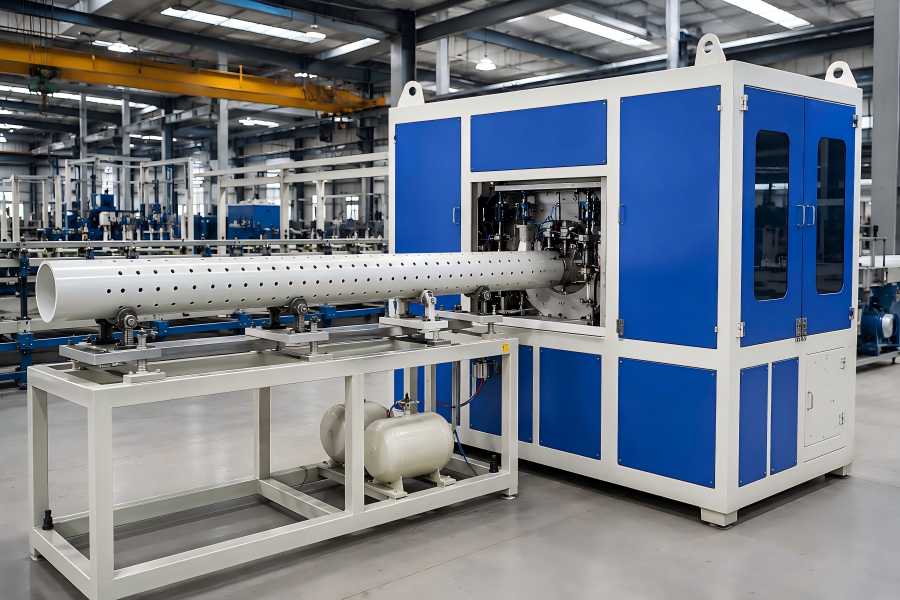
Pipe perforation is essential for drainage, irrigation, filtration, and cable protection pipes. Accurate hole size, spacing, pattern, and pipe shape directly affect performance. Modern pipe perforating machines use automation, precision control, monitoring systems, and flexible tooling to reduce defects, improve consistency, and increase production efficiency.
Inconsistent Hole Positioning
One of the most frequently encountered issues in pipe perforation is inconsistent hole placement. In many pipe products, holes must follow a specific pattern, such as straight-line perforation, spiral perforation, staggered holes, or multi-row distribution. If the hole positions are inaccurate, the entire pipe may fail to meet customer requirements.
When holes are not positioned accurately, manufacturers may experience:
- Uneven water flow
- Reduced drainage efficiency
- Non-compliance with specifications
- Customer complaints
- Increased rejection rates
This problem is especially common in older or manually operated perforation systems where pipe movement and punching operations are not fully synchronized. If the pipe feeding speed changes slightly or the machine fails to index the pipe correctly, hole spacing may become irregular.
Causes
Several factors contribute to inconsistent hole positioning:
- Pipe slippage during feeding
- Mechanical wear
- Inaccurate indexing systems
- Human error
- Unstable production speeds
In some cases, the pipe surface may also be too smooth, causing feeding rollers to lose grip. Long pipes may vibrate during movement, further affecting positioning accuracy.
Modern Solution
Modern pipe perforating machines utilize:
- Servo-driven positioning systems
- Precision encoders
- PLC control technology
- Automated synchronization systems
These technologies continuously monitor pipe movement and ensure each perforation is created at the exact programmed location. The operator can set hole spacing, row quantity, pipe diameter, and perforation length through a user-friendly control panel.
As a result, manufacturers achieve:
- Uniform hole spacing
- Improved product consistency
- Higher production accuracy
- Reduced scrap rates
This is especially valuable for large-volume production, where even a small positioning error can result in significant material waste.
Burr Formation Around Holes
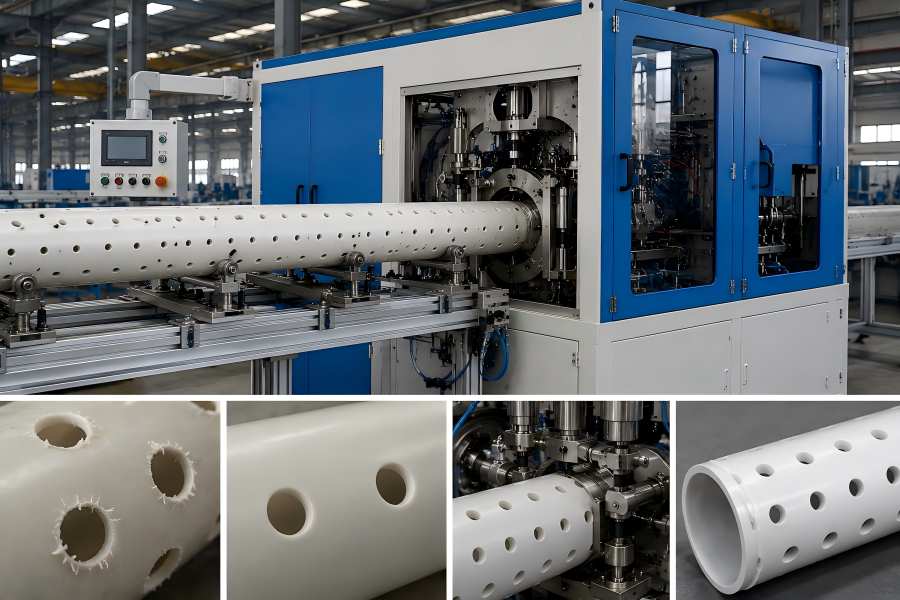
Burrs are unwanted material projections that remain around perforated holes after punching or drilling operations. Although burrs may appear to be a minor surface defect, they can seriously affect the performance and appearance of perforated pipes.
Excessive burr formation can create several problems:
- Restricted flow performance
- Difficult pipe installation
- Reduced product appearance
- Safety hazards during handling
- Additional finishing costs
For drainage pipes, burrs may block part of the hole opening and reduce water intake efficiency. For cable protection conduits or filtration pipes, burrs may damage cables, filters, or other connected components.
Causes
Burr formation often results from:
- Dull punching tools
- Excessive cutting force
- Poor tool alignment
- Inappropriate processing speeds
- Inferior tooling materials
Different plastic materials also behave differently during perforation. Softer materials may stretch before being cut, while harder materials may break or chip if the tool is not sharp enough.
Modern Solution
Today’s perforating machines address burr formation through:
- High-precision punching systems
- Optimized tool geometry
- Advanced cutting technology
- Automatic tool alignment
- Controlled punching force
Modern machines use stronger and more wear-resistant punching tools to create cleaner holes. The machine structure is also more rigid, reducing vibration during perforation. Some equipment allows operators to adjust punching speed and force according to pipe material and wall thickness.
Many modern systems also include automated tool wear monitoring that alerts operators when maintenance is required. This helps prevent poor-quality holes before defects become serious.
The result is:
- Cleaner hole edges
- Reduced secondary processing
- Better product appearance
- Improved operational efficiency
By reducing burrs, manufacturers can improve both product quality and production speed.
Pipe Deformation During Perforation
Pipe deformation is a major concern, particularly when processing thinner-wall plastic pipes. During perforation, mechanical force is applied to the pipe surface. If the pipe is not properly supported, the force may distort the pipe body.
Deformation may appear as:
- Ovalization
- Surface distortion
- Localized flattening
- Wall collapse
- Dimensional inaccuracies
Even minor deformation can compromise product performance. A pipe that loses its roundness may be difficult to connect, transport, or install. In severe cases, deformation can weaken the pipe and reduce its load-bearing capacity.
Causes
Common causes include:
- Excessive punching pressure
- Inadequate pipe support
- Improper clamping
- High processing temperatures
- Incorrect machine settings
Thin-wall pipes, large-diameter pipes, and flexible materials are more likely to deform during perforation. If the pipe is not held firmly, it may move or collapse under punching force.
Modern Solution
Modern pipe perforating machines use advanced support mechanisms such as:
- Internal mandrels
- Precision clamping systems
- Multi-point pipe support structures
- Servo-controlled pressure adjustment
These features distribute forces more evenly throughout the pipe during perforation. Internal support devices help maintain pipe roundness, while external clamps prevent movement during punching.
Benefits include:
- Maintained pipe geometry
- Improved dimensional accuracy
- Reduced product waste
- Enhanced structural integrity
For manufacturers working with multiple pipe diameters, adjustable support systems are especially useful. They allow the machine to process different pipe sizes while maintaining stable perforation quality.
Cracking and Material Damage
Plastic pipes can be sensitive to mechanical stress, especially during high-speed perforation. If the perforation process is too aggressive, cracks may form around the holes or along the pipe wall.
Cracks may occur immediately or develop later during transportation and installation. Because some flaws might not be apparent at the first inspection, this makes the issue very risky.
Causes
Material damage can result from:
- Excessive impact force
- Low-temperature processing
- Material brittleness
- Improper punch design
- Poor-quality raw materials
If production conditions are not appropriately managed, PVC pipes are especially prone to cracking. HDPE and PE pipes are more flexible, but they can still suffer from tearing or stress whitening if the perforation parameters are not suitable.
Cold workshop environments can also increase the risk of cracking. When plastic materials become less flexible at low temperatures, punching force may create stress concentration around the holes.
Modern Solution
Modern perforating equipment minimizes material stress through:
- Controlled punching force
- Optimized punching speed
- Precision tooling
- Temperature monitoring systems
- Adaptive processing algorithms
Advanced machines can automatically adjust operating parameters based on pipe material and wall thickness. Some machines allow operators to save different production recipes for PVC, PE, HDPE, and PP pipes.
This significantly reduces:
- Micro-cracks
- Stress concentrations
- Product failures
- Warranty claims
By controlling force, speed, and tool movement more accurately, modern machines help protect the material while still achieving efficient perforation.
Uneven Hole Size
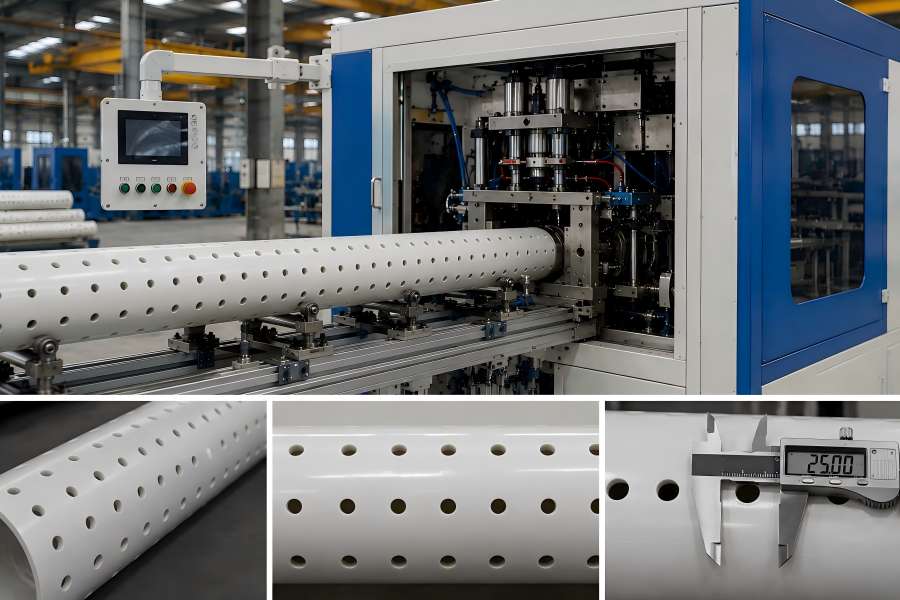
Consistent hole diameter is essential for maintaining proper drainage and filtration performance. In many applications, customers require strict hole size tolerances to ensure stable flow capacity.
Variations in hole size can cause:
- Inconsistent flow rates
- Product rejection
- Performance failures
- Quality control issues
If holes are too small, drainage or filtration efficiency may decrease. If holes are too large, the pipe may lose strength or allow unwanted particles to enter.
Causes
Hole size inconsistencies often result from:
- Tool wear
- Machine vibration
- Positioning errors
- Material variation
- Improper maintenance
Over time, punching tools gradually wear down. As the tool edge becomes dull, the hole may become rough, irregular, or smaller than expected. Machine vibration can also affect hole shape and accuracy.
Modern Solution
Modern machines maintain hole uniformity through:
- CNC-controlled punching systems
- Precision tooling
- Real-time monitoring
- Automated calibration functions
- High-rigidity machine structures
These technologies ensure every perforation meets exact specifications. Stable machine frames reduce vibration, while accurate tooling systems maintain consistent hole dimensions throughout production.
The outcome is:
- Consistent hole dimensions
- Improved product quality
- Better customer satisfaction
For manufacturers supplying infrastructure or engineering projects, consistent hole size is especially important because products must often pass strict inspection before delivery.
Low Production Efficiency
Many traditional perforation systems struggle to meet modern production demands. As pipe manufacturers receive larger orders and shorter delivery schedules, slow perforation processes can become a serious bottleneck.
Slow production speeds can lead to:
- Higher labor costs
- Increased lead times
- Lower profitability
- Limited production capacity
If the perforation process cannot keep up with extrusion or downstream packaging, the entire production line may become inefficient.
Causes
Efficiency limitations often stem from:
- Manual operation
- Frequent adjustments
- Tool changes
- Equipment downtime
- Inadequate automation
Manual feeding and positioning require more labor and are prone to errors. In addition, older machines often require operators to stop production frequently for adjustments.
Modern Solution
Modern pipe perforating machines are designed for high-speed operation.
Features include:
- Automatic feeding systems
- Multi-head perforation units
- Continuous processing
- Servo automation
- Intelligent production control
Multi-head perforation systems can create several holes at the same time, greatly improving output. Automatic feeding reduces manual handling and keeps production stable.
Manufacturers benefit from:
- Increased throughput
- Reduced labor requirements
- Faster order fulfillment
- Improved competitiveness
For factories producing large quantities of drainage pipes or agricultural pipes, automation can significantly reduce unit production costs.
Excessive Machine Downtime
Unexpected production downtime is among the costliest challenges faced by manufacturers. When perforation equipment stops unexpectedly, productivity immediately suffers. In high-volume production environments, even one hour of downtime can affect delivery schedules and increase costs.
Causes
Downtime is often caused by:
- Tool failure
- Mechanical wear
- Electrical issues
- Operator errors
- Lack of preventive maintenance
Older machines usually depend heavily on operator experience. If maintenance is not performed on time, small problems can develop into serious failures.
Modern Solution
Modern machines incorporate predictive maintenance capabilities.
These systems monitor:
- Tool condition
- Motor performance
- Operating temperatures
- Production cycles
- Component wear
Operators receive alerts before failures occur. For example, the control system may remind operators to replace punching tools after a certain number of cycles or inspect key mechanical components after long operation.
Benefits include:
- Reduced downtime
- Improved equipment reliability
- Lower maintenance costs
- Extended machine lifespan
With better maintenance planning, manufacturers can schedule service during non-production hours instead of reacting to sudden breakdowns.
Difficulty Handling Multiple Pipe Sizes
Manufacturers frequently process pipes of varying diameters and specifications. A factory may need to produce small-diameter drainage pipes one day and larger industrial pipes the next.
Traditional machines often require lengthy setup procedures when changing products.
Challenges
Frequent changeovers may cause:
- Lost production time
- Increased labor requirements
- Higher operating costs
- Production bottlenecks
If changeover is complicated, operators may spend too much time adjusting clamps, tools, feeding devices, and hole spacing settings. This reduces production flexibility.
Modern Solution
Modern perforating machines feature:
- Quick-change tooling
- Automatic adjustment systems
- Recipe-based controls
- Flexible machine configurations
Operators can quickly switch between different pipe specifications with minimal downtime. Once a pipe size and hole pattern are programmed, the machine can store the settings for future use.
This flexibility supports:
- Small-batch production
- Customized orders
- Multi-product manufacturing
- Faster market response
For pipe manufacturers serving different industries, this adaptability is a major competitive advantage.
High Material Waste
Scrap material directly impacts profitability. Even small quality defects can generate significant waste in large-scale production environments. If a machine produces defective holes for several minutes before the issue is discovered, many pipes may already be unusable.
Causes
Waste may result from:
- Misaligned perforations
- Damaged pipes
- Incorrect settings
- Startup errors
- Operator mistakes
Material waste not only increases production cost but also affects delivery efficiency. Reworking or replacing defective products requires additional time, labor, and raw materials.
Modern Solution
Modern machines reduce waste through:
- Automated quality control
- Precision positioning
- Vision inspection systems
- Real-time process monitoring
- Intelligent fault detection
Manufacturers can stop producing huge volumes of defective products by spotting problems early. Some advanced systems can stop automatically when abnormal conditions are detected.
This helps factories achieve:
- Lower scrap rates
- Better material utilization
- More stable product quality
- Improved production profitability
In competitive markets, reducing waste can make a significant difference in overall manufacturing cost.
The Role of Automation in Modern Pipe Perforation
Automation has transformed the pipe perforation industry. Instead of relying mainly on manual operation, modern production lines use intelligent equipment to control feeding, positioning, perforating, inspection, and data recording.
Today’s advanced systems integrate:
- PLC control systems
- Human-machine interfaces
- Servo technology
- Industrial sensors
- Data collection systems
- Smart production software
Automation delivers several advantages:
Improved Accuracy
Computer-controlled operations eliminate many human errors.The machine precisely replicates the same operation when the manufacturing parameters are entered.
Higher Productivity
Continuous operation significantly increases output. Automatic feeding and multi-head perforation allow factories to complete large orders faster.
Better Consistency
Every pipe is produced according to identical specifications. Customers that demand consistent quality over multiple orders should pay particular attention to this.
Lower Labor Costs
Fewer operators are required to manage production. Workers can focus on monitoring, quality inspection, and maintenance instead of repetitive manual tasks.
Enhanced Quality Control
Automated inspection ensures product compliance. When problems occur, the system can alert operators quickly or stop production to prevent further waste.
As Industry 4.0 technologies continue to develop, intelligent perforation systems are becoming even more capable and efficient. Manufacturers can collect production data, analyze equipment performance, and improve process planning over time.