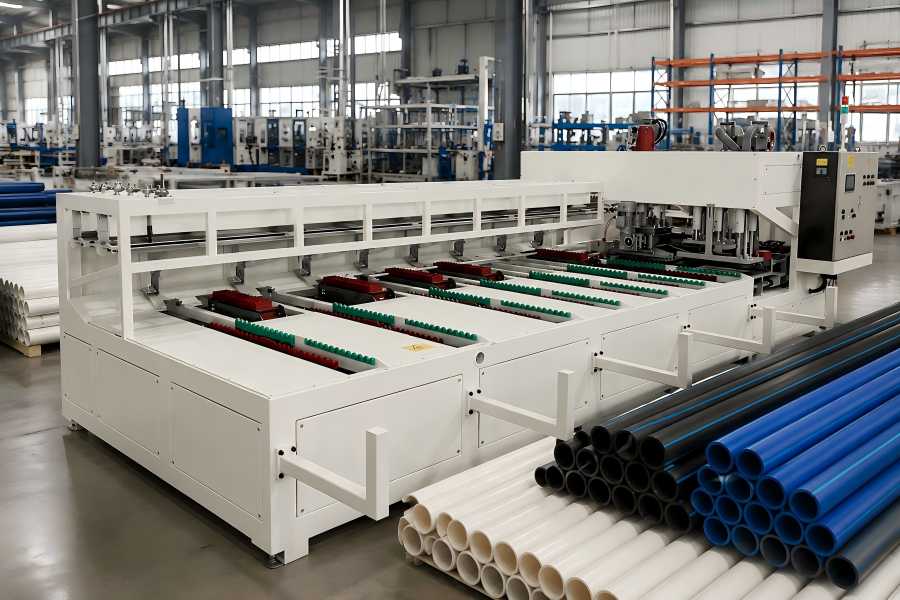
Standard machines only handle limited ranges, while modern production requires flexibility across materials and pipe sizes. Custom belling systems therefore offer scalable, precise, and efficient solutions, helping manufacturers adapt to changing demands and improve long-term operational performance.
Understanding the Role of a Belling Machine
A belling machine is designed to form an enlarged socket (commonly referred to as a “bell”) at the end of a pipe. This socket allows another pipe segment to be inserted and sealed, creating a continuous pipeline system without leakage or structural failure. This joining method is widely used because it is efficient, cost-effective, and adaptable to both low-pressure and high-pressure systems.
The belling process generally includes three core stages: controlled heating of the pipe end, mechanical expansion using a forming mold, and rapid cooling to stabilize the new shape. Each stage must be precisely controlled to avoid deformation, uneven wall thickness, or joint failure.
Belling machines are commonly applied in:
- PVC water supply and drainage pipes
- HDPE gas distribution pipelines
- Electrical conduit protection systems
- Agricultural irrigation pipelines
- Industrial chemical transport systems
The quality of the belling process directly affects system reliability. Poorly formed sockets can lead to leakage, misalignment, or structural weakness under pressure. Therefore, precision engineering is critical, and this becomes increasingly complex when multiple pipe sizes and materials are involved.
Why Customization Matters in Pipe Belling Operations
In real-world industrial environments, pipe manufacturers rarely deal with a single standardized product. Instead, they operate across a wide range of specifications driven by different industries and regional standards.
This variability is the primary reason why custom belling machine solutions for different pipe sizes are essential.
For example:
- Municipal infrastructure projects often require large-diameter drainage pipes exceeding 500mm
- Residential plumbing systems rely on medium-sized pipes between 110mm and 250mm
- Electrical conduit systems may use lightweight pipes below 50mm in diameter
- Agricultural systems require flexible production across multiple diameter ranges
A single machine configuration cannot efficiently accommodate all these requirements without performance compromises. Customization solves this issue by aligning machine structure, heating capacity, forming pressure, and cooling efficiency with specific production demands.
Key reasons customization is critical include:
Pipe Size Variability
Pipe diameter affects nearly every aspect of the belling process, including heating duration, expansion force, and mold geometry. Custom machines ensure that each pipe size receives optimized processing conditions rather than generalized settings that reduce quality.
Material Differences
PVC, CPVC, PP, and HDPE behave differently under heat and pressure. For example, PVC requires precise thermal control to prevent burning, while HDPE demands higher forming force due to its flexibility. Custom systems adjust parameters automatically based on material type.
Production Efficiency Requirements
High-output industrial plants require continuous operation with minimal downtime, while smaller facilities prioritize flexibility and quick changeovers. Custom solutions align machine architecture with production strategy.
Compliance with International Standards
Standards such as ISO, ASTM, and DIN impose strict requirements on pipe dimensions and performance. Custom machines help ensure consistent compliance across varying production batches.
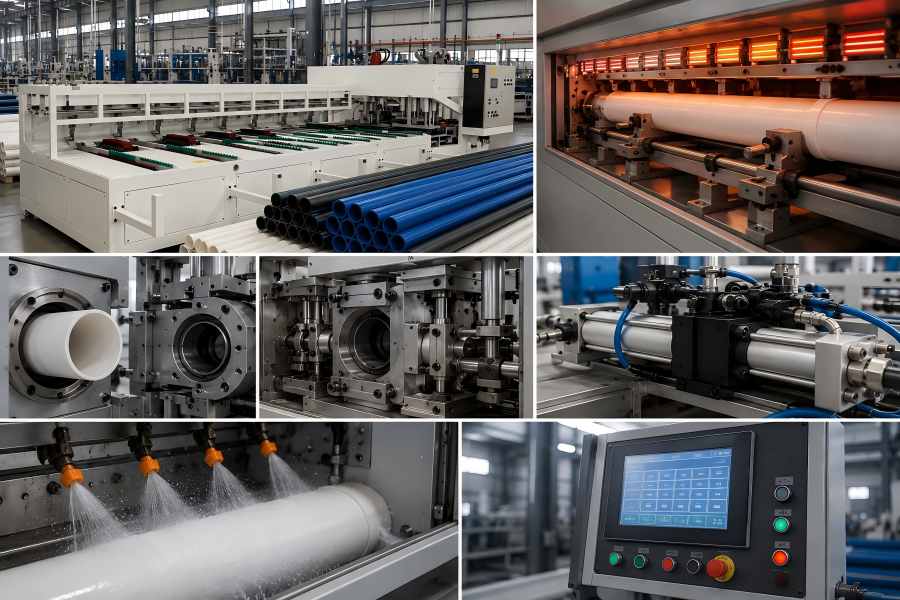
Core Components of a Custom Belling Machine
A modern custom belling machine is not a single fixed device but a modular system composed of multiple engineering subsystems. Each subsystem can be modified or upgraded depending on production needs and pipe specifications.
Heating System
The heating system is responsible for softening the pipe end before forming. In custom machines, heating design is optimized based on pipe size and material thickness.
Common heating technologies include:
- Infrared radiation heating for fast, uniform temperature distribution
- Ceramic plate heating for stable thermal output
- Hot air circulation systems for thick-walled or large-diameter pipes
Advanced systems also integrate multi-zone temperature control, ensuring that different sections of the pipe end are heated evenly to prevent deformation or stress concentration.
Forming Molds
Forming molds determine the final geometry of the socket. Custom molds are designed with high precision to match specific pipe standards.
Customization factors include:
- Inner diameter tolerance
- Socket depth and sealing length
- Rubber ring groove design
- Reinforcement rib structure for high-pressure systems
Quick-change mold systems are increasingly common, allowing manufacturers to switch between pipe sizes with minimal downtime.
Expansion Mechanism
The expansion system applies controlled force to shape the softened pipe into the mold. Depending on production requirements, different technologies are used:
- Hydraulic systems for high-force, large-diameter pipe forming
- Pneumatic systems for lightweight and medium pipes
- Servo-driven systems for high-precision applications requiring tight tolerances
The choice of mechanism directly affects product consistency and cycle speed.
Cooling System
Cooling stabilizes the newly formed socket and prevents shrinkage or deformation. Custom systems may include:
- Water spray cooling for rapid heat extraction
- Air cooling for sensitive materials requiring gradual stabilization
- Integrated mold cooling channels for continuous production environments
Efficient cooling design significantly reduces cycle time and increases overall output.
Control System
Modern custom belling machines rely on PLC or CNC-based intelligent control systems. These systems allow operators to manage complex production variables with precision.
Functions include:
- Multi-size production program storage
- Automated parameter adjustment based on pipe type
- Real-time monitoring of temperature, pressure, and cycle time
- Fault detection and predictive maintenance alerts
Advanced systems may also include IoT connectivity for remote monitoring and production analytics.
Types of Custom Belling Machine Solutions
Different manufacturing environments require different machine configurations. Customization ensures that each production setup is optimized for its intended application.
Fully Automatic Belling Machines
These systems are intended for large-scale industrial production lines where uniformity and efficiency are crucial. Usually, they consist of:
- Automatic pipe feeding and alignment
- Fully integrated heating, forming, and cooling cycles
- Digital control for instant size switching
- Minimal human intervention requirements
They are widely used in mass production facilities supplying national infrastructure projects.
Semi-Automatic Systems
Semi-automatic machines combine automation with manual input, offering flexibility for medium-scale manufacturers.
Typical features include:
- Manual loading or unloading of pipes
- Automated forming and cooling cycles
- Adjustable parameters for multiple product types
These systems are ideal for manufacturers who frequently change product specifications.
Multi-Size Adaptive Machines
These machines are specifically engineered to handle a wide range of pipe diameters within a single system.
Key features include:
- Adjustable mold assemblies
- Programmable heating zones
- Rapid tool change systems
- Intelligent parameter scaling based on pipe size
They are particularly valuable for companies serving diverse project requirements.
Heavy-Duty Industrial Belling Machines
Designed for large-scale infrastructure applications, these machines handle pipes exceeding 400mm or even 1000mm in diameter.
Characteristics include:
- Reinforced steel frames for structural stability
- High-pressure hydraulic expansion systems
- Extended heating and cooling chambers
- Industrial-grade durability for continuous operation
They are commonly used in municipal water systems, sewage networks, and industrial pipelines.
Compact Workshop Belling Machines
Compact systems are designed for small manufacturers or specialized production workshops.
Features include:
- Space-saving design
- Lower energy consumption
- Simplified control interfaces
- Easy maintenance and operation
These machines are ideal for localized production and custom orders.
Customization Based on Pipe Size Ranges
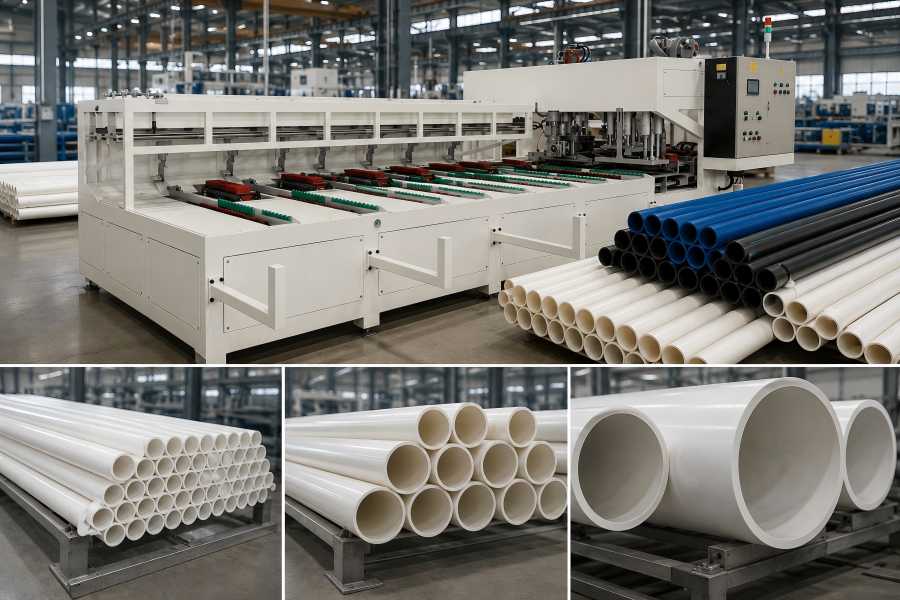
Pipe diameter is one of the most important factors influencing machine design and configuration.
Small Diameter Pipes (16mm–110mm)
Used in electrical conduits and light drainage systems:
- High-speed heating systems
- Precision molds with tight tolerances
- Rapid cooling cycles for fast output
Medium Diameter Pipes (110mm–400mm)
Common in residential and municipal infrastructure:
- Balanced heating and forming systems
- Automated mold switching capabilities
- Moderate cycle speed with high consistency
Large Diameter Pipes (400mm–1000mm+)
Used in heavy infrastructure and industrial applications:
- High-power hydraulic expansion systems
- Extended heating chambers for uniform softening
- Reinforced mechanical structures
- Longer but highly controlled cooling cycles
Each range requires specialized engineering to ensure product reliability and performance.
Key Benefits of Custom Belling Machine Solutions
Improved Production Efficiency
Custom belling machines optimize heating, forming, and cooling parameters for each pipe size, significantly reducing cycle time while maintaining stable continuous production performance across shifts.
Higher Product Quality
Precise control of temperature, pressure, and mold alignment ensures uniform socket dimensions, stronger joints, and consistent sealing performance, reducing defects and improving overall product reliability.
Reduced Material Waste
Accurate forming processes minimize deformation, cracking, and dimensional errors, which lowers rejection rates and helps manufacturers save raw materials while improving cost efficiency per production batch.
Greater Operational Flexibility
Custom systems allow quick adjustment between multiple pipe sizes and materials, enabling manufacturers to respond rapidly to diverse customer orders and changing project requirements efficiently.
Lower Long-Term Costs
Although initial investment is higher, automation reduces labor dependence, maintenance frequency, and downtime, ultimately lowering total operating costs and improving long-term return on investment significantly.
Integration with Modern Manufacturing Systems
Custom belling machines are increasingly integrated into fully automated pipe production lines, which may include:
- Extrusion systems for pipe formation
- Cutting and sizing units
- Belling and socket forming machines
- Printing and marking systems
- Automated packaging lines
This integration creates a continuous production flow from raw material to finished product.
In addition, Industry 4.0 technologies are transforming production capabilities through:
- IoT-based real-time monitoring
- Predictive maintenance systems
- Cloud-based production data analysis
- Remote operation and diagnostics
These innovations significantly improve uptime and production intelligence.
Challenges in Designing Custom Belling Machines
Complex Engineering Requirements
Designing custom belling machines requires precise coordination of thermal, hydraulic, and mechanical systems, ensuring stable performance across different pipe materials, diameters, and production conditions.
Higher Initial Investment
Custom systems involve advanced engineering, specialized components, and tailored manufacturing processes, resulting in significantly higher upfront costs compared with standard or mass-produced belling machines.
Maintenance Complexity
More sophisticated automation and multi-system integration increase maintenance difficulty, requiring skilled technicians, specialized spare parts, and more structured preventive maintenance schedules to ensure uptime.
Operator Training Requirements
Operators must understand programmable control systems, parameter adjustments, and multi-size configurations, which increases training time and demands higher technical competency for safe operation.
Future Trends in Custom Belling Machine Technology
AI-Based Process Optimization
Artificial intelligence will automatically adjust heating, pressure, and timing parameters in real time, improving consistency, reducing defects, and enabling smarter, self-learning production performance across varied pipe sizes.
Fully Autonomous Production Lines
Future systems will integrate feeding, belling, inspection, and packaging into fully automated pipelines, minimizing human intervention while maximizing speed, accuracy, and continuous manufacturing efficiency.
Energy-Efficient Heating Systems
Next-generation heating technologies will reduce energy consumption through improved insulation, infrared precision heating, and adaptive thermal control, lowering operational costs and environmental impact significantly.
Modular Machine Design
Modular architectures will allow manufacturers to upgrade or reconfigure machine components easily, enabling flexible adaptation to new pipe sizes, materials, and evolving production requirements.
Smart Quality Inspection Systems
Integrated sensors and machine vision will detect defects instantly during production, enabling real-time quality control, reducing waste, and ensuring consistent compliance with international standards.