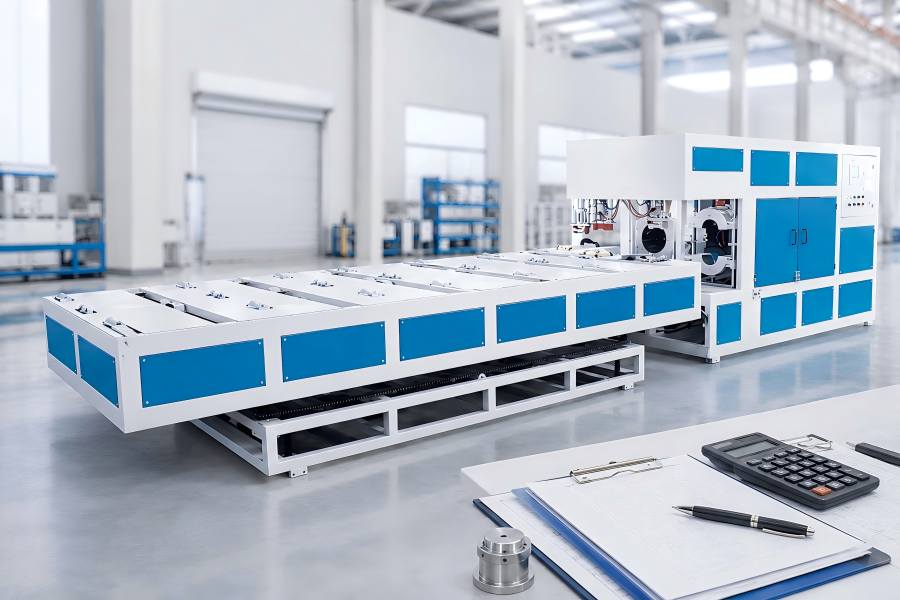
A belling machine forms pipe ends for secure socket connections in PVC, UPVC, PP, and PE pipe production. Prices typically range from USD 5,000 to over USD 100,000, depending on pipe size, automation, socket type, heating and cooling systems, controls, and whether the machine is standalone or inline.
Average Belling Machine Price Range
| Machine Type | Typical Price Range | Suitable For |
| Manual/simple semi-automatic belling machine | USD 3,000–10,000 | Small workshops, low output, simple sockets |
| Semi-automatic PVC pipe belling machine | USD 8,000–25,000 | Small to medium pipe factories |
| Automatic small/medium diameter belling machine | USD 15,000–45,000 | Regular production of PVC/UPVC pipes |
| Automatic large-diameter belling machine | USD 35,000–90,000+ | Drainage, sewage, pressure pipe production |
| Rieber / rubber ring socket belling machine | USD 50,000–120,000+ | High sealing standard pipe systems |
| Customized high-speed inline belling system | USD 80,000–150,000+ | Large-scale pipe extrusion lines |
These ranges are only general references. The final price depends heavily on technical requirements. Two machines may both be called “PVC pipe belling machines,” but their prices can be very different if one handles 63–160 mm pipe and the other handles 315–630 mm pipe with automatic feeding, PLC control, rubber ring socket forming, and water cooling.
What Determines the Cost of a Belling Machine?
Pipe Diameter Range
Pipe diameter is one of the biggest price factors. A machine designed for small conduit pipes, such as 16–63 mm, usually costs much less than a machine designed for 250 mm, 400 mm, 630 mm, or larger pipes.
Large-diameter pipes require stronger frames, larger heating ovens, bigger forming molds, more powerful pneumatic or hydraulic systems, and more stable cooling structures. This increases both material cost and manufacturing complexity.
For example, a small pipe belling machine may only need a compact heating and forming system. A large-diameter machine must support heavier pipes, longer pipe lengths, larger socket depth, and higher forming force. This is why large-diameter belling equipment can easily cost several times more than small-diameter equipment.
Automation Level
Automation has a direct impact on price. A semi-automatic machine normally requires more manual operation, such as pipe loading, positioning, unloading, or process adjustment. It is cheaper to buy but may need more labor during production.
An automatic belling machine performs pipe feeding, positioning, heating, forming, cooling, and unloading processes with minimal manual operation.
According to Yuyu Machinery’s explanation of PVC belling machines, automatic systems are generally used for higher efficiency, better consistency, and mass production, while semi-automatic models are more suitable for smaller production volumes or flexible production needs.
If your factory only produces small batches or customized pipe sizes, a semi-automatic machine may be enough. If your extrusion line runs continuously, an automatic belling machine is usually the better long-term investment because it reduces labor dependence and improves production stability.
Socket Type
Different socket types require different machine configurations. Common socket types include plain socket, U-type socket, R-type socket, and Rieber socket.
A plain socket is relatively simple. It is mainly used for pipe connection methods such as solvent cement bonding. A rubber ring socket or Rieber socket is more complex because the machine must form a precise groove or sealing structure.
Yuyu Machinery points out that different socket types require different belling machines, and the socket design directly influences the choice of equipment.
If you need only simple straight sockets, the machine cost will be lower. If you need Rieber sockets or rubber ring sealing sockets for drainage, sewage, or pressure pipe applications, the machine will require higher forming accuracy and more specialized molds, which increases the price.
Heating System
The heating system affects both machine cost and socket quality. Common heating methods consist of hot air, infrared, oven-based, ceramic, and stainless-steel heating systems.
A low-cost machine may use a simpler heating structure, but this can lead to uneven heating, longer cycle times, or unstable socket dimensions.
A better heating system provides more even temperature distribution and more accurate control. This is important because PVC pipe belling requires controlled heating; overheating may cause burning or deformation, while underheating may cause incomplete forming or socket cracks.
For factories that produce export-standard pipes or pipes with strict dimensional requirements, investing in a better heating system is often worthwhile.
Cooling System
After the pipe end is formed, it must be cooled to fix the socket shape. Cooling may be done by air cooling, water cooling, or a combined cooling system.
A basic cooling system may be enough for simple low-speed production. However, for higher output or thick-wall pipes, the cooling system must be stronger and more stable. Poor cooling can cause socket deformation, dimensional change, or unstable fitting quality.
A better cooling system increases the initial machine price, but it can reduce defects, improve cycle time, and make production more consistent.
Control System and Electrical Components
The control system also affects cost. A basic machine may use simple electrical control, while an advanced automatic machine may use PLC control, touchscreen operation, servo control, temperature control modules, sensors, and safety protection systems.
Some suppliers offer different electrical brands, such as domestic components or international brands. International components may increase the machine price, but they can improve reliability, availability of spare parts, and ease of maintenance in overseas markets.
For industrial buyers, the cheapest control system is not always the best choice. If the control system is unstable, the machine may cause frequent downtime, wrong positioning, inconsistent heating, or socket quality problems.
New vs Used Belling Machine Cost
A used belling machine is usually cheaper than a new one, but buyers need to check its condition carefully. Used machinery marketplaces list second-hand belling and socketing machines from well-known brands, but many listings require direct price inquiry because the final price depends on machine age, size range, tooling, condition, and availability.
A used machine may be suitable if your budget is limited and the machine matches your pipe specifications. However, there are risks: old molds may not match your pipe standards, electrical systems may need replacement, spare parts may be difficult to find, and installation support may be limited.
A new machine costs more, but it can be customized for your pipe diameter, socket type, production speed, voltage, factory layout, and automation requirements. For long-term production, a new machine is often more reliable.
Hidden Costs You Should Consider
When calculating the total cost of a belling machine, do not only look at the machine price. The real investment includes several additional costs.
Molds and Forming Tools
Different pipe sizes and socket designs require matching molds. If your factory produces multiple pipe diameters, you may need several mold sets. Mold cost can become significant, especially for large-diameter or rubber ring socket production.
Shipping and Packaging
A belling machine is industrial equipment, so international shipping cost can be high. The cost depends on machine size, weight, destination port, packaging method, and whether the machine needs container loading.
Import Duties and Taxes
Import duties, VAT, customs clearance fees, and local handling charges should be included in your budget. These costs vary by country and can increase the final landed cost.
Installation and Training
Some machines can be installed relatively easily, while larger automatic systems may require supplier engineers or online technical support. Training is important because operators must understand heating temperature, forming time, cooling time, alignment, mold changeover, and maintenance.
Spare Parts
Heating elements, seals, pneumatic parts, sensors, molds, and control components may need replacement over time. Before buying, ask the supplier for a spare parts list and recommended spare parts package.
Downtime Cost
A cheap machine may save money at the beginning but can cost more later if it stops frequently. Downtime affects the entire pipe production line, especially when the belling machine is connected directly with the extrusion line.
How to Choose the Right Belling Machine for Your Budget
The ideal belling machine is not always the lowest-priced or highest-priced choice. It should match your production needs.
First, confirm your pipe material. PVC and UPVC are common, but some factories also process PP or PE pipes. Different materials require different heating and forming conditions.
Second, confirm the pipe diameter range. Choose a machine that covers your current main products and possible future expansion. Choosing a machine that is undersized can restrict your future product range.
Third, verify the socket type. If your market requires rubber ring sockets or Rieber sockets, do not choose a machine designed only for plain sockets.
Fourth, check your production capacity. If the belling machine is too slow, it becomes the bottleneck of the extrusion line. If it is too advanced for your current output, you may spend more than necessary.
Fifth, evaluate supplier support. A good supplier should provide technical consultation, machine configuration suggestions, installation guidance, operation training, spare parts, and after-sales service.
Example Buying Scenarios
Small Pipe Factory
A small factory producing low-volume PVC conduit or drainage pipes may choose a semi-automatic belling machine. The budget may be around USD 8,000–20,000, depending on pipe size and machine configuration. This option keeps investment low while meeting basic production needs.
Medium PVC Pipe Manufacturer
A medium-sized factory producing 50–250 mm PVC or UPVC pipes may need an automatic belling machine. The budget may be around USD 20,000–50,000. This type of machine offers better efficiency, more stable socket quality, and lower labor dependence.
Large Drainage or Pressure Pipe Manufacturer
A factory producing 315 mm, 400 mm, 500 mm, or 630 mm pipes usually needs a stronger automatic machine with reliable heating, forming, and cooling systems. The budget may range from USD 50,000 to more than USD 100,000, especially if rubber ring socket forming is required.
Is a More Expensive Belling Machine Worth It?
A higher-priced belling machine can be worth it if it improves production stability, reduces labor cost, lowers rejection rate, and supports higher-quality sockets. In pipe production, socket defects can cause serious problems, including difficult installation, leakage, customer complaints, and product rejection.
If your factory sells into low-cost markets with simple socket requirements, a basic machine may be acceptable. But if you supply municipal drainage, water supply, infrastructure, or export markets, socket quality becomes more important. In this case, spending more on a stable automatic belling machine may reduce long-term production risk.
Final Price Guide
As a practical rule, buyers can estimate belling machine cost as follows:
| Buyer Need | Recommended Budget |
| Basic small pipe socketing | USD 5,000–15,000 |
| Semi-automatic PVC pipe production | USD 10,000–25,000 |
| Automatic medium-size pipe belling | USD 20,000–50,000 |
| Large-diameter automatic belling | USD 50,000–100,000+ |
| High-end Rieber or customized inline system | USD 80,000–150,000+ |