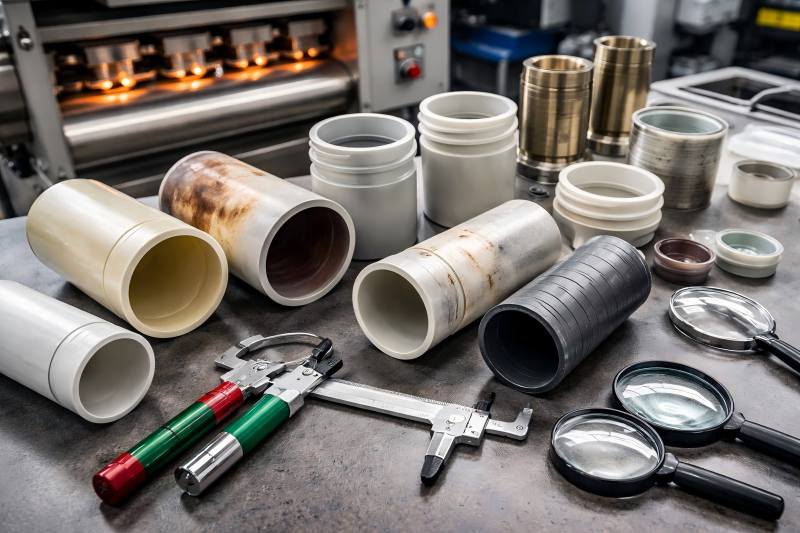
Sockets (also called bells) look simple, but they’re a tightly controlled “interface part”: the pipe must seal, align, and survive handling without cracks or leaks. Because socket formation involves heating, reshaping, vacuum/pressure forming, calibration, and cooling, small process drifts can create repeatable defects.
How sockets are formed
Most socketing lines follow a pattern:
- Pipe cut to length → end presented to socketing station
- Heating (IR/air/oven) softens the pipe end
- Forming over a mandrel (vacuum, pressure, mechanical push)
- Calibration (sizing sleeve/calibrator) to final OD/ID/taper
- Seal feature creation (gasket groove, stop shoulder, chamfer)
- Cooling (water/air) to lock dimensions
- Ejection + handling
Defects typically come from four sources:
- Thermal issues (wrong temperature, uneven heat, wrong soak time)
- Forming dynamics (vacuum leaks, pressure instability, misalignment)
- Tooling condition (mandrel wear, groove damage, blocked vacuum ports)
- Material/pipe variation (wall thickness, ovality, melt quality, contamination)
Dimensional defects
Defect A: Out-of-round / oval socket (ovality)
What you see: Socket ID/OD is not circular; gasket seating can be uneven; assembly feels tight at one angle and loose at another.
Root causes:
- Pipe arrives already oval (extrusion/cooling issues upstream)
- Uneven heating around circumference (heater alignment, dirty reflectors, uneven airflow)
- Calibration sleeve worn or out of tolerance
- Insufficient cooling time → socket relaxes after ejection
- Vacuum ports partially blocked → non-uniform pull-down
Common fixes:
- Verify incoming pipe ovality and wall distribution
- Rebalance heater zones; clean lamps/reflectors; check rotation if used
- Inspect/replace calibrator sleeve; confirm coolant flow and temperature
- Clean vacuum holes and manifolds; pressure-test vacuum circuit
Defect B: Oversized or undersized socket ID
What you see: Too loose → leaks/gasket doesn’t compress; too tight → assembly force high, risk of gasket roll.
Root causes:
- Mandrel/calibrator dimension drift (wear, thermal expansion, wrong tool set)
- Forming pressure/vacuum not hitting setpoints consistently
- Incorrect forming dwell time
- Material shrink differences (resin grade change, regrind ratio change)
- Cooling too fast/too slow causing different shrink behavior
Common fixes:
- Gauge mandrel/calibrator at operating temperature (not just cold)
- Trend vacuum/pressure over time; add alarms for slow leaks
- Lock recipe changes; control regrind % and resin lot transitions
- Standardize cooling flow and ejection timing
Defect C: Short socket length / shallow bell
What you see: Socket depth is insufficient; insertion mark/stop shoulder not reached; joint strength reduced.
Root causes:
- Pipe end not fully pushed over mandrel (stroke limit, mis-timed clamp)
- Heating too low or soak too short → material too stiff to fully form
- Forming dwell too short; early ejection
- Slippage at clamp because of contamination or low clamp force
Common fixes:
- Confirm mechanical stroke and position sensors
- Increase heating time/temperature gradually (avoid overheating)
- Increase forming dwell and/or vacuum hold
- Improve clamp surface/force; remove lubricant contamination on grip zone
Defect D: Taper angle wrong/poor lead-in chamfer
What you see: Insertion difficult; gasket may roll; spigot may shave material.
Root causes:
- Chamfer tool worn/chipped
- Calibration sleeve edge damaged
- Misalignment between pipe, mandrel, and chamfer station
- Temperature too low → tearing instead of forming cleanly
Common fixes:
- Replace chamfer tool; inspect sleeve entrance geometry
- Align pipe centering guides; check mandrel concentricity
- Tune heating profile for a smooth, ductile forming window
Seal-feature defects
Defect E: Gasket groove too shallow/too deep/mispositioned
What you see: Gasket doesn’t sit flat; pops out; rolls during assembly; leaks.
Root causes:
- Groove-forming ring insert wear, damage, or wrong insert installed
- Mandrel axial position drift (spacer wear, loose fasteners)
- Inconsistent forming pressure → groove definition varies cycle to cycle
- Material too hot → groove “washes out”; too cold → incomplete definition
Common fixes:
- Verify correct groove insert and part number; measure wear limits
- Check mandrel axial stop; lock out looseness in fixtures
- Stabilize pressure/vacuum; add “hold” time to set groove
- Adjust temperature window: aim for repeatable groove replication, not maximum softness
Defect F: Stop shoulder deformed / not square
What you see: Insertion depth varies; joint may bottom unevenly; gasket compression inconsistent.
Root causes:
- Non-uniform cooling causing warpage at shoulder
- Ejection too early while material still rubbery
- Shoulder tool edge worn or contaminated
Common fixes:
- Extend cooling time or improve local cooling near shoulder
- Delay ejection; reduce part handling stress at hot state
- Clean tooling faces; restore sharp but not cutting edges
Surface and structural defects
Defect G: Burn marks, brown/black discoloration, “glossy melted” look
What you see: Dark spots, shiny patches, sometimes odor; brittleness in severe cases.
Root causes:
- Overheating (lamp too close, dwell too long, hot spots)
- Stagnant airflow in heater causing local temperature peaks
- Contamination on pipe surface (oil, printing ink solvents) that burns
- Incorrect heater zoning after maintenance
Common fixes:
- Reduce peak temperature or dwell; increase distance or add rotation
- Balance heater zones; confirm airflow pattern
- Improve upstream cleaning/handling; verify ink/solvent compatibility
- Use temperature mapping (IR camera or contact probes on dummy trials)
Defect H: Whitening/stress marks/craze lines
What you see: White lines or haze, often near groove, chamfer, or shoulder; can precede cracks.
Root causes:
- Forming while too cold (high strain in brittle region)
- Excessive mechanical stretch due to aggressive pushing or low heat
- Sharp tooling edges concentrating stress
- Rapid quench cooling inducing thermal stress
Common fixes:
- Increase heat slightly or extend soak for uniformity
- Reduce forming speed; smooth transitions
- Radius sharp edges (within spec); polish damaged tooling
- Moderate cooling rate; avoid extreme cold water at critical features
Defect I: Cracks (radial/axial), split socket mouth
What you see: Visible cracks immediately or after a short time; failures in handling or hydrotest.
Root causes:
- Underheating + over-stretch (most common)
- Excessive notch effect (damaged chamfer tool, scratched groove area)
- Material defects: poor fusion/gelation, contamination, moisture (for some polymers)
- Residual stress from uneven cooling or early ejection
Common fixes:
- Bring pipe end into proper forming temperature window
- Remove notch sources; stop using damaged tools immediately
- Tighten resin handling (drying where required; control contamination; limit degraded regrind)
- Increase cooling/conditioning before ejection and stacking
Defect J: Wrinkles, folds, “orange peel” texture
What you see: Circumferential wrinkles; rough texture; sometimes localized near socket mouth.
Root causes:
- Material too hot and soft → buckling during push/forming
- Push speed too high; poor control of forming sequence
- Vacuum applied too late or unevenly
- Calibrator mismatch causing compressive instability
Common fixes:
- Lower heat slightly; shorten dwell to reduce over-softening
- Reduce push speed; synchronize vacuum/pressure timing earlier
- Check calibration sleeve entry and alignment
- Ensure uniform vacuum distribution (ports, seals, manifold)
Defect K: Bubbles, blisters, voids
What you see: Raised blisters or internal voids; can weaken socket.
Root causes:
- Trapped air due to vacuum leak, blocked vents, or late vacuum
- Moisture/volatile contamination (depends on polymer and additives)
- Excessive heating driving volatiles out during forming
Common fixes:
- Leak-test vacuum system; clean vents and vacuum ports
- Improve material storage/handling; control contaminants
- Reduce overheating; use stable heating, not high peak spikes
Defect L: Scratches, drag marks, tooling lines
What you see: Long scratches along insertion direction; scuffed sealing land; cosmetic defects.
Root causes:
- Mandrel surface roughness or contamination
- Lack of proper release strategy (if used) or excessive friction
- Misalignment causing rubbing during insertion/ejection
- Debris in calibrator sleeve
Common fixes:
- Polish/clean mandrel; implement routine wipe schedule
- Verify alignment; check ejection path
- Filter/clean coolant and sleeve interiors; keep area dust-free
- Use only approved release agents (wrong ones can harm gasket sealing)
One Table to Diagnose Fast
| Defect / Symptom | Most Likely Root Causes | First Checks (Fastest) |
| Oval socket / inconsistent insertion force | Uneven heating, incoming ovality, sleeve wear, vacuum imbalance | Measure pipe ovality; heater zone mapping; vacuum port cleaning; sleeve gauge |
| ID too loose / leaks | Tool wear, shrink variation, low vacuum/pressure, short dwell | Check tool dimensions hot; trend vacuum/pressure; confirm dwell time |
| ID too tight / high insertion force | Oversized mandrel, low shrink, over-cooling, wrong tool set | Verify tool set; measure ID after conditioning; coolant temp/flow |
| Shallow bell / short length | Low heat, push stroke short, clamp slip | Check stroke sensors; clamp force; heating soak time |
| Gasket groove poor | Insert wear/wrong insert, unstable pressure, wrong temperature | Inspect groove insert; pressure stability; temperature window |
| Burn marks | Overheat, hot spots, contamination | Reduce peak heat; check lamp distance; surface cleanliness |
| Whitening / cracks | Too cold forming, sharp edges, residual stress | Increase uniform heat; inspect edges; extend cooling/ejection delay |
| Wrinkles/folds | Too hot + fast push, vacuum timing late | Lower heat; slow push; vacuum timing and distribution |
| Blisters/voids | Vacuum leak/blocked vents, volatiles/moisture | Leak test; clean vents/ports; check material handling |
Root-cause Patterns that Save the Most Time
Pattern 1: “Same defect, multiple lines” → check material + incoming pipe geometry
If a defect appears across different socketing machines, it’s often upstream:
- Pipe wall thickness variation (eccentricity)
- Ovality from haul-off/cooling
- Resin lot change, stabilizer package change, or regrind shift
Best practice: Keep a short “incoming pipe record” per lot: OD/ID, ovality, wall thickness at 0°/90°/180°/270°, surface condition.
Pattern 2: “Defect drifts over the shift” → thermal expansion or vacuum leak
If sockets start good then go off-size:
- Mandrel temperature creeps up (dimension shift)
- Calibration sleeve heats and expands
- Vacuum seals soften and begin leaking
Best practice: Measure critical dimensions at operating temperature and trend vacuum level every hour.
Pattern 3: “Defect is cyclical” → timing, sensor, or pressure control
Cyclical defects often point to:
- Heater cycling overshoot
- Vacuum valve sticking intermittently
- Pressure regulator instability
- Mechanical clamp slipping every N cycles
Best practice: Correlate defect rate with logged cycle data (pressure/vacuum/time/temperature).
Prevention: Process Controls that Reduce Scrap Fastest
Control the heating window (not just “more heat”)
Uniformity matters more than peak temperature. Use:
- Zoned heater control
- Rotation (where appropriate)
- Clean reflectors and consistent distance to pipe surface
Stabilize vacuum/pressure forming
- Add low/high alarms for vacuum setpoint and decay rate
- Maintain seals and hoses; tiny leaks cause big geometry variation
- Keep vacuum ports clean (a weekly cleaning schedule beats troubleshooting)
Tooling discipline
- Track mandrel and groove insert life (cycles) and wear limits
- Inspect for nicks and sharp edges (crack starters)
- Keep calibration sleeves clean; a single chip can scratch hundreds of parts
Cooling and handling
- Don’t eject “rubbery” sockets: they will relax, ovalize, or crack later
- Ensure local cooling at gasket groove/shoulder
- Avoid stacking pressure while parts are warm
Quality checks to catch defects before shipment (simple and effective)
- Go/No-Go gauges for ID, socket depth, groove geometry
- Roundness/ovality checks at multiple clock positions
- Insertion force monitoring (even a simple force fixture helps)
- Visual inspection standards with photos for burn/whitening/wrinkles
- Hydrotest sampling plan aligned with your applicable standard
Second table: “First response” troubleshooting workflow
| Step | What to Do | What It Tells You |
| 1 | Compare a “good” vs “bad” socket from the same hour | Confirms drift vs random variation |
| 2 | Check vacuum level and decay (leak-down test) | Leak or blocked port issues |
| 3 | Map heater zones / inspect heater cleanliness | Uneven heat or hot spot creation |
| 4 | Inspect mandrel + calibrator sleeve for wear, debris, nicks | Direct cause of sizing + scratches + cracks |
| 5 | Verify stroke/position sensors and clamp grip | Shallow bells, misalignment, wrinkles |
| 6 | Review resin/pipe lot change, regrind %, upstream extrusion stability | Systemic causes beyond socketing station |
| 7 | Adjust only one variable at a time and document | Prevents “fixing” into a new defect |
Conclusion
Socket quality is mainly a battle against non-uniform heat, unstable forming forces, and tooling wear/contamination, with incoming pipe geometry and material variation as the silent multipliers. If you build your troubleshooting around those four pillars (heat, force, tooling, material), most socket defects become predictable and preventable.
If you tell me your pipe type (PVC/UPVC/CPVC/HDPE), socket standard (rubber ring vs solvent), and the top 3 defects you’re seeing, I can turn this into a tighter, step-by-step corrective action plan (settings to check first, typical ranges to adjust, and what not to change).