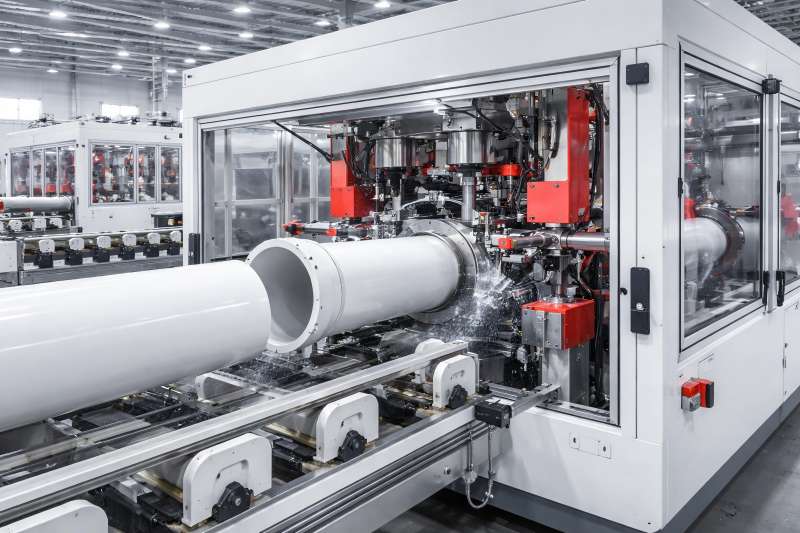
A belling machine (socketing machine) is the downstream “connection-maker” in a pipe extrusion line: it forms the socket (bell) so pipes can be joined quickly with rubber ring sealing, solvent cement, or other coupling methods.
Because PVC/UPVC, CPVC, and HDPE behave very differently when heated and formed, the “best” belling solution is always a match between your pipe material, diameter range, wall thickness, end-connection type, and the throughput you expect.
Start With the Output You Need: Pipe Range, Speed, and Socket Type
Before you compare brands or machine styles, define three production basics:
Pipe material and grade
- PVC/UPVC: rigid thermoplastic; forms well with controlled heating; sensitive to overheating and surface degradation.
- CPVC: higher temperature resistance than PVC; typically needs tighter temperature control and may require higher heating energy for consistent forming.
- HDPE: tougher, more elastic, higher shrink behavior; forming needs careful cooling calibration to lock dimensions.
Pipe diameter and wall thickness range
A belling machine has a “sweet spot” for OD and SDR ranges. Machines that claim a huge range often require longer changeovers, more tooling sets, and more tuning time.
Socket standard / joint type
Common socket outcomes include:
- Rubber ring socket (integral gasket seat): requires precise internal groove geometry and repeatability.
- Solvent cement socket (typical PVC/UPVC): needs smooth, controlled surface and correct taper.
- Long spigot + socket systems (some municipal standards): may require longer forming tooling and special cooling.
- Special couplers / multi-step sockets: need customized mandrels, calibration, and often servo-controlled sequences.
If you lock these three inputs first, everything else becomes a structured selection process.
Choose the Right Belling Process Type
Most belling machines on extrusion lines fall into two main categories:
Inline (on-line) belling
The pipe comes directly from the haul-off/cutter into the belling station.
Best for:
- High-volume, steady output.
- Repeating standard sizes often.
- Plants prioritizing labor reduction and steady throughput
Pros:
- Less handling; lower labor
- Better flow for automated lines
- Consistent cycle timing when tuned
Cons:
- Line speed may be limited by belling cycle
- Requires stable extrusion/cutting accuracy
- More sensitive to upstream fluctuations
Offline belling
Pipes are cut and stacked first, then belled in a separate station.
Best for:
- Mixed sizes with frequent changeovers
- Smaller factories scaling up gradually
- Situations where extrusion runs faster than belling capacity
Pros:
- Extrusion line can run independently
- Easier to schedule by size batches
- Can add multiple offline belling stations as demand grows
Cons:
- More handling and floor logistics
- Higher labor unless automated loading/unloading is added
Decision tip: If your business is driven by a few “cash-cow sizes” running daily, inline belling usually pays off. If you have many SKUs, varied standards, or frequent small orders, offline may give you higher overall factory efficiency.
Heating Method: The Core Difference Between PVC/UPVC/CPVC and HDPE
Heating must bring only the pipe end into a controlled “forming window” without degrading material, distorting OD, or creating internal stress that later causes ovality, leakage, or cracks.
Common heating options
- Infrared (IR) oven: fast response, efficient; excellent for PVC/UPVC; works for HDPE with correct tuning and shielding.
- Hot air convection: gentler, good for thicker walls; may be slower; useful when surface quality is critical.
- Contact heating (heated mandrel/plate): direct energy transfer; can be stable but risks surface marks if not controlled well.
- Combined heating: IR + hot air is common for wide diameter ranges or thicker pipes.
Here’s a practical comparison you can use during specification:
| Material | Typical forming behavior | Heating control priority | Common best-fit heating | Notes for buyers |
| PVC / UPVC | Forms easily; can scorch if overheated | Tight temperature uniformity; avoid surface degradation | IR or IR + hot air | Look for closed-loop temp control and stable rotation/heating time |
| CPVC | Needs higher energy; sensitive to inconsistency | Very tight temperature + cycle repeatability | IR + hot air (often) | Ask about proven CPVC recipes and tooling materials suited to CPVC temps |
| HDPE | Elastic; higher shrink; needs strong calibration | Controlled heating + strong cooling/calibration | IR with strong cooling station | Cooling design and calibration sleeve quality matter as much as heating |
Cooling and Calibration: Where Socket Quality Is “Locked In”
A socket can look good right after forming but fail dimensional checks after cooling or storage if the cooling is not designed properly. This is especially true for HDPE because it shrinks more and “moves” longer after forming.
Key cooling design elements:
- Water spray or water ring cooling: quick heat extraction; good for cycle time.
- Cooling sleeves/calibrators: ensure the socket ID/OD stays in tolerance.
- Internal cooling mandrel: improves roundness and groove stability for rubber ring sockets.
What to verify:
- Does the machine have a dedicated calibration phase (not just “cooling”)?
- Are cooling circuits separated for different zones (bell mouth vs gasket seat)?
- Is the cooling time adjustable by recipe, not by manual trial only?
For gasket sockets, the internal groove must be stable. If cooling is uneven, the groove can become oval or shallow in spots, leading to sealing problems.
Forming Method: Vacuum, Pressure, or Mechanical Expansion?
The “forming” step creates the socket geometry. Depending on machine design and standards, you may see:
Vacuum forming
Vacuum pulls softened material to the tooling surface.
Strengths:
- Great surface replication
- Good for certain socket profiles and thin-to-medium walls
Watch-outs:
- Needs good sealing and stable vacuum system
- Can struggle on thick walls without sufficient heating
Internal pressure forming (air pressure)
Air pressure pushes material outward to the mold.
Strengths:
- Strong forming force; good for thicker walls
- Often used for consistent shape in some designs
Watch-outs:
- Requires good pressure control and safety systems
- Tool sealing and cycle timing are critical
Mechanical expansion (mandrel expansion)
A mechanical mandrel expands the pipe end into shape.
Strengths:
- Very repeatable if servo-controlled
- Can be robust for specific socket types
Watch-outs:
- More mechanical wear; mandrel precision matters
- Surface finish depends heavily on mandrel condition
Buyer guidance: For rubber ring sockets, prioritize whichever forming method your target standard has proven in the field—then focus on calibration and groove accuracy. For solvent sockets, surface quality and taper control usually dominate.
Automation Level: Manual, Semi-Auto, or Fully Automatic
Automation affects your labor cost and consistency.
Manual/semi-auto
Operators load pipe ends, initiate cycles, remove pipes.
Best for: small plants, frequent size changes, low-to-medium throughput.
Fully automatic
Auto-loading, centering, heating, forming, cooling, and discharge—often with servo axes and recipe control.
Best for: high volume, consistent sizes, limited labor availability.
Critical automation features to consider:
- Automatic centering and length positioning (prevents uneven sockets)
- Recipe management (one-touch parameter sets for each size/material)
- Automatic lubricant dosing (if your process needs it; improves consistency)
- Reject detection (temperature out-of-range, incomplete forming, vacuum fault)
Changeover Speed and Tooling Strategy
Changeover is where many plants lose hidden production hours.
Ask these questions:
- How many tooling sets are required across your diameter range?
- How long does a typical size change take (real-world, not marketing)?
- Are mandrels, molds, and calibrators quick-lock style or bolt-heavy?
- Does the PLC store recipes per size + material + thickness?
Tooling quality factors
- Tool steel grade and surface hardening
- Polishing level (affects socket surface and demolding)
- Coatings (optional) for wear reduction
- Cooling channel design inside molds
If you run both PVC and HDPE, consider whether you’ll dedicate machines or at least dedicate tooling sets—cross-material tooling compromises can create quality issues.
Dimensional Accuracy and Standards Compliance
Socketing is not just “forming a bell”; it’s manufacturing a connection interface.
Key dimensional outputs to control:
- Socket ID and taper
- Insertion depth
- Bell mouth chamfer
- Gasket groove depth/width and position (for rubber ring sockets)
- Roundness and ovality
If you sell into regulated markets, the belling machine must support:
- Stable repeatability across shifts
- Measurable, traceable settings
- Capability to meet standard tolerances (your QC should verify actual standard requirements)
Practical tip: Ask suppliers to provide sample sockets with your target material and size, then check:
- Ovality after full cooling
- Groove consistency around circumference
- Leak test performance in your assembly method
Throughput Matching: Don’t Let Belling Become the Bottleneck
Your extrusion output rate must match belling cycle time. The belling cycle typically includes:
- Pipe end positioning and clamp
- Heating (often the longest step)
- Forming
- Calibration/cooling
- Release and discharge
If your target line speed is aggressive, consider:
- Dual-station belling (two forming heads) alternating cycles
- Longer heating tunnel with staged zones
- Parallel offline belling stations to support multiple SKUs
A simple matching table can help you decide what features matter most:
| Production situation | Risk if machine is underspecified | Recommended belling configuration focus |
| High-volume, few sizes | Bottleneck limits total output | Inline + fast heating + dual station or optimized cooling |
| Mixed sizes, frequent changeovers | Excess downtime and scrap | Offline or inline with quick-change tooling + strong recipe control |
| Thick-wall pipes | Incomplete forming, ovality | Higher heating capacity + stronger calibration/cooling |
| HDPE gasket sockets | Shrink/ovality causes leakage | Excellent calibration design + controlled cooling + recipe tuning |
| CPVC sockets | Surface defects, inconsistency | Very stable temperature control + proven CPVC tooling and process |
Control System and Process Stability
A modern belling machine should not rely on operator “feel.” Look for:
- Closed-loop temperature control (multi-zone if possible)
- Servo-controlled motion for mandrel/mold movement (repeatable strokes)
- Vacuum/pressure feedback sensors
- Alarm logic and interlocks (prevents forming when not in range)
- Recipe storage and user permissions (reduces accidental parameter drift)
- Data logging (helpful for quality audits and troubleshooting)
Stability features cut scrap and simplify training across multiple shifts.
Utilities, Footprint, and Integration With Your Line
Belling machines rely on utilities that can quietly limit performance:
Compressed air
Needed for actuators and sometimes pressure forming. Undersized air supply leads to cycle instability.
Cooling water
Stable flow and temperature are essential, especially for high-speed socketing and HDPE.
Vacuum system
If vacuum forming is used, verify pump capacity, filtration, and ease of maintenance.
Integration points
- Cutter synchronization and pipe length accuracy
- Conveyor alignment and centering
- Downstream stacking or coiling (for some HDPE setups)
When comparing two machines with similar “specs,” the one that integrates cleanly with your existing cutter/haul-off and factory utilities often wins in real uptime.
Quality, Maintenance & TCO
The purchase price is only a fraction of lifetime cost. Focus on:
Wear parts and consumables
- Seals, O-rings, vacuum gaskets
- Mandrel surfaces, calibration sleeves
- Heater elements or IR lamps
- Sensors and pneumatic valves
Ease of maintenance
- Tooling access without full disassembly
- Quick drain and cleaning for cooling circuits
- Clear troubleshooting diagnostics on the HMI
Supplier support
- Commissioning and training quality
- Availability of spare parts
- Remote troubleshooting capability
- Process documentation (recipes, parameter ranges)
A belling machine that runs 3–5% higher uptime can easily outperform a cheaper machine over a year of production.
Conclusion
Choosing a belling machine for PVC/UPVC/CPVC/HDPE production lines is ultimately about process control: controlled heating, repeatable forming, and reliable calibration/cooling—matched to your pipe range, socket standard, and throughput goals. Define your socket type and production reality first, then select the machine style (inline/offline), heating and cooling design, forming method, and automation level that deliver consistent sockets with minimal changeover pain. When you evaluate quotes, focus on stability, tooling strategy, integration, and support—because uptime and socket quality are what pay back your investment.