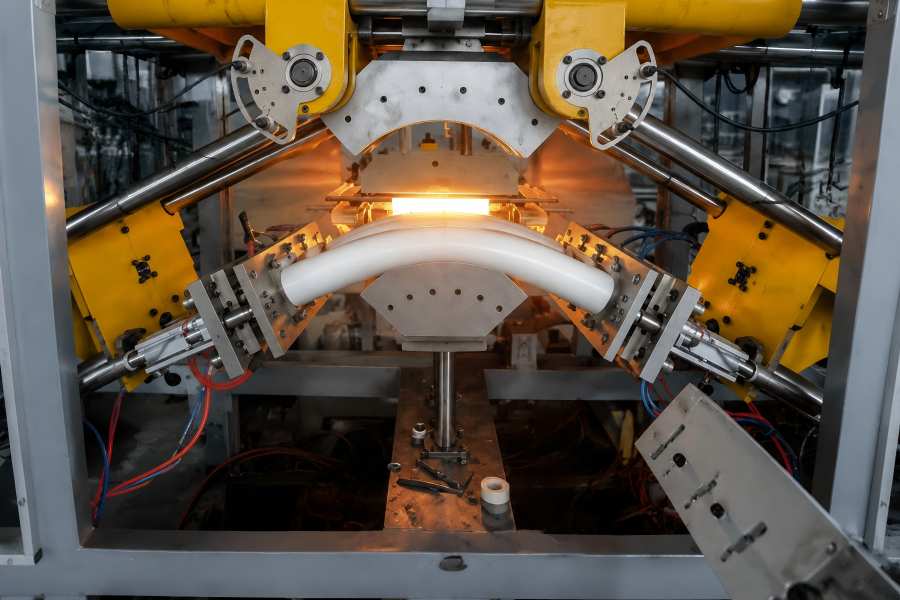
Heating temperature directly affects PVC pipe flexibility, dimensional stability, and surface quality during bending. Insufficient heat can cause cracking and springback, while excessive heat may lead to flattening, wrinkling, and discoloration. Controlling temperature together with heating time, pipe size, and bending radius is essential for consistent bending quality.
Why Heating Temperature Is Critical in PVC Pipe Bending
PVC is a thermoplastic whose stiffness changes with temperature. At room temperature, rigid PVC has limited flexibility, making bending difficult and causing high tensile and compressive stresses.
Heating softens PVC and allows smoother bending around the mold. However, it must retain enough strength to maintain its circular cross section during forming.
A properly controlled heating process should:
- Reduce the bending force required
- Improve material flexibility
- Distribute deformation more evenly
- Minimize cracking and excessive springback
- Maintain the pipe cross section
- Protect surface quality
Typical Heating Temperature Range for PVC Pipe Bending
The appropriate heating temperature depends on PVC formulation, pipe diameter, wall thickness, bend radius, heating method, and production speed.
For many rigid PVC pipe bending applications, approximately 100–150°C can be used as a general reference range. Actual production temperatures should be established through material data and process testing.
| Heating Condition | Approximate Temperature | Pipe Behavior | Typical Bending Result |
| Insufficient heating | Below 90°C | Pipe remains relatively rigid | High force, cracking or springback |
| Low forming range | 90–110°C | Partial softening | Better for gentle bends |
| Typical forming range | 110–140°C | Good flexibility with reasonable stability | Stable bending for many applications |
| High forming range | 140–160°C | Pipe becomes very soft | Higher flattening and wrinkling risk |
| Excessive heating | Above 160°C | Material stability decreases | Surface and dimensional defects may occur |
These values are general guidelines. Manufacturers should determine the appropriate processing window based on PVC compound, pipe diameter, wall thickness, and bend geometry.
What Happens When PVC Pipe Is Heated
As PVC temperature increases, its resistance to deformation gradually decreases.
At relatively low temperatures, the pipe remains stiff. Considerable mechanical force is required to create the bend, and deformation tends to concentrate in a relatively small area.
As the pipe enters a suitable forming range, it becomes sufficiently flexible to follow the mold more smoothly. Tensile and compressive stresses can be distributed over a larger section of the bend.
If the temperature rises too high, the pipe wall may become overly soft, making it difficult to maintain its original circular shape.
The process can therefore be divided into three general conditions:
- Underheated PVC: high stiffness and high bending resistance.
- Properly heated PVC: sufficient flexibility with adequate structural stability.
- Overheated PVC: excessive softness and increased deformation risk.
Good bending quality normally occurs within the middle condition rather than at the highest possible temperature.
How Low Heating Temperature Affects Bending Quality
Insufficient heating is a common cause of PVC bending problems. When the pipe remains too rigid, the bending equipment must overcome greater material resistance.
Cracking
The outside wall of a pipe bend experiences tensile stress. If PVC has not been sufficiently softened, its ability to accommodate this elongation is limited.
Small cracks may first appear around the outside radius. Under more severe conditions, the pipe can split during forming.
The risk becomes higher when:
- The bending radius is small
- Pipe walls are relatively thick
- Bending speed is too high
- The heating area is too short
- PVC formulation is relatively rigid
Increasing the temperature gradually within an acceptable processing range can reduce bending resistance and improve deformation capability.
Excessive Springback
Springback occurs when the pipe partially returns to its original shape after bending. Underheated PVC generally shows greater elastic recovery.
For example, a pipe may be formed mechanically to approximately 90°, but after cooling and releasing the fixture, the final angle may become 86° or 87°.
If this variation changes between production cycles, maintaining consistent bend angles becomes difficult.
Proper heating reduces bending resistance and allows the pipe to retain its formed geometry more effectively.
Higher Bending Force
Lower pipe temperature means greater mechanical resistance.
This increases the load on:
- Bending molds
- Clamping mechanisms
- Rotary arms
- Transmission systems
- Pipe positioning components
Higher forming resistance can also increase process variation because small temperature differences may produce noticeable differences in required bending force.
Irregular Bend Radius
When the pipe is too stiff, deformation may concentrate around a small area rather than spreading smoothly throughout the intended bend.
The resulting pipe may show a sharp transition or inconsistent curvature instead of a smooth radius.
This problem becomes especially important when producing standardized elbows or repeated curved sections where dimensional consistency is required.
How Excessive Heating Affects PVC Pipe Bending Quality
Increasing temperature improves flexibility only within a certain range. Once the pipe becomes excessively soft, structural stability decreases rapidly.
Pipe Flattening
Flattening is one of the most common problems associated with excessive heating.
Bending stretches the outside wall and compresses the inside wall. These forces naturally tend to distort the circular cross section.
When the pipe retains sufficient stiffness, the wall can resist this deformation. When overheated, however, the softened wall provides less resistance.
The pipe cross section may gradually change from circular to oval.
Flattening becomes more likely with:
- High heating temperatures
- Thin pipe walls
- Tight bending radii
- Large pipe diameters
- Insufficient internal support
For drainage, conduit, irrigation, or fluid-handling applications, excessive ovality can affect internal flow area, assembly, and connection accuracy.
Inner-Wall Wrinkling
The inside radius experiences compression during bending.
When PVC is excessively softened, the compressed material may lose stability and buckle inward, producing visible wrinkles.
Wrinkling is particularly likely when high temperature is combined with a tight bending radius.
Reducing temperature slightly, increasing the bend radius, or introducing suitable internal support can improve the result.
Wall Thinning
The outside radius experiences elongation during forming.
If the pipe becomes too soft, this section can stretch excessively. As a result, wall thickness around the outside radius decreases.
Moderate wall-thickness variation may be acceptable for some non-pressure products, but excessive thinning can reduce the mechanical strength of the finished bend.
Surface Discoloration and Damage
Excessive temperature or excessive heating time can also affect surface appearance.
Possible problems include:
- Yellowing
- Local discoloration
- Gloss changes
- Rough surface texture
- Mold impressions
- Local overheating marks
For visible pipe products or components requiring consistent appearance, these defects can significantly increase rejection rates.
Temperature Uniformity Is as Important as Temperature Level
Correct temperature alone cannot guarantee good bending quality. The pipe must also be heated uniformly.
For example, if one side of the bending area reaches approximately 130°C while the opposite side remains much cooler, the hotter section will deform more easily.
Instead of bending symmetrically, deformation may shift toward the softer section.
Uneven heating can result in:
- Irregular bend geometry
- Local wall thinning
- Uneven ovality
- Wrinkling
- Angle variation
- Inconsistent bending radius
Temperature differences can occur both around the circumference and along the pipe length.
Circumferential temperature variation is particularly important when using directional heating systems such as infrared heaters. Pipe rotation or heaters arranged around multiple sides can help achieve more uniform heat distribution.
Longitudinal uniformity is controlled mainly by heater arrangement, heating-zone length, and pipe movement.
For automated production, improving temperature uniformity can sometimes produce a greater quality improvement than simply increasing the heater setting.
Heating Zone Length and Bending Quality
Heating-zone length determines how much of the pipe becomes flexible before bending.
A short heating zone concentrates deformation within a relatively small area. This may be useful for certain compact bends but increases local stress and deformation.
A longer heating zone allows deformation to spread over a larger section, generally producing a smoother curve.
| Bending Requirement | Heating Zone Strategy | Main Consideration |
| Gentle large-radius bend | Longer heating zone | Smooth deformation |
| 45° bend | Moderate heating zone | Balance between efficiency and stability |
| 90° bend | Match heated area to bend arc | Maintain consistent radius |
| Tight-radius bend | Precisely controlled heating zone | Prevent collapse and wrinkling |
| Large-diameter pipe | Longer, uniform heating zone | Reduce temperature differences |
Heating-zone length should therefore be selected according to the required bend geometry rather than remaining fixed for every product.
If a manufacturer changes from a large-radius bend to a compact 90° bend, both temperature and heated length may require adjustment.
How Pipe Diameter Influences Heating Requirements
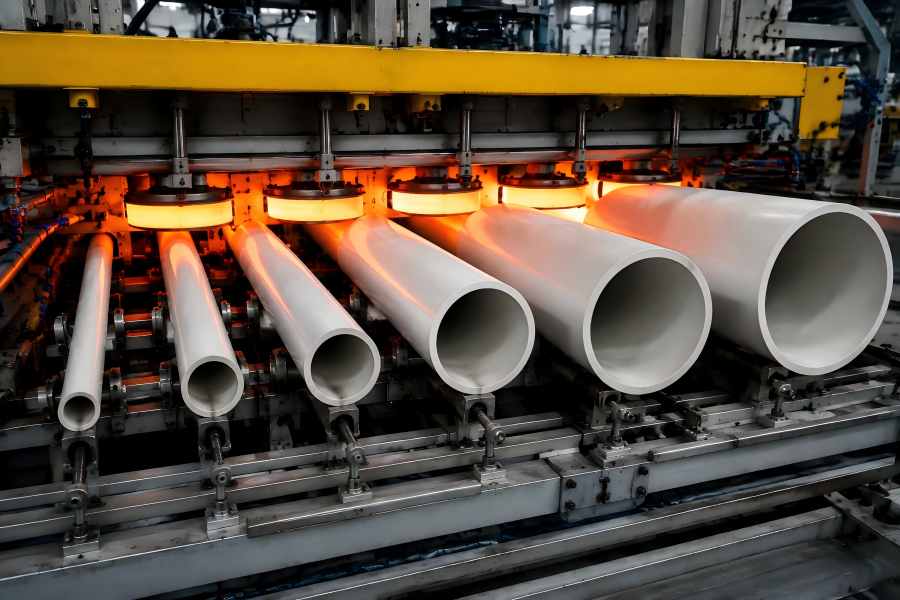
Pipe diameter affects heating speed, temperature distribution, and bending stability.
Small-diameter PVC pipes contain less material in the bending area and normally reach the required forming condition relatively quickly.
Large-diameter pipes require more thermal energy and a larger controlled heating zone.
| Pipe OD | General Heating Requirement | Main Processing Challenge |
| 20–50 mm | Relatively fast heating | Avoid overheating |
| 50–110 mm | Moderate heating | Maintain uniformity |
| 110–200 mm | Longer heating cycle | Control temperature through the wall |
| 200–400 mm | Larger heating zone | Prevent uneven softening |
| Above 400 mm | Customized heating strategy | Maintain overall temperature uniformity |
Simply increasing heater temperature is not always the best solution for large pipes.
If heat input is too aggressive, the outside surface may become excessively soft while other areas remain relatively rigid. A longer and more controlled heating cycle can provide more uniform thermal distribution.
Large-diameter pipes are also more susceptible to cross-sectional deformation because the softened wall must support a larger structure.
As diameter increases, temperature control should therefore be coordinated more closely with mold design and internal support.
How Wall Thickness Affects Heating
Wall thickness affects how quickly heat penetrates PVC pipe. Thin-wall pipes heat faster, reducing heating time but increasing the risk of overheating, especially during production stops.
Uneven heating may leave the outer surface hot while inner layers remain cooler. Bending too early can result in inconsistent flexibility across the pipe wall.
This can cause:
- Higher bending resistance
- Uneven wall deformation
- Increased springback
- Irregular bend geometry
- Surface overstretching
For thick-wall PVC pipes, longer and more gradual heating is generally preferable to simply increasing heater output.
This allows heat to penetrate through the wall while reducing the risk of excessive surface temperature.
Relationship Between Heating Temperature and Bending Radius
Bending radius determines how severely the PVC pipe must deform.
A large-radius bend distributes deformation over a longer pipe section. The difference between outer-wall tension and inner-wall compression is relatively moderate. A tight-radius bend creates much greater deformation.
As bending radius decreases:
- Outer-wall elongation increases
- Inner-wall compression increases
- Wall thinning becomes more likely
- Wrinkling risk increases
- Cross-sectional ovality becomes more significant
Increasing heating temperature can make the pipe flexible enough to achieve tighter bends, but there is a limit.
If temperature is raised excessively, the pipe may become easier to bend while simultaneously becoming more difficult to keep round.
For tight-radius PVC pipe bending, manufacturers therefore need to balance four main factors:
- Heating temperature
- Bending radius
- Pipe wall thickness
- Internal support
Heating Methods Used in PVC Pipe Bending Machines
The heating method affects heating speed, uniformity, energy consumption, and temperature control.
Hot Air Heating
Hot air systems circulate heated air around the pipe, providing relatively uniform heating, especially when airflow surrounds the entire bending section.
This method is suitable for applications requiring gradual and controlled softening, although heating speed may be slower than with direct radiant systems.
Infrared Heating
Infrared heaters transfer thermal energy directly to the PVC surface.
Advantages include:
- Fast heating response
- Adjustable heater output
- Zoned heating
- Easy integration into automated equipment
- Relatively high heating efficiency
However, the heater arrangement must be carefully designed to prevent one side of the pipe from receiving significantly more energy than another.
Pipe rotation can be used to improve circumferential heating uniformity.
Electric Resistance Heating
Electric heating elements can be arranged around a defined bending area.
They provide controllable heat output and can be integrated with digital temperature controllers.
For automatic PVC pipe bending equipment, multiple heating zones can be controlled independently to accommodate different pipe lengths and bending radii.
Heating Ovens
Heating ovens or chambers can provide relatively uniform thermal conditions.
They are often suitable for batch processing or applications requiring longer heating periods.
The main limitation is that heating and material transfer may require more time compared with continuous inline systems.
Actual Pipe Temperature vs Heater Temperature
A critical distinction in PVC pipe bending is the difference between heater setting temperature and actual pipe temperature.
An infrared heating element may operate at a significantly higher temperature than the PVC surface. Similarly, a hot-air system may be set to a particular air temperature while the pipe itself remains cooler.
Actual pipe temperature depends on:
- Heater output
- Distance between heater and pipe
- Heating duration
- Pipe diameter
- Wall thickness
- PVC formulation
- Pipe surface characteristics
- Ambient temperature
- Air movement
Therefore, manufacturers should avoid assuming that the displayed heater temperature represents the actual forming temperature of the PVC.
Temperature sensors, infrared measurement devices, and controlled process trials can help establish the relationship between machine settings and actual pipe condition.
This distinction is particularly important when transferring process parameters between different bending machines.
How Heating Time Interacts with Temperature
Heating temperature and heating time must be considered together.
A high heater setting combined with a short heating time may quickly soften the outside surface, but heat may not penetrate evenly through the pipe wall.
A moderate temperature combined with a longer heating period can often produce more uniform softening.
For example, thick-wall PVC pipe usually benefits from gradual heating because thermal energy needs time to penetrate toward the inner wall.
In contrast, thin-wall pipe may require shorter heating periods to avoid excessive softening.
The correct process therefore depends on the combination of:
Heating Temperature + Heating Time + Heating Zone + Pipe Rotation
Changing one parameter may require adjustment of the others.
In continuous production, line speed also becomes part of this relationship. Increasing production speed reduces the time each pipe spends in the heating zone. Heater output or heating-zone length may therefore need to be adjusted accordingly.
Bending Speed After Heating
Once the PVC pipe reaches the desired forming condition, it should normally move into the bending operation without excessive delay.
PVC begins cooling as soon as it leaves the heating zone.
If transfer time varies significantly between cycles, the actual pipe temperature at the moment of bending will also vary.
This can cause:
- Different bending forces
- Inconsistent springback
- Angle variation
- Different degrees of flattening
- Unstable cycle-to-cycle quality
Automatic transfer systems help reduce this variation by maintaining a consistent time between heating and forming.
Bending speed itself also matters.
Very rapid forming may concentrate deformation and increase stress, while excessively slow bending may allow the pipe to cool significantly before the bend is completed.
A repeatable bending speed should therefore be established together with the heating parameters.
Cooling Temperature and Shape Retention
Heating allows PVC pipe to be formed, while cooling allows the new geometry to become stable.
After bending, the pipe should normally remain supported until sufficient rigidity has returned.
Releasing the pipe while it is still too warm can cause:
- Springback
- Angle changes
- Radius distortion
- Cross-sectional deformation
- Local sagging
Cooling can be performed naturally or accelerated through controlled air or other suitable cooling systems.
If one production cycle cools for 20 seconds and another for only 10 seconds, final bend geometry may vary even when heating conditions are identical.
For automated PVC pipe bending, controlled cooling time can therefore be programmed as part of the complete bending cycle.
Common Temperature-Related PVC Bending Defects
Temperature-related defects provide useful indicators when optimizing PVC pipe bending parameters.
| Defect | Likely Temperature Cause | Recommended Adjustment |
| Cracking | Temperature too low | Gradually increase heating |
| Excessive springback | Insufficient softening | Increase forming temperature or heating time |
| Flattening | Excessive softening | Reduce temperature or improve internal support |
| Wrinkling | Pipe too soft | Reduce heating and optimize bend radius |
| Discoloration | Excessive temperature or heating time | Reduce temperature or shorten heating cycle |
| Uneven bend | Uneven temperature distribution | Improve heating uniformity |
| Wall thinning | Excessive softening | Optimize temperature and bending radius |
This table can also serve as a troubleshooting guide. Cracking and high springback usually indicate insufficient softening, while flattening, wrinkling, and discoloration often suggest excessive or uneven heating.
Heating-zone length should therefore be selected according to the required bend geometry rather than remaining fixed for every product.
If a manufacturer changes from a large-radius bend to a compact 90° bend, both temperature and heated length may require adjustment.
How Internal Support Helps Control Deformation
When PVC is heated to its forming condition, the pipe wall loses some of its ability to resist cross-sectional deformation.
Internal support can help maintain the pipe shape during bending.
Common support methods include:
- Fixed mandrels
- Flexible mandrels
- Internal inserts
- Filling materials
- Controlled internal air pressure
These methods provide resistance against inward collapse while the outside and inside walls undergo tension and compression.
Internal support becomes particularly important for:
- Thin-wall pipes
- Large-diameter pipes
- Tight-radius bends
- Applications requiring low ovality
Temperature and support should be optimized together.
If the temperature is too low, even strong internal support cannot eliminate excessive bending resistance. If temperature is too high, the pipe may still deform around the support system.
The objective is to soften the PVC sufficiently while using support to maintain dimensional stability.
How to Determine the Best Heating Temperature
The most suitable heating temperature should be determined through controlled production trials rather than using a single universal setting.
Manufacturers can begin with the PVC material supplier’s recommended processing information and then test different conditions on the actual bending equipment.
Important parameters to record include:
- Pipe outside diameter
- Wall thickness
- PVC formulation
- Heater setting
- Actual pipe temperature
- Heating time
- Heating-zone length
- Bend angle
- Bend radius
- Bending speed
- Cooling time
After each trial, the finished pipe should be evaluated for bend angle, ovality, wall thickness, surface condition, cracking, wrinkling, and springback.
For example, a manufacturer may test the same PVC pipe at approximately 110°C, 120°C, 130°C, and 140°C.
If the pipe shows excessive springback at 110°C but begins flattening significantly at 140°C, a more suitable processing window may exist around 120–130°C.
Further trials can then narrow the range until stable production conditions are established.
The goal is not to identify one exact temperature. In industrial production, a reliable temperature window is more useful because small process variations are unavoidable.
How PVC Pipe Bending Machines Improve Heating Control
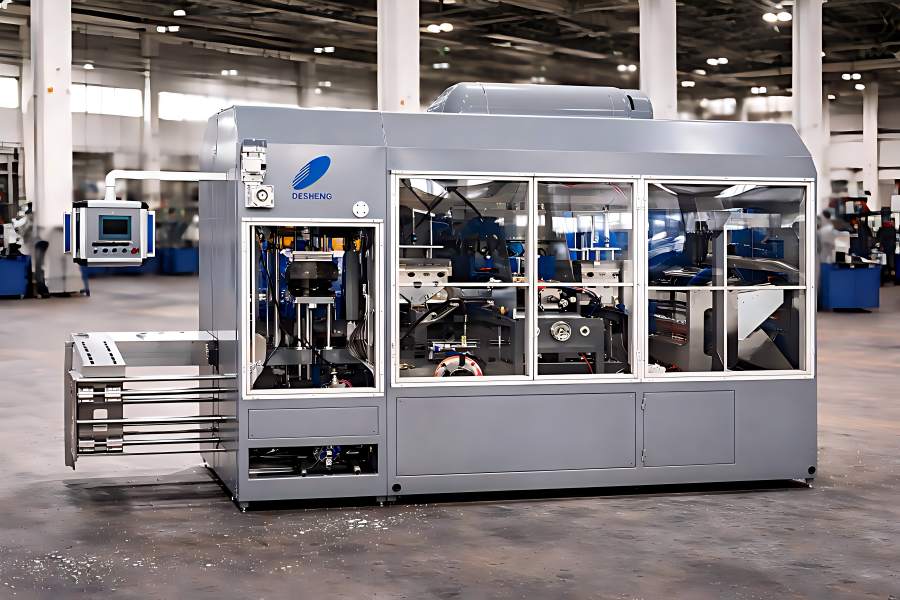
For continuous or high-volume production, PVC pipe bending machines can integrate heating, positioning, forming, and cooling into a controlled process.
Compared with manual heating and bending, automated equipment can provide more repeatable heating conditions and reduce dependence on operator judgment.
Depending on machine configuration, temperature-control functions may include:
- Multi-zone heating
- Adjustable heater power
- Digital temperature control
- Infrared temperature monitoring
- Programmable heating time
- Automatic pipe rotation
- Controlled bending speed
- Automatic transfer
- Cooling-time control
- Recipe storage
Recipe control is particularly useful when one production line processes multiple pipe specifications.
For example, a 50 mm thin-wall PVC pipe may require relatively fast heating and a short cycle, while a 160 mm thick-wall pipe may require a longer heating period and larger heating zone.
Instead of manually readjusting every parameter, the machine can store separate production recipes containing heating time, heater output, bending speed, bend angle, and cooling settings.
This improves repeatability when switching between products and helps manufacturers maintain consistent bending quality across larger production batches.