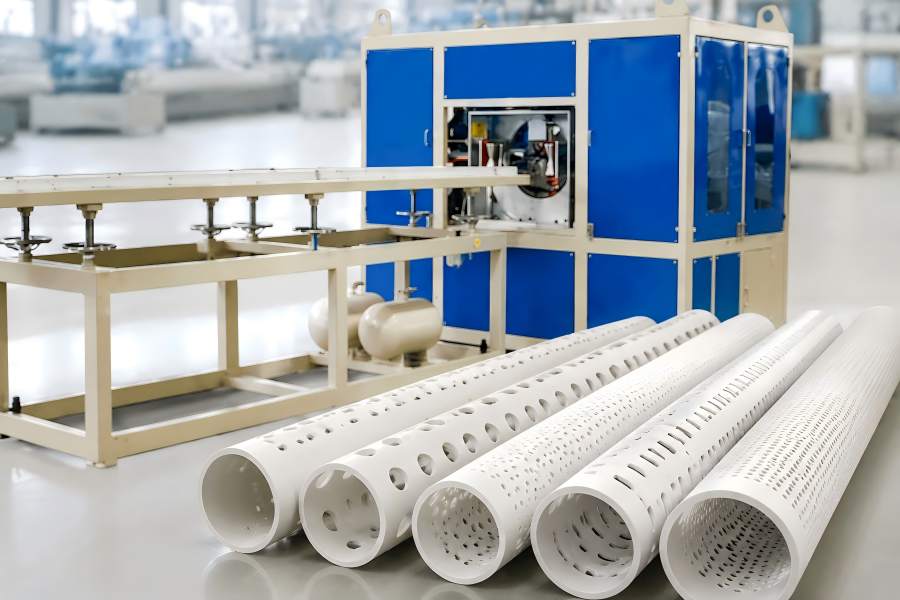
PVC pipe perforating machines create customized hole patterns for drainage, irrigation, filtration, and water collection applications. Different designs, including round, slot, staggered, and multi-row holes, optimize flow performance, filtration efficiency, and pipe strength for various pipeline requirements.
Common Hole Patterns Produced by PVC Pipe Perforating Machines
A modern PVC pipe perforating machine can produce multiple hole patterns by changing tooling design, drilling parameters, and CNC programming. Different patterns are developed to meet different fluid flow and filtration requirements.
The following table shows common hole pattern parameters used in PVC pipe production:
| Hole Pattern | Typical Hole Size | Hole Arrangement | Opening Ratio | Common Applications |
| Round Hole Pattern | 3–12 mm diameter | Straight or staggered rows | 5–25% | Drainage, irrigation |
| Slot Hole Pattern | 1–5 mm width, 10–50 mm length | Parallel or distributed slots | 10–35% | Filtration, water collection |
| Staggered Hole Pattern | 3–10 mm diameter | Offset rows | 15–30% | Underground drainage |
| Multi-row Hole Pattern | 2–8 mm diameter | Multiple longitudinal rows | 20–40% | High-flow drainage systems |
| Spiral Hole Pattern | 3–10 mm diameter | Helical distribution | 10–30% | Special drainage applications |
| Custom Pattern | Customized | CNC programmed | According to design | Industrial applications |
Round Hole Patterns
Round hole patterns are among the most common designs produced by PVC pipe perforating machines. Circular openings allow water or air flow while maintaining pipe strength.
Hole diameters typically range from 3–12 mm. Smaller holes suit filtration and irrigation, while larger holes support higher-flow drainage applications.
A PVC Pipe Perforating Machine can produce round holes using drilling or punching technology. CNC-controlled systems allow manufacturers to precisely control:
- Hole diameter
- Hole spacing
- Number of rows
- Circumferential distribution
- Processing speed
For example, a drainage pipe with a diameter of 110 mm may use 6–12 rows of 6 mm round holes, while a small irrigation pipe may use fewer rows with 2–4 mm openings.
Advantages of Round Hole Patterns
Round holes provide several benefits:
High structural stability
The circular shape helps distribute stress evenly around the opening area, reducing the risk of cracking during installation and under underground pressure.
Flexible customization
Manufacturers can easily adjust hole size and spacing according to customer requirements.
Suitable for various materials
Round hole processing can be applied to PVC, HDPE, PE, and other plastic pipes.
Typical applications include:
- Agricultural drainage pipes
- Garden irrigation systems
- Underground water collection pipes
- Septic drainage systems
Slot Hole Patterns
Slot hole patterns are another widely used perforation design, especially in applications requiring higher filtration efficiency.
Unlike circular holes, slot holes are elongated openings that provide a larger surface area for water entry. A slot hole usually has a width of 1–5 mm and a length of 10–50 mm.
Slot patterns are commonly produced through specialized cutting blades or CNC-controlled slotting systems integrated into PVC pipe perforating equipment.
The main advantage of slot holes is their ability to provide a higher open area while maintaining controlled filtration performance.
For example:
| Slot Parameter | Typical Range |
| Slot Width | 1–5 mm |
| Slot Length | 10–50 mm |
| Slot Spacing | 10–100 mm |
| Opening Ratio | 10–35% |
Slot holes are often selected for:
- Geotextile drainage systems
- Landfill drainage pipes
- Water filtration pipelines
- Agricultural water management systems
Compared with round holes, slot holes usually provide better water collection efficiency because the longer opening allows more contact area between surrounding soil and the pipe surface.
However, excessive slot openings may reduce pipe strength, so manufacturers must balance opening ratio and structural requirements.
Staggered Hole Patterns
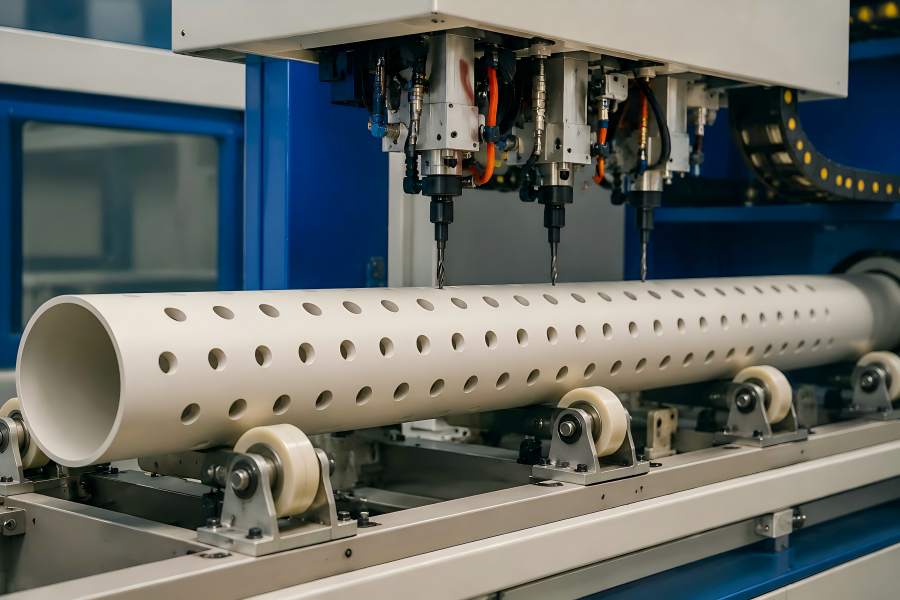
A staggered hole pattern arranges openings in an offset layout rather than placing them directly in straight lines.
This design improves the distribution of openings around the pipe circumference and helps maximize drainage efficiency while maintaining mechanical strength.
For example, instead of placing holes directly above each other:
Row 1:
○ ○ ○ ○ ○
Row 2:
○ ○ ○ ○ ○
The offset arrangement creates a more balanced opening distribution.
A PVC Pipe Perforating Machine with CNC control can easily achieve staggered patterns by programming different drilling positions.
Benefits of Staggered Patterns
Improved Water Collection
Because holes cover more surface areas around the pipe, water can enter from multiple directions.
Better Pipe Strength
The offset design avoids creating continuous weak lines along the pipe wall.
Higher Flow Efficiency
Compared with simple straight-line patterns, staggered holes usually provide more uniform drainage performance.
Staggered perforation is commonly used in:
- Underground drainage networks
- Agricultural drainage projects
- Highway drainage systems
- Municipal water management projects
Straight-line Hole Patterns
Straight-line hole patterns are simple and economical designs where holes are arranged in parallel rows along the pipe length.
This pattern is often used when the drainage direction is predictable or when production efficiency is the priority.
A PVC Pipe Perforating Machine can produce straight-line patterns at high speed because the processing movement is relatively simple.
Typical parameters include:
| Parameter | Range |
| Hole Diameter | 3–10 mm |
| Number of Rows | 2–12 rows |
| Longitudinal Spacing | 20–150 mm |
| Production Speed | 5–30 pipes/min |
Advantages include:
- Simple production process
- High manufacturing efficiency
- Easy inspection
- Lower tooling complexity
Straight-line patterns are widely used in standard drainage pipes and general-purpose perforated PVC pipes.
Multi-row Hole Patterns
Multi-row perforation refers to pipes with several parallel rows of holes distributed around the circumference.
This design increases the total opening area and improves water intake capacity.
For high-capacity drainage systems, manufacturers may produce pipes with 8, 10, or even more rows of holes.
A typical multi-row configuration:
| Pipe Diameter | Number of Rows | Hole Diameter |
| 50–75 mm | 4–8 rows | 3–6 mm |
| 90–160 mm | 6–12 rows | 4–10 mm |
| 200 mm+ | Customized | Customized |
Multi-row patterns are suitable for:
- Large drainage projects
- Agricultural irrigation systems
- Industrial water collection
- Infrastructure construction
The main consideration is maintaining the balance between open area and pipe strength.
Spiral Hole Patterns
Spiral hole patterns arrange openings along a helical path around the pipe surface.
This design provides a continuous distribution of openings and is commonly used in specialized applications that require balanced water intake.
Compared with traditional straight rows, spiral patterns can:
- Improve circumferential coverage
- Reduce stress concentration
- Provide smoother drainage distribution
However, spiral processing requires more advanced CNC control systems and precise positioning mechanisms.
Therefore, spiral hole patterns are usually produced by high-end automatic PVC pipe perforating machines.
Customized Hole Patterns
Modern customers increasingly require customized perforation designs due to different project conditions.
A CNC-controlled PVC Pipe Perforating Machine allows manufacturers to create customized patterns based on:
- Pipe diameter
- Wall thickness
- Required flow rate
- Filtration requirements
- Installation environment
Customized options include:
- Different hole diameters
- Mixed hole sizes
- Special spacing
- Multiple opening zones
- Customer-designed patterns
For example, a drainage pipe used in a wetland restoration project may require larger openings at the lower section and smaller filtration holes at the upper section.
Factors Affecting PVC Pipe Perforation Design
The final perforation pattern of a PVC pipe is determined by multiple technical factors. A suitable PVC Pipe Perforating Machine must provide flexible adjustment capabilities to meet different production requirements.
Pipe Diameter and Wall Thickness
Pipe dimensions are among the most important factors affecting hole pattern design.
Larger diameter pipes generally allow more holes because they provide a larger surface area for perforation. However, wall thickness must also be considered because excessive openings may weaken the pipe structure.
Typical examples:
| Pipe Diameter | Recommended Hole Diameter | Common Hole Arrangement |
| 20–50 mm | 2–5 mm | Single or double rows |
| 63–110 mm | 3–8 mm | Multiple straight or staggered rows |
| 125–200 mm | 5–12 mm | Multi-row patterns |
| Above 200 mm | Customized | Engineering designs |
For underground drainage applications, larger pipes often require higher opening ratios to handle increased water flow.
Hole Size and Opening Ratio
The opening ratio refers to the percentage of the pipe surface occupied by holes.
It is one of the key parameters determining flow performance.
A higher opening ratio generally provides:
- Faster water collection
- Greater drainage capacity
- Improved filtration efficiency
However, too high an opening ratio can reduce:
- Pipe compression resistance
- Impact strength
- Long-term durability
Typical opening ratios:
| Application | Recommended Opening Ratio |
| Light irrigation | 5–15% |
| Agricultural drainage | 10–25% |
| Underground drainage | 15–35% |
| High-flow collection systems | 25–40% |
A professional PVC Pipe Perforating Machine allows manufacturers to precisely control the opening ratio by adjusting hole quantity, spacing, and distribution.
Hole Spacing and Distribution
Hole spacing determines how evenly fluids enter the pipe.
Smaller spacing increases the number of openings and improves collection efficiency, while larger spacing helps maintain structural strength.
Common spacing ranges:
- Small irrigation pipes: 10–50 mm
- Drainage pipes: 30–150 mm
- Heavy-duty drainage systems: customized according to engineering requirements
The distribution method is also important.
Compared with simple straight-line arrangements, staggered or spiral patterns can provide more balanced performance because openings are distributed across different areas of the pipe surface.
Pipe Application Requirements
Different industries require different perforation designs.
For example:
Agricultural Irrigation
Irrigation pipes usually require:
- Small hole diameters
- Uniform spacing
- Controlled water release
Typical parameters:
- Hole diameter: 1–5 mm
- Opening ratio: 5–20%
Underground Drainage
Drainage systems usually require:
- Larger openings
- Higher opening ratio
- Better soil filtration performance
Typical parameters:
- Hole diameter: 5–12 mm
- Opening ratio: 15–35%
Filtration Systems
Filtration applications require:
- Precise slot dimensions
- Stable opening size
- High processing accuracy
Typical parameters:
- Slot width: 1–3 mm
- Slot length: 10–40 mm
Production Speed and Machine Configuration
The production capacity of a PVC Pipe Perforating Machine directly affects manufacturing efficiency.
Different machine configurations provide different production speeds:
| Machine Type | Processing Method | Production Capability |
| Semi-automatic Perforating Machine | Manual loading, automatic processing | 5–15 pipes/min |
| Automatic Perforating Machine | Automatic feeding and positioning | 15–40 pipes/min |
| CNC Perforating System | Programmable high-precision processing | Customized high-speed production |
For large-scale pipe manufacturers, automatic CNC systems are preferred because they provide:
- Higher consistency
- Faster production
- Reduced labor requirements
- Flexible pattern adjustment
How PVC Pipe Perforating Machines Create Different Hole Patterns
Different hole patterns require different processing technologies. Modern perforating equipment usually uses drilling, punching, cutting, or CNC-controlled systems.
Drilling-based Perforation System
Drilling systems use rotating tools to create precise circular holes in PVC pipes.
This method is commonly used for:
- Round holes
- Small diameter openings
- Precision filtration pipes
Advantages:
- High accuracy
- Smooth hole edges
- Adjustable hole size
Typical drilling parameters:
| Parameter | Range |
| Hole Diameter | 2–12 mm |
| Processing Accuracy | ±0.1–0.3 mm |
| Suitable Pipe Size | 20–500 mm |
Drilling technology is especially suitable for applications requiring accurate hole dimensions.
Punching-based Perforation System
Punching systems use mechanical force to create holes quickly.
This method provides:
- High production efficiency
- Lower processing cost
- Stable output
It is commonly used for:
- Standard drainage pipes
- Large-volume production
However, punching tools require proper maintenance to maintain hole quality.
CNC-controlled Perforation System
CNC technology represents the most advanced solution for PVC pipe perforation.
Through programmable control, manufacturers can produce almost any hole pattern.
A CNC system can adjust:
- Hole position
- Hole diameter
- Row quantity
- Spacing
- Rotation angle
This makes it ideal for customized projects.
Advantages include:
- High repeatability
- Flexible production
- Reduced manual adjustment
- Easy pattern switching
For manufacturers producing multiple pipe specifications, CNC perforating machines provide significant production advantages.
Applications of Different PVC Pipe Hole Patterns
Different hole designs are selected according to the working environment and performance requirements.
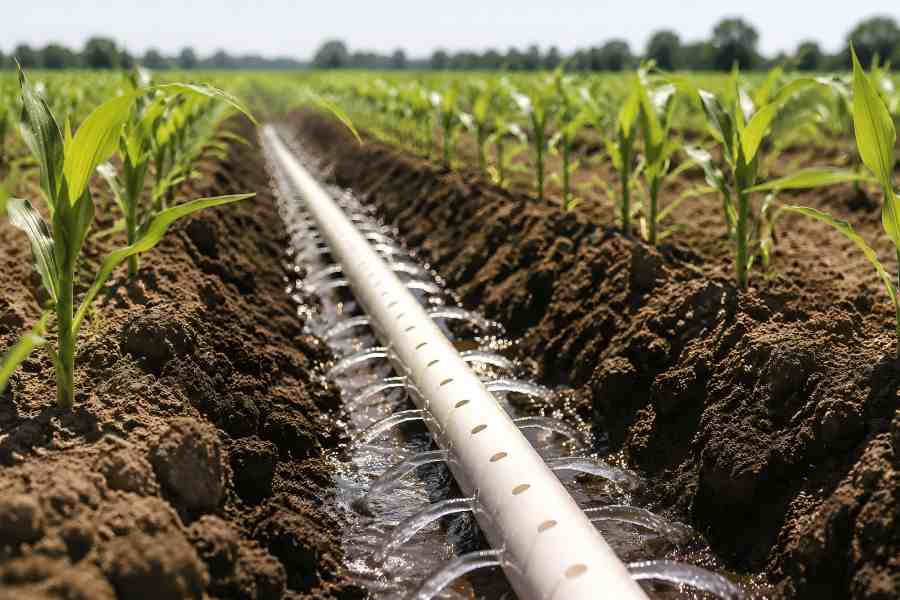
Agricultural Irrigation Pipes
Agricultural irrigation systems widely use perforated PVC pipes for efficient water distribution.
Agricultural irrigation systems widely use perforated PVC pipes for efficient water distribution.
The main purpose is to distribute water evenly through controlled openings.
Common patterns:
- Round hole pattern
- Small staggered holes
- Multi-row holes
Typical requirements:
| Parameter | Value |
| Hole Diameter | 1–5 mm |
| Spacing | 20–100 mm |
| Opening Ratio | 5–20% |
Benefits include:
- Uniform water distribution
- Reduced water waste
- Improved irrigation efficiency
Underground Drainage Pipes
Underground drainage is one of the largest applications for perforated PVC pipes.
These systems collect excess water from:
- Agricultural fields
- Roads
- Buildings
- Sports facilities
Common patterns:
- Staggered holes
- Multi-row holes
- Slot holes
Typical specifications:
| Parameter | Range |
| Pipe Diameter | 75–300 mm |
| Hole Size | 5–12 mm |
| Opening Ratio | 15–35% |
Water Collection and Filtration Pipes
Filtration systems require precise openings to control particle entry.
Slot patterns are commonly preferred because they provide:
- Controlled filtration
- Larger effective opening area
- Stable performance
Applications include:
- Groundwater collection
- Rainwater harvesting
- Industrial filtration
Industrial Pipeline Systems
Some industrial applications require customized perforation designs.
Examples include:
- Chemical filtration
- Wastewater treatment
- Cooling systems
- Process water collection
Industrial users often require customized solutions because operating conditions vary significantly.
A CNC PVC Pipe Perforating Machine can produce specialized patterns according to project requirements.
Construction and Infrastructure Projects
Modern construction projects increasingly use perforated PVC pipes for:
- Foundation drainage
- Tunnel drainage
- Landscape drainage
- Highway systems
These applications usually require:
- High mechanical strength
- Reliable drainage performance
- Long service life
Therefore, engineers often select staggered or multi-row perforation designs.
How to Choose the Right Hole Pattern for PVC Pipe Production
Choosing the right hole pattern is crucial for optimizing drainage, filtration, and flow performance. Manufacturers should consider application requirements and key design factors when selecting a perforation solution.
Consider the Application Requirements
The final application is the first factor when choosing a hole pattern.
- Irrigation pipes usually require small, evenly distributed holes to provide controlled water release.
- Drainage pipes often need larger openings and higher opening ratios to improve water collection efficiency.
- Filtration pipes commonly use precise slot patterns to control particle entry.
- Industrial systems may require customized perforation designs based on specific operating conditions. .
Balance Flow Capacity and Pipe Strength
A larger opening area improves water flow, but excessive perforation may reduce pipe strength. Therefore, manufacturers need to balance drainage capacity with structural stability.
For underground applications, staggered and multi-row patterns are often preferred because they provide higher opening areas while maintaining better mechanical performance.
Select Suitable Hole Size and Spacing
Hole diameter and spacing directly affect filtration efficiency and flow rate.
| Application | Recommended Pattern | Typical Hole Size |
| Irrigation | Round Hole | 1–5 mm |
| Drainage | Staggered or Multi-row | 5–12 mm |
| Filtration | Slot Hole | 1–3 mm width |
Smaller openings improve filtration control, while larger openings provide higher flow capacity.
Match the Pattern with Machine Capability
The selected hole design should match the production capability of the PVC Pipe Perforating Machine.
Standard machines are suitable for simple round or straight-line patterns, while CNC-controlled systems can produce complex designs, including spiral and customized perforation layouts.
Manufacturers should consider:
- Pipe diameter range
- Production volume
- Required accuracy
- Pattern flexibility
By selecting the right hole pattern and matching it with suitable perforating equipment, PVC pipe manufacturers can improve product performance, production efficiency, and application reliability.