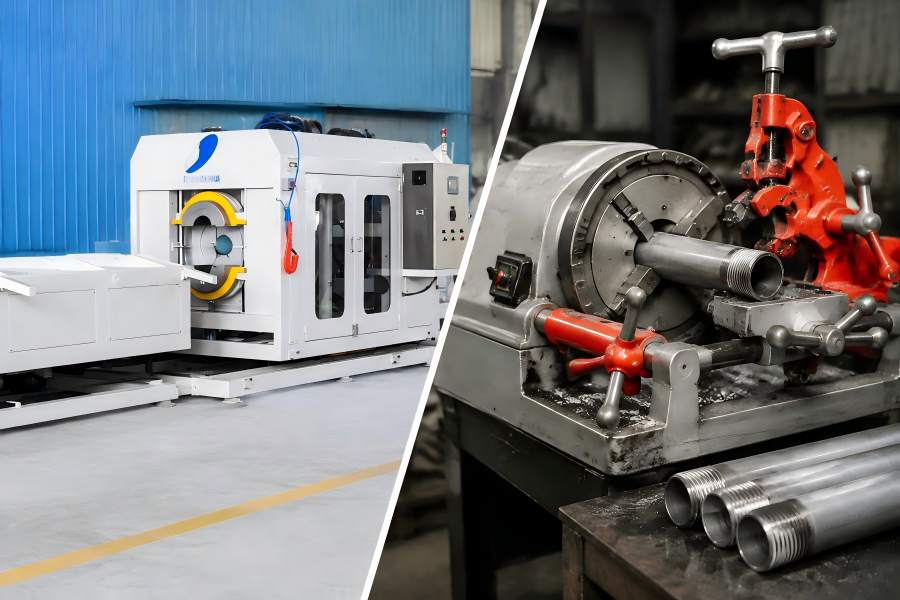
Plastic pipe threading and metal pipe threading require different processing methods due to differences in material properties, hardness, and production requirements. Choosing the right threading machine helps manufacturers achieve accurate threads, stable production, and reliable pipe connections for different applications.
Basic Differences Between Plastic Pipes and Metal Pipes
The main reason plastic pipe threading machines differ from metal pipe threading machines is the difference in material characteristics.
Plastic pipes are commonly made from PVC, HDPE, PE, and PPR. They are lightweight, corrosion-resistant, and easy to process, but their softer structure requires controlled cutting pressure and appropriate tooling.
Metal pipes, including steel, stainless steel, and cast iron pipes, have much higher hardness and mechanical strength. Threading these materials requires stronger cutting forces, rigid machine structures, and wear-resistant tools.
The different material characteristics create different requirements for the threading process.
| Comparison | Plastic Pipes | Metal Pipes |
| Common Materials | PVC, PE, HDPE, PPR | Steel, Stainless Steel, Iron |
| Material Hardness | Lower hardness and flexible | Higher hardness and rigid |
| Cutting Resistance | Lower cutting resistance | Higher cutting resistance |
| Main Processing Challenge | Prevent deformation and cracking | Maintain cutting force and accuracy |
| Machine Requirement | Precision control and suitable tooling | Strong structure and powerful drive system |
For plastic pipes, the priority is usually protecting the pipe structure while creating accurate threads. Since plastic materials can deform under excessive pressure, threading machines must provide stable clamping and controlled cutting.
For metal pipes, the focus is usually on machining strength and durability. The equipment needs enough power to remove material efficiently while maintaining thread dimensions.
Different Threading Process Requirements
Although both plastic pipe threading machines and metal pipe threading machines create threaded connections, their processing methods are different.
Plastic Pipe Threading Process
Plastic pipe threading requires careful control because plastic materials have lower strength compared with metals. Excessive cutting force can damage the pipe surface, reduce wall thickness, or create uneven threads.
A plastic pipe threading machine usually focuses on:
- Controlled cutting pressure
- Accurate positioning
- Material-specific tooling
- Smooth thread formation
During the process, the pipe is securely fixed, and specialized threading tools gradually form the required thread profile. The machine must maintain consistent movement to avoid sudden pressure changes.
For PVC and similar plastic pipes, maintaining a clean thread surface is especially important because the connection often depends on sealing performance. Rough or damaged threads may affect installation quality.
Metal Pipe Threading Process
Metal pipe threading requires significantly higher mechanical force. Since metal materials have greater hardness, the machine needs a stronger drive system and more rigid components.
Metal pipe threading typically involves:
- High torque operation
- Heavy-duty cutting tools
- Strong clamping systems
- Higher machining stability
The threading process removes more material compared with plastic pipe threading. Therefore, machine vibration control and tool durability become important factors.
Compared with plastic pipe threading, metal pipe threading places more emphasis on machining power and resistance to tool wear.
Machine Structure Differences
The structure of a threading machine directly affects processing performance. Since plastic and metal pipes have different machining requirements, their equipment designs are also different.
Plastic Pipe Threading Machine Structure
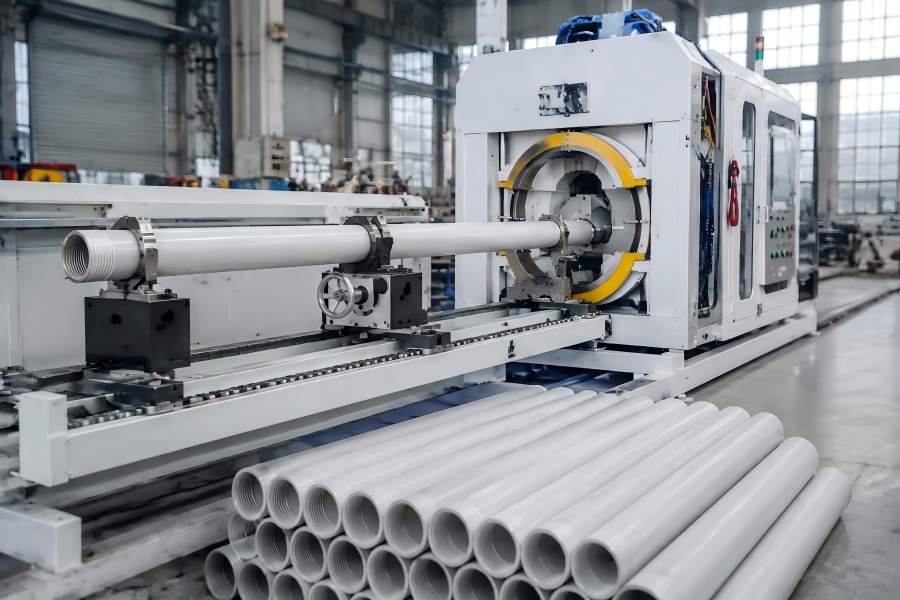
A plastic pipe threading machine is generally designed with flexibility and precision in mind.
Typical features include:
- Adjustable processing parameters
- Customized threading tools
- Stable pipe positioning system
- Efficient production operation
Because plastic pipes are widely used in plumbing, irrigation, electrical conduit, and industrial systems, manufacturers often require machines that can handle different pipe sizes and materials.
A well-designed plastic pipe threading machine helps maintain consistent thread quality while minimizing material damage.
Metal Pipe Threading Machine Structure
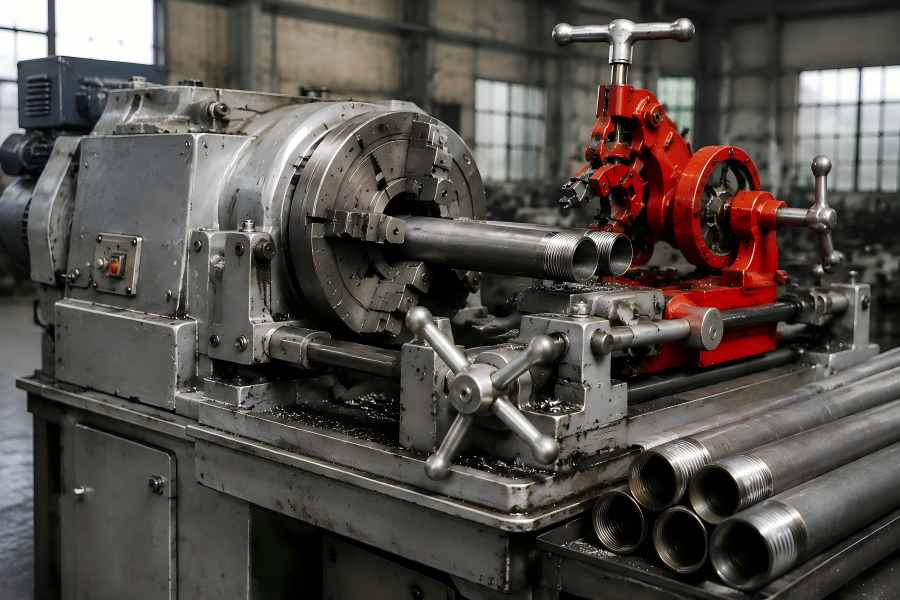
Metal pipe threading machines usually require heavier construction.
Typical features include:
- Strong machine frame
- High-power motor system
- Reinforced transmission components
- Heavy-duty clamping mechanism
These features allow the machine to withstand the higher forces generated during metal cutting.
The equipment must remain stable during operation because even small movements can affect thread accuracy when processing hard materials.
| Machine Feature | Plastic Pipe Threading Machine | Metal Pipe Threading Machine |
| Machine Structure | Precision-oriented design | Heavy-duty rigid design |
| Processing Force | Moderate | High |
| Tool Requirement | Material-specific tools | High-strength cutting tools |
| Main Goal | Protect pipe quality | Achieve powerful machining |
Differences in Cutting Tools and Blades
Cutting tools are among the key factors influencing threading quality. Plastic and metal pipes require completely different tool designs.
Plastic Pipe Threading Tools
Plastic pipe threading tools are designed to create clean and accurate threads without damaging the pipe surface.
Important requirements include:
Sharp Cutting Performance
Plastic materials require sharp tools to create smooth thread profiles. A dull tool may generate uneven surfaces or excessive friction.
Material Compatibility
Different plastics have different characteristics. For example:
- PVC requires stable cutting performance
- HDPE requires tools suitable for flexible materials
- PPR requires precise processing control
Using suitable tooling helps maintain consistent results.
Reduced Material Stress
Since plastic pipes can deform under pressure, tools must work smoothly with controlled force.
Metal Pipe Threading Tools
Metal pipe threading tools require higher durability because they process harder materials.
Key requirements include:
Wear Resistance
Metal cutting generates more friction and heat, so tools must maintain performance during continuous operation.
High Strength
Threading dies and cutters must withstand strong mechanical forces.
Accurate Machining Capability
Metal pipe connections often require high dimensional accuracy, especially in industrial applications.
The selection of suitable cutting tools directly affects production efficiency and final product quality.
Thread Quality Requirements
Thread quality is one of the most important factors determining the performance of a pipe connection. Although both plastic and metal pipes require accurate threading, the quality requirements are different due to differences in material characteristics and application conditions.
Plastic Pipe Thread Quality Requirements
For plastic pipes, thread quality mainly focuses on smooth forming, sealing performance, and preventing structural damage.
Important requirements include:
Smooth Thread Profile
Plastic pipe threads should have a clean and even surface. Rough or damaged threads may affect connection performance and create sealing problems.
No Cracking or Material Damage
Because plastic materials are more sensitive to stress, excessive cutting force may cause:
- Cracks around the threaded area
- Uneven thread depth
- Reduced pipe strength
A suitable plastic pipe threading machine helps minimize these risks through controlled processing.
Stable Sealing Performance
Many plastic pipe systems rely on threaded connections combined with sealing materials. Accurate thread dimensions help ensure reliable installation.
Common applications include:
- Plumbing systems
- Irrigation pipelines
- Water supply networks
- Industrial plastic piping
Metal Pipe Thread Quality Requirements
Metal pipe threading usually focuses on mechanical strength and dimensional accuracy.
Important requirements include:
High Dimensional Accuracy
Metal pipe threads often need to withstand higher pressure and mechanical loads, requiring precise thread dimensions.
Strong Mechanical Connection
In applications such as oil pipelines, industrial systems, and construction projects, threaded connections must maintain long-term stability.
Resistance to Heavy-Duty Conditions
Metal threaded connections may face:
- High pressure
- Temperature changes
- Mechanical vibration
Therefore, the threading process requires higher machining accuracy and stronger equipment capability.
Applications of Plastic Pipe Threading Machines
Plastic pipe threading machines are widely used in industries where lightweight, corrosion-resistant, and easy-to-install piping systems are required.
Plastic pipes offer several benefits over metal pipes, such as:
- Lower weight
- Better corrosion resistance
- Easier transportation
- Flexible installation options
A dedicated plastic pipe threading machine helps manufacturers produce threaded plastic pipes efficiently while maintaining consistent quality.
Plumbing and Water Supply Systems
Plastic threaded pipes are frequently used for water supply applications in residential and commercial buildings.
Manufacturers use plastic pipe threading equipment to produce pipes with reliable connections for:
- Cold water systems
- Hot water pipelines
- Building plumbing systems
Irrigation Applications
Agricultural irrigation systems often require lightweight and corrosion-resistant pipes.
Plastic pipe threading machines support the production of:
- PE irrigation pipes
- PVC irrigation pipes
- Agricultural pipeline components
The ability to produce accurate threaded connections helps simplify installation and maintenance.
Electrical Conduit Production
PVC pipes are widely used as electrical conduits because they provide insulation protection and corrosion resistance.
Threaded conduit pipes require accurate processing to ensure easy connection during installation.
Industrial Plastic Pipeline Systems
Many industrial facilities use plastic pipelines for chemical transportation, water treatment, and process systems.
Plastic pipe threading machines enable manufacturers to produce customized pipe solutions for different project requirements.
Applications of Metal Pipe Threading Machines
Metal pipe threading machines are mainly used in industries requiring high-strength and pressure-resistant pipeline systems.
Common applications include:
Oil and Gas Industry
Metal pipes are widely used in oil and gas transportation systems because they can withstand demanding operating conditions.
Threading machines are required to create strong and accurate connections for pipeline assembly.
Construction Projects
Steel pipes are frequently used for:
- Building structures
- Fire protection systems
- Mechanical installations
Metal pipe threading equipment helps achieve durable connections for construction applications.
Industrial Manufacturing
Manufacturing facilities often use metal pipelines for:
- Compressed air systems
- Hydraulic systems
- Industrial fluid transportation
The high strength of metal pipes makes them suitable for heavy-duty environments.