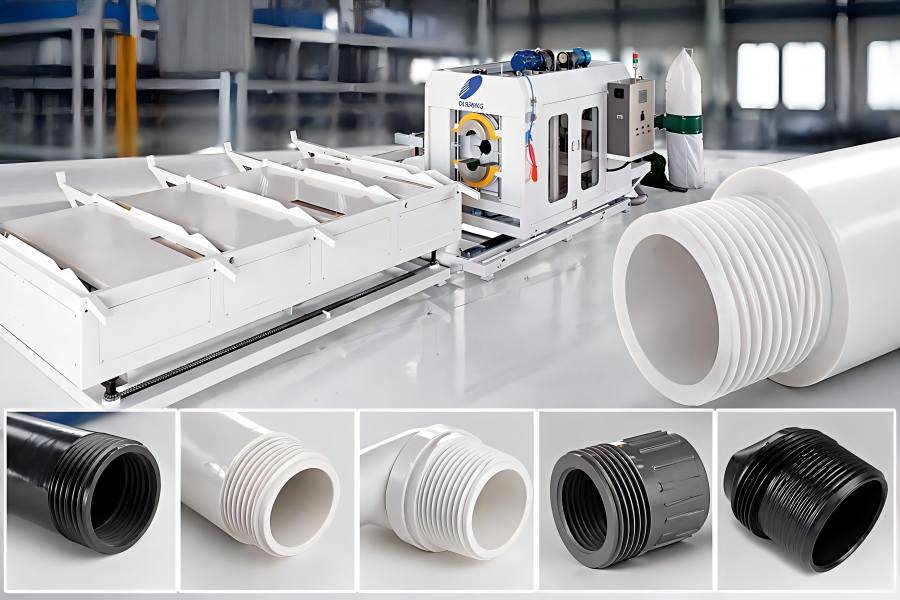
In plastic pipe manufacturing, thread cutting is critical because poor threads can cause leaks, loose connections, and product rejection. Automatic pipe thread cutting machines improve efficiency and consistency, but choosing the right machine also requires understanding thread shape types, since plastic materials respond differently to cutting than metal.
What an Automatic Pipe Thread Cutting Machine?
An automatic plastic pipe thread cutting machine is designed to cut threads on plastic pipe ends with minimal manual handling. Depending on the machine design, it may perform several processes in a continuous or semi-integrated sequence.
Typical functions include:
- Automatic pipe feeding
- Pipe positioning and clamping
- End facing or chamfering
- External thread cutting
- Sometimes internal thread cutting
- Cooling or air-blow cleaning
- Automatic return and unloading
- Size or parameter adjustment through control systems
Compared with metal pipe threading machines, machines for plastic pipes may emphasize smoother cutting action, lower heat buildup, gentler clamping, and cleaner chip management. Since plastic materials can soften or deform if handled roughly, the machine must balance efficiency with control.
The exact thread shape types the machine can process depend on its tooling system, control precision, clamping stability, and material adaptability.
V-Thread
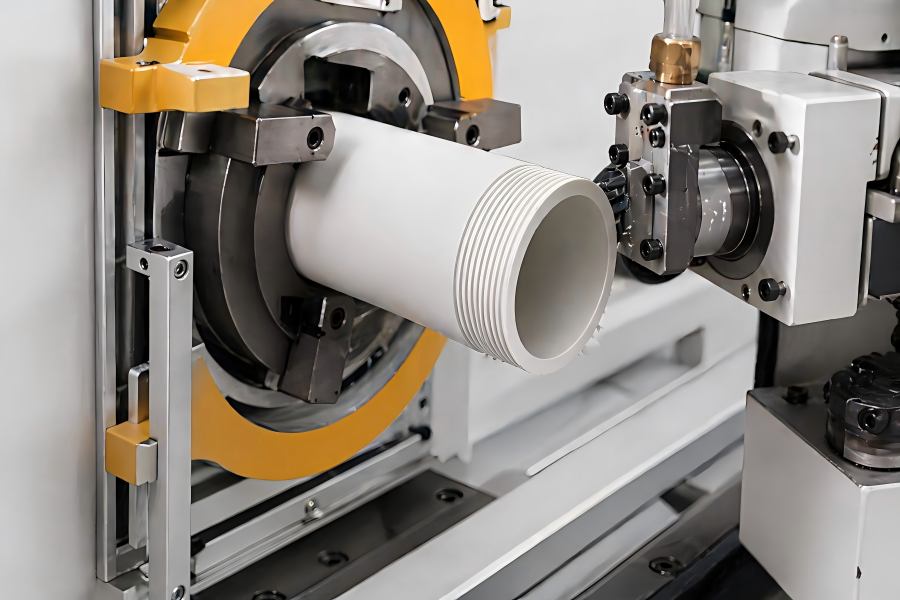
The V-thread is the most common thread shape in general manufacturing and one of the most widely processed thread profiles on plastic pipes. It has a triangular cross-sectional form, with angled flanks meeting at a crest and root. Many standard thread systems are based on the V-thread shape.
Main characteristics of V-thread
- Triangular thread profile
- Strong and familiar connection form
- Easy to standardize
- Suitable for many joining applications
- Common in both tapered and straight-thread systems
Common applications
- PVC plumbing connectors
- Plastic irrigation pipe ends
- Pool and spa piping components
- Light industrial fluid connectors
- Plastic electrical conduit accessories
- General-purpose pipe fittings and unions
For plastic pipe processing, the machine must cut the V-thread cleanly without crushing, overheating, or creating ragged edges. Since plastic is softer than metal, tool sharpness and feed stability are very important. If the cut is too aggressive, the thread crest may deform. If the cutting speed generates too much heat, the plastic may smear instead of cutting cleanly.
For most manufacturers, the V-thread is the foundation of plastic pipe threading production.
Tapered V-Thread
A tapered V-thread uses the same basic triangular thread shape as the standard V-thread, but the diameter gradually changes along the threaded section. This taper allows the threaded parts to tighten progressively and create a more secure fit. In many systems, tapered plastic pipe threads are used when a more compact and firm connection is needed.
Main characteristics of tapered V-thread
- Triangular thread profile with taper
- Improved tightening action
- Common in threaded sealing systems
- Frequently used with thread seal tape or sealant
Common applications
- Plastic plumbing fittings
- Threaded PVC adapters
- Irrigation fittings
- Water treatment equipment connections
- Some chemical transfer accessories
Cutting tapered threads on plastic pipes requires precise axial feed and consistent taper control. Because plastic can deform under pressure, overcutting or poor taper accuracy can damage sealing performance. The machine should maintain stable pipe centering and controlled cutting depth throughout the threaded length.
This thread shape is especially important for manufacturers producing fittings intended to connect tightly without complicated assembly.
Parallel V-Thread
Parallel V-thread also uses a triangular thread profile, but its diameter remains constant along the threaded length. Unlike tapered threads, it usually depends on a gasket, washer, O-ring, or other sealing element rather than thread interference alone.
Main characteristics of parallel V-thread
- Straight, non-tapered profile
- Uniform diameter
- Good for controlled, repeatable fit
- Often used with external sealing components
Common applications
- Plastic unions
- Filter housings
- Pool system fittings
- Instrumentation-related plastic connectors
- Threaded caps and closures
- Plastic adapters with O-ring sealing
Parallel threads can be very useful in plastic systems because they allow controlled engagement without over-tightening the pipe wall. Since many plastic connections are sensitive to excessive force, the combination of straight threads with an O-ring or gasket often creates a safer and more reliable joint.
An automatic plastic pipe thread cutting machine for this thread type should deliver high dimensional consistency and smooth surface quality.
Round Thread
Round thread has a curved profile, with rounded crests and roots instead of sharp angles. This shape is valued in applications where threads may be repeatedly assembled, exposed to dirt, or subjected to wear.
Main characteristics of round thread
- Smooth rounded profile
- Less stress concentration than sharp threads
- Better resistance to wear and impact
- Easier handling in rough-use environments
Common applications
- Plastic closures and caps
- Utility-grade pipe connectors
- Agricultural irrigation accessories
- Portable fluid-handling components
- Plastic couplings exposed to frequent opening and closing
Round threads can be especially useful in plastic because their smoother geometry reduces sharp stress points. This may lower the risk of cracking in more brittle plastics and improve durability in repeated-use applications.
However, the machine must support the correct profile tooling. A round thread cannot be accurately produced with standard V-thread cutters alone. Stable feed, sharp tools, and controlled material removal are essential.
Knuckle Thread
Knuckle thread is closely related to round thread and is often used where durability is more important than high precision. Its form is smooth and rounded, making it more resistant to damage from repeated handling or contamination.
Main characteristics of knuckle thread
- Rounded contours
- Durable in rough conditions
- Low risk of thread edge chipping
- Suitable for coarse but practical connections
Common applications
- Large plastic caps
- Utility connectors
- Low-pressure pipe closures
- Containers and tank fittings using plastic threaded sections
- Field-use components that are opened frequently
Plastic parts that are opened and closed often can benefit from a less aggressive thread geometry. Knuckle thread helps reduce localized wear and can be more forgiving during manual assembly.
For automatic thread cutting machines, this means the tooling system must be capable of reproducing smooth profiles consistently without rough or stepped cutting marks.
Buttress Thread
Buttress thread is an asymmetrical thread shape designed to handle heavy axial force in one direction. One flank is nearly vertical or more load-bearing, while the opposite flank is angled. Although not as common as V-threads in ordinary plastic plumbing, buttress threads are useful in specialized plastic components where one-direction load resistance is important.
Main characteristics of buttress thread
- Asymmetrical thread profile
- Excellent strength in one load direction
- Good for locking or pressure-retaining structures
- More specialized than standard V-thread
Common applications
- Plastic tank fittings
- Large-diameter closures
- Pressure vessel lids in polymer systems
- Specialized industrial plastic couplings
- Retaining rings and threaded locking parts
Buttress threads can be attractive for plastic because they distribute force efficiently in one direction. In certain closures or retaining connections, this helps reduce stripping risk.
But they also require profile-specific tooling and precise setup. The machine must be capable of cutting the asymmetrical form accurately and repeatably, especially if the product is part of a pressure or containment system.
Square Thread
Square thread has flat crests, flat roots, and nearly vertical flanks. It is usually associated with power transmission rather than simple joining or sealing. In standard plastic pipe systems it is less common, but it may still be used in pipe-like plastic components with mechanical movement or adjustment functions.
Main characteristics of square thread
- Flat profile surfaces
- Efficient motion or force transfer
- Lower radial pressure than some other thread forms
- Difficult to machine precisely
Common applications
- Plastic adjustment sleeves
- Telescopic or locking pipe-like assemblies
- Plastic machine parts with threaded motion
- Specialty engineering components
Square thread is not the first choice for ordinary plastic pipe connection, but it can be useful where the part functions more like a mechanical component than a fluid connector.
For an automatic plastic pipe thread cutting machine, square threads require high profile control and machine rigidity. Although plastic is easier to cut than steel, preserving clean square geometry without corner damage still requires careful tooling.
Trapezoidal Thread
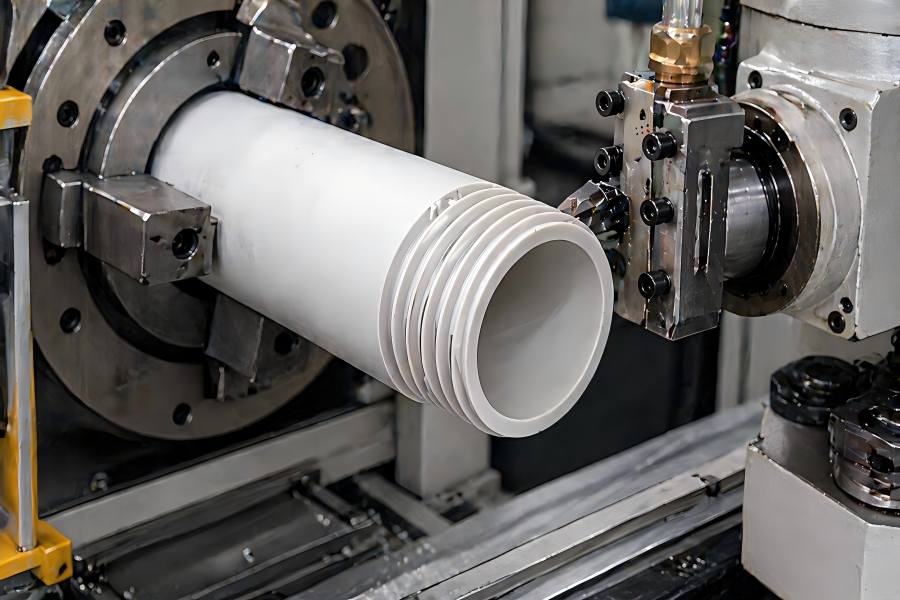
Trapezoidal thread is similar to square thread in function but uses angled flanks, making it easier to manufacture while still providing good load-bearing performance. It is often preferred over square thread for practical industrial production.
Main characteristics of trapezoidal thread
- Broad, strong profile
- Better machinability than square thread
- Good for repeated movement and load support
- Suitable for mechanical and structural applications
Common applications
- Plastic actuator sleeves
- Locking collars
- Adjustable pipe supports
- Mechanical assemblies with polymer threaded sections
- Specialized industrial plastic parts
If a manufacturer produces plastic threaded parts that combine pipe form with mechanical function, trapezoidal threads may be required. These threads typically need programmable machine settings, stable cutting, and custom tooling support.
More advanced automatic machines are better suited for this kind of flexibility.
Saw-Tooth or One-Direction Load Threads
Some threaded plastic parts use a saw-tooth or direction-oriented profile when the application requires locking or load retention primarily in one direction. These are more specialized and are not typical of ordinary plumbing pipes, but they can appear in certain technical plastic assemblies.
Main characteristics of saw-tooth threads
- Direction-specific geometry
- Good for locking or retaining functions
- Often custom or semi-custom in design
- Used in more specialized products
Common applications
- Special locking couplings
- Custom plastic closures
- Technical assemblies with one-way load conditions
- Proprietary threaded polymer parts
Machines producing these thread profiles must be flexible. The supplier should have the capability to offer customized tooling and, preferably, adjustable programmable settings. For OEM work or specialized plastic engineering products, this flexibility is more important than raw speed.
Special Considerations When Cutting Threads on Plastic Pipes
Thread shape selection on plastic pipes is influenced not just by function, but also by material behavior. Compared with metal, plastic introduces several important factors.
Heat sensitivity
Plastic materials may become soft if too much heat is produced during the cutting operation. Thread shapes with deeper profiles or slower chip release may require careful speed control.
Deformation risk
Thin-walled plastic pipes can deform during clamping or cutting. The thread shape must be cut cleanly without collapsing the pipe end.
Stress cracking
Sharp thread roots can create stress concentration, especially in brittle plastics. Rounded or better-supported profiles may offer durability advantages in some applications.
Surface quality
Plastic thread surfaces must be smooth enough to assemble well without tearing. Tool sharpness and chip removal are critical.
Material variation
PVC, CPVC, PP, PE, ABS, and nylon all behave differently during threading. A machine suitable for one material may need adjustment for another.
How Thread Shape Affects Machine Selection
When choosing an automatic pipe thread cutting machine, manufacturers should evaluate the thread shape range they need now and in the future.
Important questions include:
- Does the machine support only standard V-thread, or also round, buttress, and custom shapes?
- Can tooling be changed easily?
- Is the clamping system gentle enough for plastic pipes?
- Does the machine control heat and cutting pressure well?
- Can it maintain profile consistency across different plastic materials?
- Is it designed for mass production, flexible short runs, or both?
The answers help determine whether the machine is suitable for basic plastic pipe threading or for a wider product range.