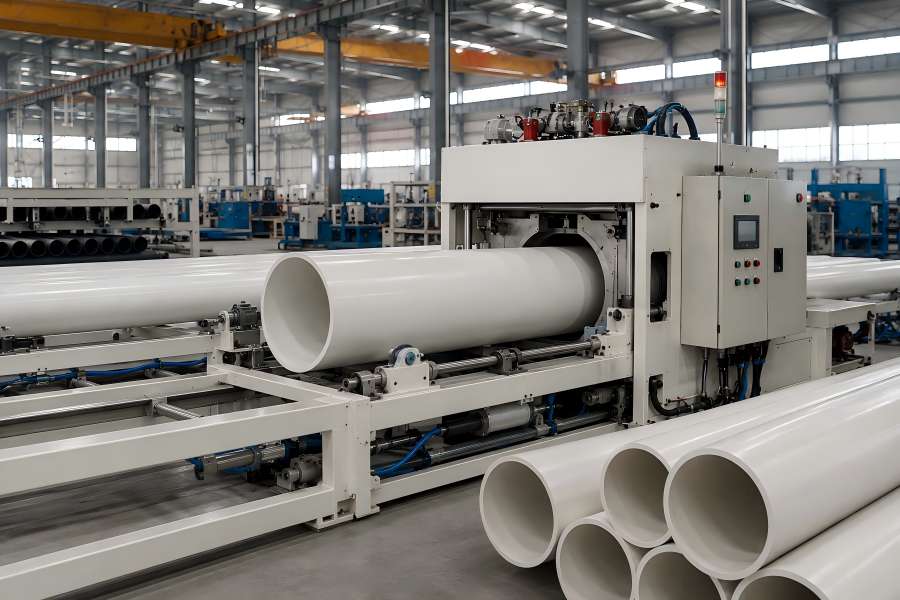
Large-diameter pipes are widely used in infrastructure such as water, sewage, industrial transport, drainage, and energy systems. Belling machines are essential for forming precise socket ends, ensuring secure, leak-proof connections and maintaining dimensional accuracy, structural integrity, and consistent performance in manufacturing.
Understanding Large-Diameter Pipe Manufacturing
Large-diameter pipes typically refer to pipes with diameters ranging from 200 mm to over 2000 mm, depending on the application and material type. Common materials include:
- PVC (Polyvinyl Chloride)
- HDPE (High-Density Polyethylene)
- PP (Polypropylene)
- CPVC (Chlorinated Polyvinyl Chloride)
These pipes are widely used in:
- Municipal water supply systems
- Sewage and wastewater treatment networks
- Industrial fluid transportation
- Agricultural irrigation systems
- Cable protection and utility conduits
Manufacturing such pipes involves several stages, including extrusion, cooling, cutting, and end-forming. Among these stages, end-forming—particularly socket (belling) formation—is crucial for ensuring that pipes can be connected efficiently and securely during installation.
The Role of Belling Machines in Large-Diameter Pipe Production
Ensuring Dimensional Accuracy
Large-diameter pipes require extremely tight tolerances, especially at the socket end. In pipeline systems, even a slight variation may result in poor fitting, leaks, or structural flaws.
Belling machines ensure:
- Consistent socket diameter
- Uniform wall thickness after expansion
- Accurate groove formation for sealing rings
- Precise alignment between pipe and mold
This level of accuracy is essential for infrastructure applications where reliability is non-negotiable.
Supporting High Structural Integrity
During socket formation, thermoplastic material is heated and reshaped. If the process is not properly controlled, the pipe may suffer from:
- Weak points at the socket junction
- Material thinning
- Internal stress accumulation
- Deformation after cooling
Modern belling machines are designed to distribute heat evenly and control expansion force precisely, ensuring that the structural integrity of large-diameter pipes is preserved.
Improving Production Efficiency
In large-scale manufacturing environments, production speed is a key factor. Belling machines significantly improve efficiency by:
- Automating socket forming processes
- Reducing manual labor requirements
- Minimizing cycle time per pipe
- Enabling continuous production line integration
For manufacturers producing thousands of meters of pipe daily, even small improvements in cycle time translate into significant productivity gains.
Reducing Material Waste
Large-diameter pipes are expensive to produce due to their size and material usage. Any defect in the socketing process can result in:
- Scrap pipes
- Rework costs
- Production delays
Belling machines reduce waste by ensuring first-pass accuracy. Real-time monitoring is another feature of advanced systems that helps identify irregularities early on.
Types of Belling Machines Used in Large-Diameter Pipe Manufacturing
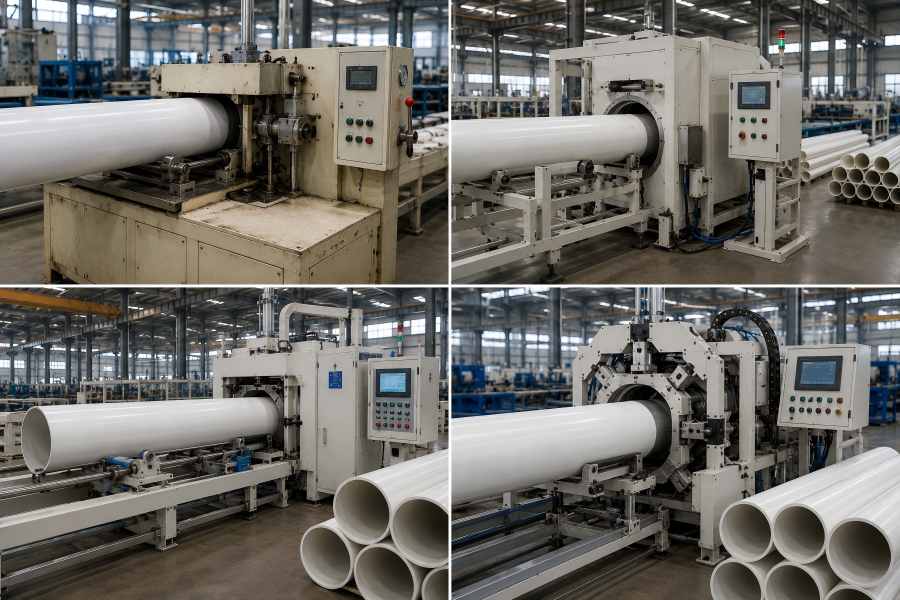
Different production needs require different types of belling systems. The most common categories include:
Manual Belling Machines
These are basic systems used for small-scale production or specialized pipe manufacturing. They require operator intervention for:
- Pipe positioning
- Heating control
- Mold insertion
While less common in large-diameter applications, they may still be used in custom production environments.
Semi-Automatic Belling Machines
Semi-automatic systems combine manual loading with automated forming and cooling processes. They offer:
- Improved consistency compared to manual systems
- Moderate production speed
- Lower investment cost
They are suitable for mid-sized manufacturers handling medium production volumes.
Fully Automatic Belling Machines
Fully automatic systems dominate large-diameter pipe production lines. These machines integrate seamlessly with extrusion lines and include:
- Automatic pipe feeding
- Precision heating systems
- Hydraulic or servo-driven expansion units
- Automated cooling and unloading
They provide the highest level of efficiency, accuracy, and consistency, making them ideal for industrial-scale production.
CNC-Controlled Belling Systems
Advanced manufacturing facilities often use CNC-controlled belling machines for maximum precision. These systems allow:
- Programmable socket dimensions
- Real-time process adjustments
- Data monitoring and quality control integration
- Custom socket profiles for specialized applications
CNC systems are especially valuable for infrastructure projects requiring non-standard pipe designs.
Key Technological Components in Modern Belling Machines
Modern belling machines used in large-diameter pipe manufacturing incorporate several advanced technologies:
Precision Heating Systems
Uniform heating is essential for consistent pipe expansion. Infrared or hot-air heating systems ensure that the pipe end reaches the correct temperature without degrading material properties.
Hydraulic Expansion Units
Large-diameter pipes require significant force to form sockets. Hydraulic systems provide controlled and stable expansion pressure, preventing material damage.
Cooling Systems
Rapid and uniform cooling is critical for maintaining socket shape. Water spray or air-cooling systems are commonly used to stabilize the formed end.
Sensor-Based Monitoring
Sensors track:
- Temperature distribution
- Expansion pressure
- Socket dimensions
- Cycle time
This data ensures real-time quality control and process optimization.
Quality Control in Large-Diameter Pipe Belling
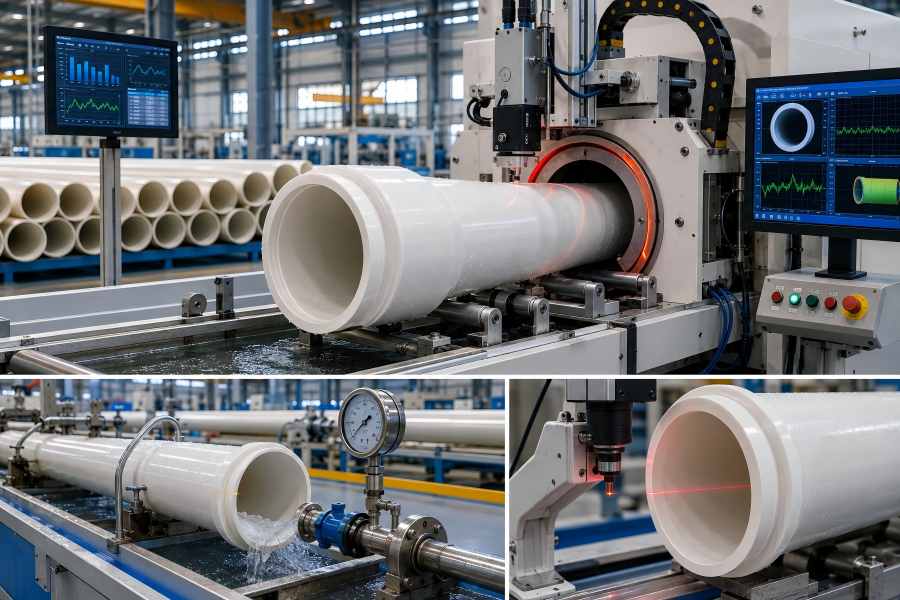
One of the most crucial elements of pipe manufacturing is quality control. Belling machines contribute to this in several ways:
- Automated dimensional verification
- Real-time defect detection
- Consistent repeatability across production batches
- Integration with factory quality management systems
Manufacturers often conduct additional post-process inspections, including pressure testing and dimensional scanning, to ensure compliance with industry standards.
Challenges in Large-Diameter Pipe Belling
Material Behavior Variability
Different thermoplastic materials respond inconsistently to heat, pressure, and cooling, making it difficult to maintain uniform socket quality across large-diameter pipe production batches.
Energy Consumption
Heating thick pipe ends requires substantial and continuous energy input, significantly increasing operational costs and creating pressure to improve energy efficiency in manufacturing systems.
Equipment Cost
High-precision automatic and CNC belling machines involve substantial upfront investment, which can be a barrier for small and medium-sized pipe manufacturers entering the market.
Maintenance Requirements
Large mechanical and hydraulic components experience wear under high temperature and pressure cycles, requiring frequent inspection, calibration, and replacement of critical machine parts.
Process Stability Control
Maintaining stable synchronization between heating, expansion, and cooling stages is complex, and small deviations can lead to socket deformation or dimensional inconsistencies.
Operator Skill Requirements
Even with automation, operators must understand machine parameters and material behavior well, as incorrect settings can quickly cause defects in large-diameter pipe production.
Integration with Automated Production Lines
Modern pipe manufacturing facilities rely heavily on automation. Belling machines are typically integrated into fully automated production lines that include:
- Extrusion systems
- Cooling tanks
- Cutting machines
- Socket forming units
- Packaging systems
This integration allows continuous, high-speed production with minimal human intervention.
The synchronization between extrusion speed and belling cycle time is particularly important for maintaining production stability.
Industrial Applications of Belling Machines
Municipal Water Supply Systems
Belling machines enable reliable socket formation for large-diameter pipes used in municipal water networks, ensuring leak-free connections and long-term stability across urban distribution systems.
Wastewater and Sewer Networks
In sewage infrastructure, socketed pipes formed by belling machines provide tight sealing performance, preventing leakage, groundwater contamination, and structural failure in underground drainage systems.
Industrial Fluid Transportation
Factories use large pipelines for chemicals, slurry, and cooling fluids, where belling machines ensure durable joints capable of withstanding pressure, corrosion, and continuous operational stress.
Oil and Gas Pipeline Systems
In energy infrastructure, belling machines support socketed pipe connections that help maintain safe, high-capacity transport of hydrocarbons under demanding pressure and environmental conditions.
Agricultural Irrigation Networks
Large-diameter pipes used in irrigation systems rely on socketed ends formed by belling machines, enabling efficient water distribution across vast farmland with minimal leakage.
Cable Protection and Conduit Systems
Telecommunication and power infrastructure uses socketed conduit pipes, where belling machines ensure smooth internal connections that protect cables from moisture, mechanical damage, and soil pressure.
Future Trends in Belling Machine Technology
Smart Manufacturing Integration
Future belling machines will integrate IoT connectivity, enabling real-time monitoring, remote diagnostics, and production data analysis to improve efficiency and reduce unexpected downtime.
AI-Based Quality Control
Artificial intelligence will be used to automatically detect defects, optimize forming parameters, and adjust process conditions in real time for consistent socket quality.
Energy Efficiency Improvements
Next-generation systems will focus on reducing energy consumption through advanced heating elements, optimized thermal control, and improved insulation during large-diameter pipe processing.
Fully Automated Production Lines
Belling machines will become fully integrated into unmanned production lines, synchronizing extrusion, cutting, and socketing processes with minimal human intervention required.
Modular and Flexible Design
Manufacturers will adopt modular machine structures, allowing quick adjustment for different pipe sizes, materials, and socket standards without extensive mechanical reconfiguration.
Predictive Maintenance Systems
Advanced sensors and data analytics will enable predictive maintenance, identifying wear and potential failures early to reduce downtime and extend equipment lifespan.